
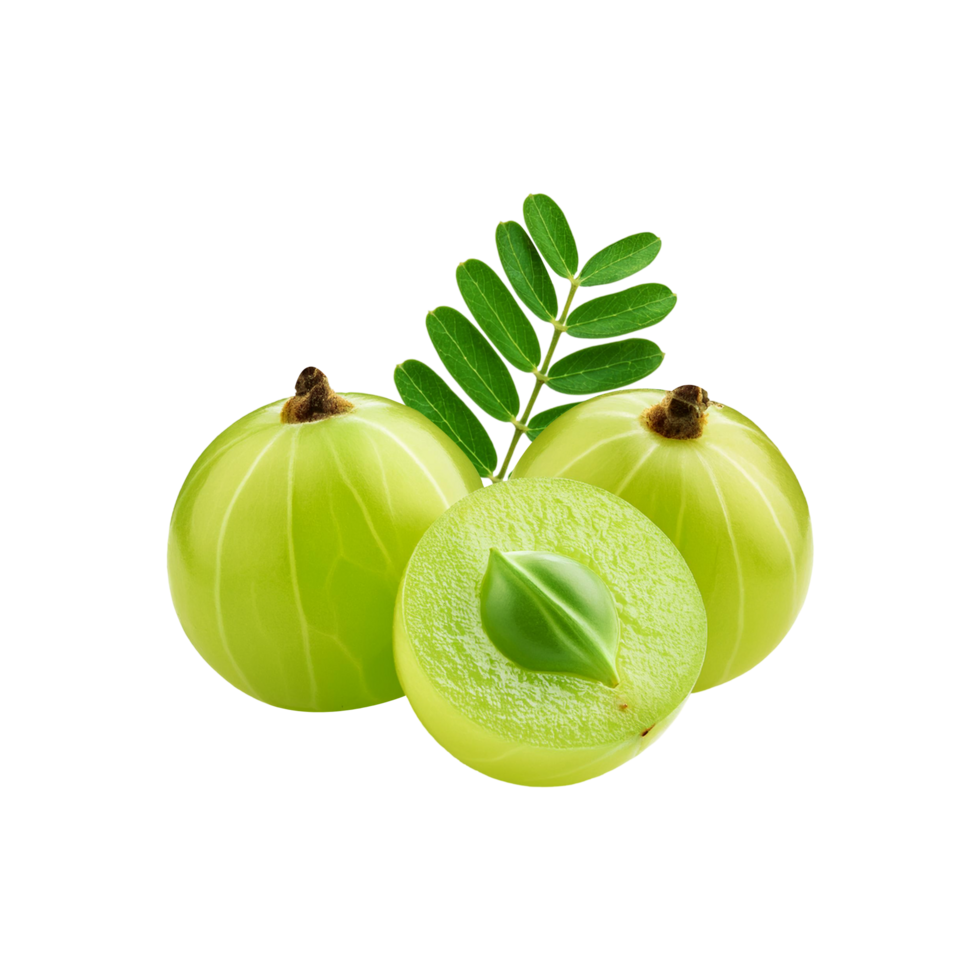
Amla oil for hair does its best work at the root. Amla, the Indian gooseberry, is one of the richest natural sources of vitamin C and tannins, and it is traditionally used for strong roots, shine and keeping hair dark. Massaged into the scalp two or three times a week, it delivers those antioxidants to the skin where the follicles live. On the strand it adds gloss, which is pleasant, but that is the smaller job.
Most people get this backwards. They coat the length with amla oil for shine and skip the scalp. The length is dead keratin; it cannot absorb a vitamin. The follicle is living tissue with its own blood supply, and that is where vitamin C has something to do.
We use amla at 5% in our 17-Herb Hair Oil. This post explains what it does at the root, how to apply it so it gets there, and where its limits are.
What amla is, and why it was dried on the terrace
Amla is the fruit of Phyllanthus emblica, a mid-sized tree that fruits across north and central India between November and February. The fruit is pale green, hard, and sour enough to make your eyes water. Older households dried it in the winter sun on the terrace, powdered it, made murabha from it, and steeped it in oil. Chyawanprash is built around it.
The reason it earned all that effort is its chemistry. Amla carries vitamin C in unusually high amounts, along with tannins such as emblicanin, gallic acid and ellagic acid. Those tannins are part of why amla’s vitamin C is more stable than the vitamin C in, say, an orange, which breaks down quickly once cut.
Heat still degrades vitamin C, which is one reason we cold-infuse rather than boil. A slow steep over weeks keeps more of what the fruit has than a quick simmer does. We cannot tell you exactly how much survives into the oil, because we have not measured it, and we would rather say that than guess.
Vitamin C at the root versus on the strand
At the root
A hair follicle is a small organ. At its base sits the dermal papilla, a cluster of cells that signals the follicle to grow, rest or shed. Those cells need a steady supply of blood, oxygen and a few specific nutrients. Vitamin C is one of them, because the body uses it to make collagen, the protein that forms the scaffolding around each follicle.
Vitamin C is also an antioxidant. The scalp takes a beating from UV, pollution and the by-products of its own oil production, and oxidative stress on the follicle is one of the quieter drivers of thinning. An antioxidant applied directly to the scalp is doing some of the housekeeping that the follicle cannot do alone.
There is early research here. Lab studies on amla extract have shown it can encourage the growth of dermal papilla cells. That is cells in a dish rather than hair on a head, so we read it as encouraging rather than conclusive. Tradition is stronger than the trial data, and we say so.
On the strand
Tannins are astringent. On the hair shaft they help lay the cuticle flat, which is what makes amla-oiled hair catch the light. They also leave a very slight darkening over repeated use, which is the basis of the old belief that amla keeps hair black. Both are real, both are surface effects, and both disappear if you stop.
So the strand gets shine and a little depth. The root gets collagen support and antioxidant cover. If you only have three minutes, spend them on the root.
How to apply amla oil so it reaches the root
The method is the same one we use for every herb in the blend, because the goal is the same: scalp first, length second.
- Warm two or three pumps between your palms.
- Part the hair in sections and press the oil onto the scalp with your fingertips. The aim is skin contact, not a glossy coat.
- Massage in slow circles for two to three minutes. Move the skin, do not scrub it.
- Run whatever is left down the length and over the ends.
- Leave 30 minutes, or overnight if your scalp is not oily, then wash with a mild shampoo.
Two or three times a week is enough. The full technique, with the mistakes we see most often, is in our guide to applying hair oil correctly. Patch-test the inner arm the first time. Amla is gentle, but every skin is different.
The 60-day rule. Vitamin C at the root supports the next growth cycle, not the hair that is already out. One 100ml bottle lasts about four weeks. Most people see the difference at week eight. That is why we sell it as a pair: 2 × 100ml for ₹999, buy one get one free. Two bottles is one full cycle.
Amla’s partners in the blend
Amla rarely appears alone in classical formulations, and there is a reason. Its job is to feed and protect the root. Other herbs do the jobs it cannot.
Bhringraj, also at 5%, is the density herb, traditionally used for growth and a calmer scalp. Neeli indigo cools the scalp and is what actually keeps dark hair looking deep, where amla’s effect is a faint tint by comparison. Henna conditions and adds gloss along the length. Brahmi supports the follicle and reduces breakage. Castor seals the ends so the shine amla gives has something to sit on. Manjistha is traditionally used for scalp circulation, which is how any of the above reaches the follicle in the first place.
We list all 17 herbs and their percentages on our ingredients page. If you are comparing amla oils, look for a percentage, not a picture of the fruit.
Amla oil, amla powder or eating amla
People ask which is best. Each does a different thing, so the honest answer is a short table.
| Form | What it does | Where it falls short |
|---|---|---|
| Amla oil on the scalp | Antioxidants and tannins delivered to the follicle; conditioning and shine on the strand | Does nothing for internal deficiencies |
| Amla powder hair pack | Strong astringent clean, cuticle smoothing, slight darkening | Drying if overused; messy; no leave-on benefit |
| Eating amla (fresh, murabha, juice) | Vitamin C in the diet, which also helps the body absorb iron from dal and greens | Takes months to show on the hair; sour |
If your ferritin is low, which is common in Indian women, eating amla with iron-rich meals is a quiet, useful habit. It is not a substitute for a blood test and a doctor’s advice. The oil works on the outside, the fruit on the inside, and neither replaces the other.
What amla oil will not do
It will not reverse grey hair. Greying is largely genetic, with stress and low B12 contributing, and no oil changes that. It will not fix hair fall driven by thyroid, PCOS, low iron or the months after childbirth; in those situations, oiling is supportive and the doctor is essential. And it will not show results in a week. The follicle runs on its own clock.
Apoorva’s grandfather kept a small steel katori of amla-infused oil warming on the stove on Sunday evenings. That memory is part of why the brand exists, and part of why we are careful about what we promise. You can read how Check by ASG started in a Delhi kitchen if the longer story interests you.
Frequently asked questions
Does amla oil darken hair?
Amla is traditionally used to keep hair dark and glossy, and its tannins give a slightly deeper look to the strand after a few washes. It does not dye hair, and it will not turn grey hair black. For colour depth without dye, indigo does more of the work in our blend.
Can amla oil reverse grey hair?
No, and we would be wary of any oil that claims to. Greying is mostly genetic, with stress and vitamin B12 playing a part. Amla is traditionally used to slow early greying, research is limited, and we describe it as supportive at best.
Can I use amla oil every day?
You can, but two or three applications a week, massaged into the scalp, do more than a daily coat on the length. Daily oiling of an already oily scalp tends to cause buildup rather than benefit.
Is amla oil good for an oily scalp?
Amla itself is astringent, which suits an oily scalp better than heavier single oils do. The trick is to apply less, keep it on the scalp, leave it for 30 to 60 minutes rather than overnight, and wash well. In our blend, nimbu and reetha help with excess oil too.
Does amla oil smell strong?
Fresh amla smells sour and green. Cold-infused into oil it becomes earthy and mild, and in a blend with henna and bhringraj it reads as herbal rather than fruity. We use no synthetic fragrance, so the smell is only the herbs.
Amla has been the shine herb for so long that its better job gets overlooked. Put it on the scalp, give the root three minutes of slow circles, and give the follicle its eight weeks. If you would like to try it in a blend where it has company, the two-bottle pair at ₹999 covers one full cycle.