
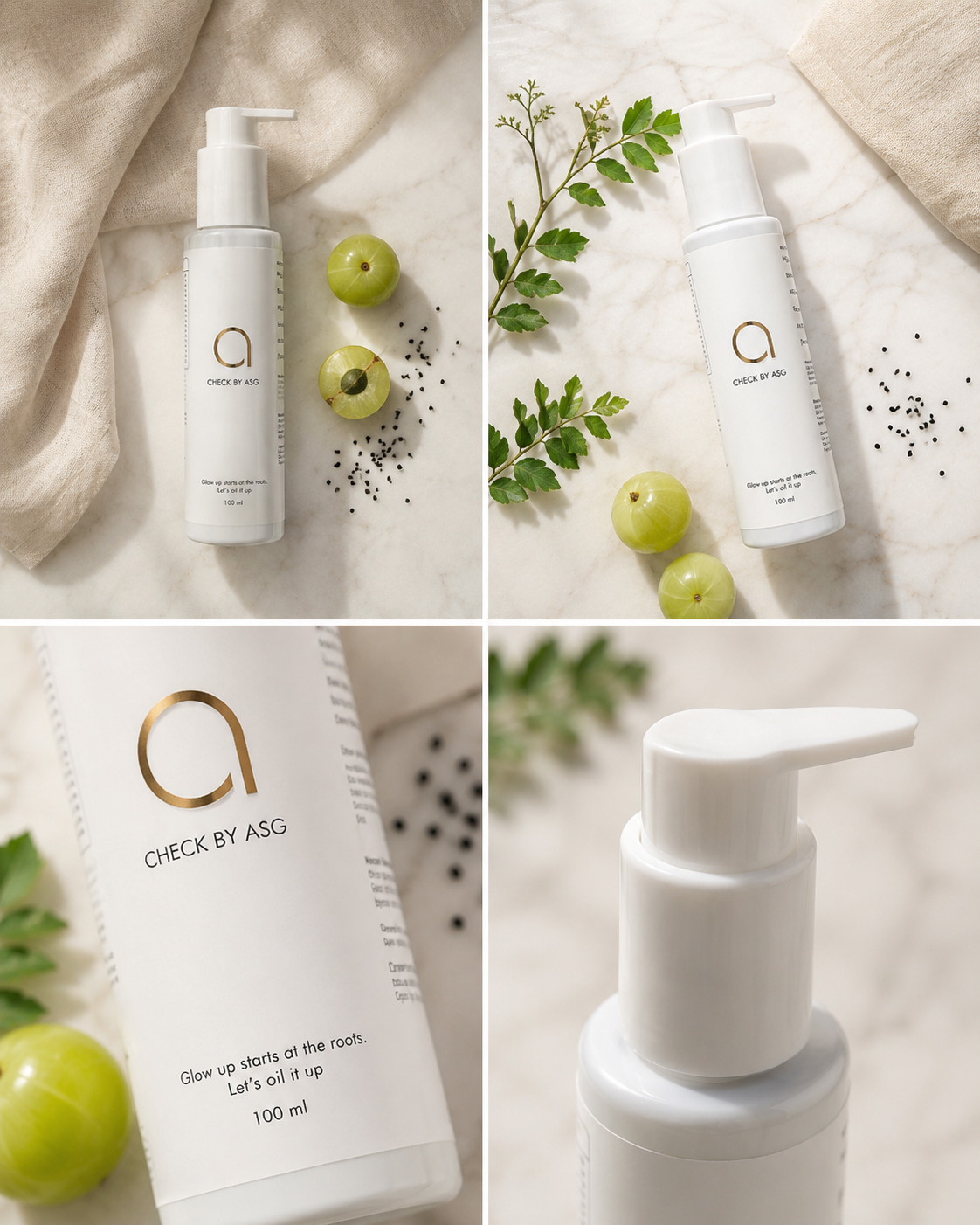
Our 17 herb hair oil is one 100ml bottle that contains amla, bhringraj, jatamansi, neeli indigo, aloe vera, brahmi, kalonji, karanja, neem, nimbu, onion, reetha, shikakai, heena, olive, manjistha, and castor, cold-infused with no heat, no mineral oil, no silicones, and no synthetic fragrance. This page explains what each herb is there to do, how much of it is present where we disclose the figure, and why the blend is built the way it is.
We wrote this because the ingredient list on a bottle tells you names, not reasons. Seventeen names can look like a brand throwing everything in. It is not. Each herb has a job, and most of those jobs fall into three groups: roots and density, scalp calm and circulation, and cleansing and conditioning.
The oil these herbs go into is our 17-Herb Ayurvedic Hair Oil.
Read it top to bottom, or jump to the herb you are curious about. Every section links to a longer post on that single ingredient.
How to read this guide
Four herbs are at 5% each: amla, bhringraj, jatamansi, and neeli indigo. Aloe vera is at 2%. For the remaining twelve we do not publish the individual figure on the blog, though they are present in meaningful rather than trace amounts, and the full disclosed breakdown is on our ingredients page, where we list all 17 herbs and their percentages.
Throughout, we use words like “helps”, “supports”, and “traditionally used for”. That is deliberate. Hair oil research is thin in places, and a herb with centuries of use behind it still deserves honest language about what it can and cannot do. Oil alone will not fix a thyroid problem, and we will say so wherever it applies.
Group one: the root and density herbs
These are the herbs people buy a hair oil for. They work at the scalp, where the follicle is, rather than on the strand.
Amla, 5%
Indian gooseberry. The most vitamin C-rich fruit most of us will ever eat, and the reason our oil is made without heat, because vitamin C does not survive a simmer. At the root, amla has a long traditional reputation for strengthening hair at the follicle and for keeping the scalp’s natural colour and shine. Many people notice shine first, within a few weeks, and then a feeling of the roots being more anchored during the comb test. The full case is in our post on why amla’s vitamin C matters more at the root than on the strand.
Bhringraj, 5%
Eclipta alba, the herb Ayurvedic texts call the king of hair. It is traditionally used for density, growth, and scalp health, and it is the one ingredient we would not make the oil without. There is some early animal research suggesting bhringraj extract may support the hair growth phase; human research is limited, and we say so. What we can say is that it is at 5% for a reason, and that it is the backbone of the blend. Read more in our guide to bhringraj and what to expect in eight weeks.
Onion
Not glamorous, but useful. Onion is rich in sulphur compounds, and sulphur is part of keratin, the protein hair is made of. In traditional use, and in a small amount of published work on onion juice, it is associated with strengthening and thickening the hair that is already there. Infused into oil it does not smell of onion. We explain what the sulphur actually does for thinning hair in its own post.
Kalonji
Black seed, Nigella sativa. Rich in antioxidants and in thymoquinone, which is the compound most of the research on kalonji looks at. It has a strong regrowth tradition across the Middle East and South Asia. We hold that tradition with respect and with caution: it is a supporting herb here, not a promise. Our post on kalonji oil, tradition versus evidence lays out what is known and what is not.
Brahmi
Bacopa monnieri, better known as a herb for the mind. On the scalp it is traditionally used for follicle nourishment and for reducing breakage, and it has a calming quality that pairs with jatamansi. If you have hair that snaps at the mid-length rather than falling from the root, brahmi is one of the herbs doing the work. More in brahmi for breakage, follicles, and stress.
Group two: scalp calm and circulation
A scalp that is inflamed, itchy, congested, or simply stressed does not grow hair well. This group addresses the ground the hair grows in.
Jatamansi, 5%
Nardostachys jatamansi, a root from the high Himalaya with an earthy, slightly sweet smell that is a large part of why the oil smells the way it does. Traditionally used to calm a stressed scalp and the person attached to it. It is also one of the reasons the oil is cold-infused: its aroma is volatile and heat drives it off. It is at 5% because the stress-and-hair-fall link is real and we wanted the herb that addresses it to be present in a proportion that matters. Our post on the Himalayan root most oils leave out has the longer version.
Manjistha
Rubia cordifolia, a red-rooted climber traditionally used to support scalp circulation. Circulation is why scalp massage works, and manjistha is there to support what your fingertips are doing. It is the herb behind our tagline that glow up starts at the roots. We wrote about it in manjistha for scalp circulation.
Neeli indigo, 5%
Indigofera tinctoria. Most people know it as a hair dye, but in an oil infusion rather than a paste it does not deposit visible colour. What it does is cool the scalp and, with regular use, help keep naturally dark hair looking deep rather than faded. It is at 5% because it is a classical Ayurvedic hair herb in its own right, not a colourant we snuck in. We explain the difference between indigo oil and indigo dye in neeli indigo for colour depth without dye.
Karanja
Pongamia pinnata, a quiet herb that rarely gets a headline. It helps clear buildup from the scalp and helps protect it from the everyday irritation of pollution, sweat, and hard water. It is one half of the pair we lean on for dandruff. More in karanja oil for scalp protection.
Neem
Azadirachta indica, the other half of that pair. Purifying, traditionally used for dandruff and itch, and bitter enough that a little goes a long way. If your scalp flakes or itches, neem and karanja are the herbs to read about first, and persistent cases still need a dermatologist. Our guide to neem for dandruff, itch, and buildup covers it.
Nimbu
Lemon. A mild astringent that helps balance excess oil on the scalp so that roots stay fresher between washes. It is infused, not squeezed, which is the difference between a balancer and an irritant. People with oily scalps who gave up on oiling should start with our post on nimbu for oily scalps.
The 60-day rule. One 100ml bottle lasts about four weeks. Most people see the difference at week eight, which is roughly one full hair growth cycle and the minimum time for seventeen herbs to show what they do. That is why we sell it as a pair: 2 × 100ml for ₹1,999. Two bottles is one full cycle.
Group three: cleanse and condition
These herbs are why the oil washes out in one shampoo, why the lengths feel soft, and why it does not need silicone to leave a finish.
Reetha
Soapnut, Sapindus mukorossi. The fruit contains natural saponins, which is why it has been used as a hair wash in India for as long as anyone has written things down. In an oil it acts as a gentle built-in cleanser: it helps the oil rinse away cleanly, adds a little body, and leaves no residue. We explain it in reetha for a clean scalp with zero residue.
Shikakai
Acacia concinna, India’s original conditioner. Mildly cleansing and softening, it is traditionally used to leave hair smooth and easy to comb without stripping it. If reetha is the wash, shikakai is the conditioner that followed it. More in shikakai, India’s original conditioner.
Heena
Henna, Lawsonia inermis. As a paste it stains. As an oil infusion it does not, because the dye molecule needs water and time to bind. What is left is the conditioning: a smooth, glossy finish and a strand that feels thicker to the touch. We cover the staining question directly in heena in hair oil, conditioning without staining.
Aloe vera, 2%
The only water-based hydrator in the blend. Oils lock moisture in; aloe helps put some there first. At 2% it keeps the scalp from reading the astringent herbs as drying and gives the lengths something to hold on to. Our post on aloe vera in hair oil explains why hydration lets the other herbs work.
Olive
The one non-Indian ingredient, and it is there as a light emollient. It spreads the heavier herbs evenly, helps the lengths hold moisture, and keeps the texture of the oil light enough to wear. It does not grow hair and we do not say it does. The full explanation is in why a Mediterranean oil is in an Ayurvedic blend.
Castor
Thick, rich in ricinoleic acid, and almost unusable alone because of its texture. In a blend it seals the ends and gives shine. It is in a proportion small enough that the oil stays pourable from a pump. We explain why castor is in the blend and why it should not be alone.
All 17 herbs at a glance
| Herb | Proportion | Main job in the blend |
|---|---|---|
| Amla | 5% | Vitamin C at the root, shine |
| Bhringraj | 5% | Density, growth support, scalp |
| Jatamansi | 5% | Calms a stressed scalp |
| Neeli indigo | 5% | Cools scalp, keeps dark colour deep |
| Aloe vera | 2% | Water-based hydration |
| Brahmi | see ingredients page | Follicle nourishment, breakage |
| Kalonji | see ingredients page | Antioxidants, regrowth tradition |
| Karanja | see ingredients page | Clears buildup, protects from irritation |
| Neem | see ingredients page | Purifying, dandruff, itch |
| Nimbu | see ingredients page | Balances excess oil |
| Onion | see ingredients page | Sulphur, strengthens, thickens |
| Reetha | see ingredients page | Gentle cleanser, body, no residue |
| Shikakai | see ingredients page | Conditioner, softens |
| Heena | see ingredients page | Conditioning, glossy finish |
| Olive | see ingredients page | Light emollient, locks moisture |
| Manjistha | see ingredients page | Scalp circulation |
| Castor | see ingredients page | Seals ends, shine |
Why seventeen, and not three
A fair question. Single-ingredient oils are honest and cheap, and we have nothing against a bottle of plain coconut oil. The case for a blend is that hair problems arrive in clusters. Someone with hair fall usually also has a scalp that is either too oily or too dry, lengths that are breaking, and a stress level that is not helping. One herb addresses one of those. A blend built in groups, as above, addresses several at once, each at a proportion that lets it do its work.
The risk with a long list is dilution: twenty herbs at a pinch each is a perfume, not a hair oil. Our answer is the percentages. Four herbs at 5% and aloe at 2% is a quarter of the bottle by volume accounted for before the supporting herbs are counted. We compared the two approaches in detail in 17-herb oil versus single-ingredient oils.
How it is made and how to use it
Cold-infused, by hand
Cold-infused, in small batches, by hand. The herbs steep in the base oil without heat, which keeps amla’s vitamin C and jatamansi’s scent, both of which a simmer would lose. It takes weeks per batch and it is why we cannot make it in the quantities a factory would. It is also why we use a pump bottle: a cold-infused oil is better protected from air and fingers.
The blend started in Apoorva’s Delhi kitchen after she came back from the UK, with the memory of her father and grandfather oiling her hair on Sunday evenings in a small town, a steel katori of warm oil and a comb. Her promise is simple: if she would not use it, she would never ask you to. The story of how the oil came to be is on its own page.
The routine
Warm a few pumps in your palms. Massage the scalp in slow circles for two to three minutes. Run what is left through the lengths. Leave it 30 minutes or overnight, then wash. Two or three times a week. Patch-test on the inner forearm before the first use, because natural does not mean nobody reacts. One bottle lasts about four weeks; results typically show at six to eight.
It is made for men and women, for all hair types including colour-treated, and it is dermatologically tested. It contains no mineral oil, no silicones, and no synthetic fragrance, so what you smell is the herbs.
Frequently asked questions
Why does the oil have 17 herbs instead of one or two?
Because hair fall, dryness, dandruff, and dullness rarely arrive alone. A scalp usually needs more than one thing at once: circulation, calming, cleansing, conditioning. Seventeen herbs let the blend cover those jobs in one bottle, each at a proportion that lets it do its work without crowding the others.
Which herbs are at 5% and why does that matter?
Amla, bhringraj, jatamansi, and neeli indigo are each at 5%, and aloe vera is at 2%. We publish these because most herbal oils list twenty ingredients without saying how much of any is present. A 5% proportion is enough to matter; a trace is not.
Is this oil suitable for colour-treated hair?
Yes. There is no mineral oil, silicone, or synthetic fragrance, and the herbs that could affect colour, neeli indigo and heena, are present in an oil infusion rather than as a paste, so they condition without depositing visible colour. Patch-test first, as with any new product.
Does cold infusion really make a difference?
It keeps heat-sensitive compounds like amla’s vitamin C and the volatile scent of jatamansi that simmering would drive off. Whether that shows on your head over eight weeks is something only your own hair can answer, but the chemistry is clear: less heat, less lost.
How long does one bottle last and when should I expect to see something?
One 100ml bottle lasts about four weeks at two to three sessions a week. Most people notice something at six to eight weeks, which is roughly one hair growth cycle. That is why we sell the oil as a pair of bottles.
Can I use this oil if I have a medical cause for hair fall?
Oiling is supportive, not a replacement for diagnosis. If you suspect thyroid, PCOS, iron deficiency, or post-illness shedding, get a blood test and see a doctor. The oil can sit alongside that; it cannot stand in for it.
Seventeen herbs is a lot to explain, which is why we have given each one its own page. The short version is that the blend is built in three groups, that the herbs that matter most are present in amounts we are willing to print, and that nothing in the bottle is there for the label. If you would like to see what they do together over one full cycle, two bottles for ₹1,999 is where most people start.
All 17 herbs, in one bottle
Bhringraj, amla, brahmi and 14 more cold-infused herbs — our 17-Herb Ayurvedic Hair Oil is made for hair fall, thinning and slow growth.