
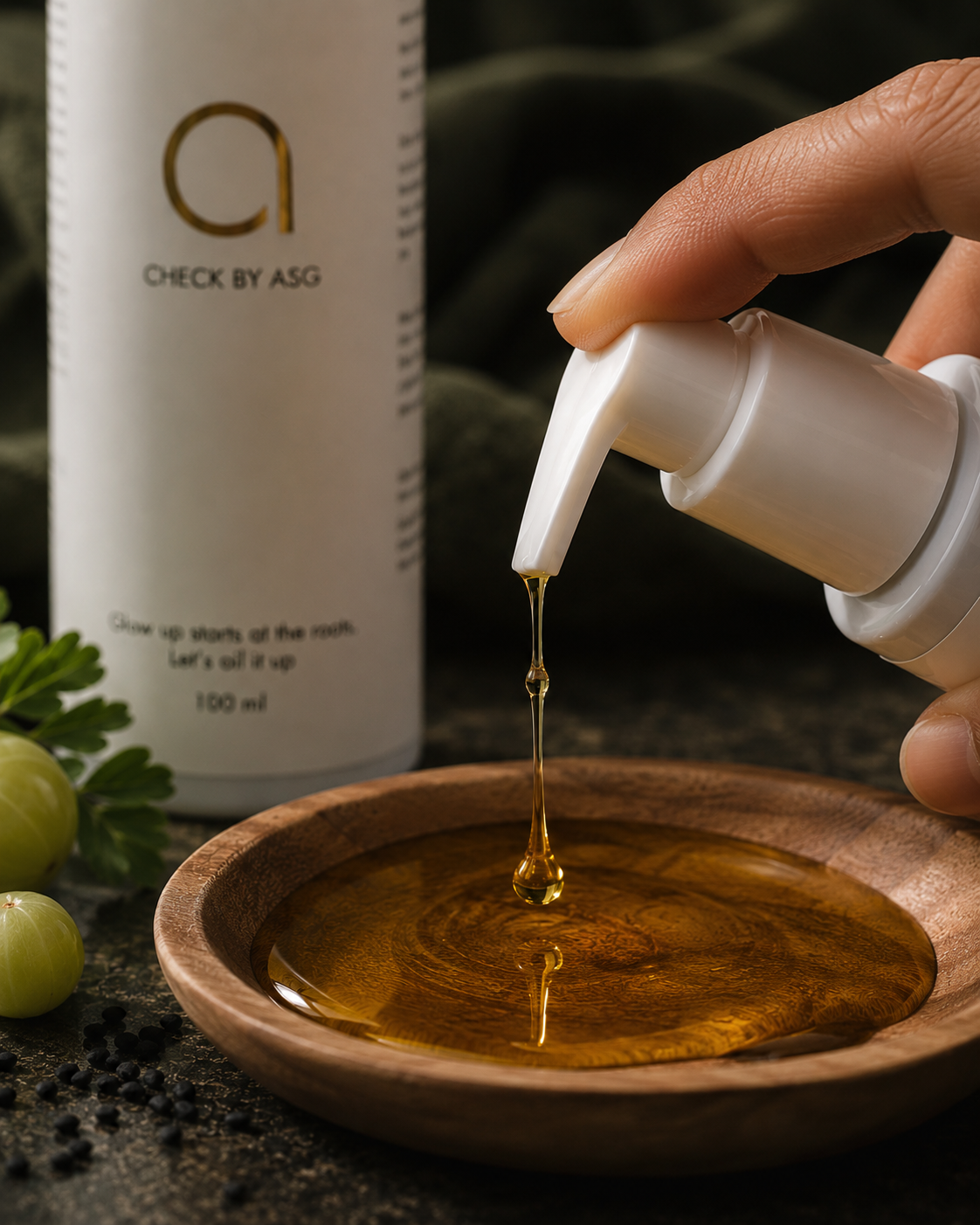
The best hair oil for hair growth in India is the one whose label you can read and whose routine you will actually follow for eight weeks. That sounds like a dodge. It is not. We make a hair oil, so we have an obvious interest here, and we would still tell you that the brand name matters less than five things on the label and one thing in your bathroom cabinet.
This guide does not rank products. It teaches you how to judge any hair oil in about two minutes, so you can walk into a chemist in Pune or scroll a marketplace at midnight and know what you are looking at. We will tell you plainly where our 17-Herb Hair Oil fits and, just as plainly, who should not buy it.
For the full checklist, see how to choose the best Ayurvedic hair oil for hair fall.
Start with what “growth” can honestly mean, because that is where most disappointment begins.
What a hair oil can and cannot do for growth
Hair grows about a centimetre a month, set by genetics and health. No oil speeds that up by much. What an oil can do is change the three things that make hair look thin: breakage, shedding and scalp condition.
Breakage is hair snapping mid-strand because the cuticle is dry or rough. Oils that coat and seal the strand reduce it within a few washes. Shedding is hair leaving from the root, and part of it is normal. A calmer, cleaner, better-massaged scalp may reduce the excess part. Scalp condition is itch, flakes, buildup and excess sebum, which keep follicles from working at their best. A good oil improves this within two weeks.
What an oil cannot do is override hormones, iron deficiency, thyroid imbalance or PCOS. If any of those are behind your hair fall, oil is supportive and a doctor is essential. We say this in every post because it is the single most useful thing a hair oil brand can tell you.
The five things to check on any hair oil label
Turn the bottle around. Ignore the front. The back tells you everything.
1. The base oil, and whether it is mineral oil
Every hair oil is mostly a base, and the base is where cost gets cut. Mineral oil (sometimes listed as liquid paraffin or paraffinum liquidum) is a petroleum by-product. It is cheap, stable and not harmful, but it sits on the hair and does nothing for the scalp beyond coating it. If it is the first ingredient, the herbs listed after it are riding on a filler.
Look instead for a plant base: coconut, sesame, olive, castor, almond, or a blend. The base should be named, not hidden under “oil blend”. We wrote in detail about mineral oil and silicones in hair products and why we skip both.
2. Herb names and, ideally, percentages
Ingredient lists run from highest to lowest quantity. A label that says “with Bhringraj and Amla” on the front but lists them after fragrance on the back has told you everything. Fragrance is usually under one percent, so anything after it is a trace.
The best labels give percentages for the main herbs. Few do, because it exposes how little herb is actually in the bottle. We publish ours. Amla 5%, Bhringraj 5%, Jatamansi 5%, Neeli Indigo 5%, Aloe Vera 2%, and the rest of the seventeen in order. You do not need to buy from us to use this rule. Just ask every brand the same question and watch who answers.
3. How the herbs got into the oil
There are two broad methods. Heat extraction boils herbs into oil, which is fast and cheap but can degrade delicate compounds. Cold infusion steeps herbs in oil over weeks without heat, which is slow and costs more. Neither is magic, but the method tells you how much time and care went into the bottle. If the label does not say, the answer is almost always heat. Our post on cold-infused versus heat-extracted hair oil goes deeper.
4. Fragrance and silicones
Synthetic fragrance is the most common cause of scalp irritation in hair products. It is also what makes an oil smell “luxurious” on the shelf. A herbal oil should smell like herbs, which means earthy, slightly bitter, sometimes a little like a kitchen. Silicones (anything ending in -cone or -siloxane) make hair feel silky instantly while doing nothing at the root. They belong in a serum, not in a scalp oil.
5. Packaging and dose
This sounds trivial. It is not. An oil in a wide-mouth cap bottle gets poured, spilled and over-used. A pump bottle gives you the same two or three pumps every time, which keeps the dose right and the bottle lasting the four weeks it should. If you are going to oil three times a week for two months, the bottle you reach for at 9 pm on a Tuesday needs to be easy.
The 60-day rule. One 100ml bottle lasts about four weeks. Most people see the difference at week eight. That is why we sell it as a pair: 2 × 100ml for ₹1,999. Two bottles is one full cycle.
Herbs with real tradition behind them
You will see hundreds of herb names on Indian hair oils. A handful have both long Ayurvedic use and at least some modern research interest. Here is how to read them.
| Herb | Traditionally used for | What to look for |
|---|---|---|
| Bhringraj | Density, growth, scalp health. The classic “king of hair” herb. | Should be in the top five ingredients. Ours is 5%. |
| Amla | Vitamin C at the root, shine, premature greying. | Fruit extract, not just “amla fragrance”. |
| Jatamansi | Calming a stressed scalp. A Himalayan root most oils leave out because it is costly. | Rare on labels. A sign the maker spent on herbs. |
| Onion | Sulphur for strength and thickness. | Onion seed or bulb extract. Should not smell raw. |
| Neem and Karanja | Dandruff, itch, buildup, scalp protection. | Essential if your scalp is oily or flaky. |
| Brahmi | Follicle nourishment, breakage. | Often paired with Bhringraj. |
| Castor | Sealing ends, shine. | Should be a minor ingredient, not the base, or the oil will be too heavy. |
An oil does not need all of these. A plain cold-pressed coconut oil with nothing else is a perfectly good pre-wash conditioner. But if the front of the bottle says “growth”, the back should show Bhringraj, Amla or Onion near the top, not buried in the last line.
What price tells you, and what it does not
Hair oil in India runs from under ₹100 to well over ₹1,500 for a hundred millilitres. Price alone is not a quality signal. A ₹150 oil can be an excellent single-ingredient coconut or sesame oil. A ₹1,200 oil can be mineral oil with fragrance and a beautiful box.
What price does tell you, once you have checked the label, is where the money went. Seventeen separately sourced herbs cost more than two. Cold infusion over weeks costs more than boiling for an afternoon. Small handmade batches cost more than a factory run. Dermatological testing costs money per product. A pump costs more than a cap. If the label shows those things, a higher price is explained. If it does not, you are paying for marketing.
A fairer measure is cost per application. Our 17-Herb Hair Oil comes as a two-bottle pair, 2 × 100ml for ₹1,999. Two bottles cover roughly eight weeks at two or three applications a week, which works out to about ₹85 to ₹100 per session. Compare that with any oil on the same basis, not by the sticker price.
How to run a fair eight-week test
Whichever oil you choose, test it properly or you will never know whether it worked.
- Patch-test behind the ear for 24 hours, even with natural ingredients.
- On day one, take a photo of your parting in daylight and count hairs after twenty slow comb strokes.
- Oil two or three times a week. Warm a few pumps in your palms, massage the scalp in slow circles for two to three minutes, leave for thirty minutes or overnight, then wash.
- Do not change shampoo, diet or anything else during the test, so you know what caused what.
- Repeat the photo and comb count every two weeks. Judge at week eight, not week three.
Expect scalp calm in two weeks, less breakage by week four, and visible baby hairs around week eight. We laid out the full timeline in our post on how long hair oil takes to show results.
Marketing phrases to read with a raised eyebrow
Some claims are legal and still misleading. “Visible results in 7 days” is possible for softness, impossible for growth. “Ayurvedic formula” on its own means nothing without named herbs. “Infused with 50 herbs” with no percentages often means a pinch of each. “Patented” describes the paperwork, not the result. “Suitable for all hair types” is fine, but only if the oil is light enough for fine hair and strong enough for an oily scalp, which few manage.
Also be wary of before-and-after photos with different lighting, different hair lengths or different partings. Real change at eight weeks is subtle in a photo. Dramatic is usually staged.
Where our oil honestly fits
Check by ASG makes one product: a 17-Herb Hair Oil, 100ml, in a pump bottle. It is handmade in small batches, cold-infused without heat, dermatologically tested, and made without mineral oil, silicones or synthetic fragrance. It is for men and women, all hair types including colour-treated. We list all 17 herbs and their percentages, which is the first thing we would ask of anyone else.
It is a good fit if you have hair fall from stress, breakage, a flaky or oily scalp, hard water or seasonal shedding, and you are willing to oil two or three times a week for two months. It is not the right buy if you want a cheap pre-wash conditioner, if you need a perfumed oil, if you are under a dermatologist’s care for a scalp condition without checking with them first, or if you will not patch-test. We would rather you buy a ₹150 coconut oil and use it than buy ours and leave it in the cupboard.
Apoorva started this in a Delhi kitchen with a simple rule, “If I wouldn’t use it, I’d never ask you to.” Everything above comes from the same place. Read the label, run the test, and let the hair decide.
Frequently asked questions
Which oil is best for hair growth in India?
There is no single best oil. Look for a named plant base rather than mineral oil, growth herbs like Bhringraj, Amla and Onion near the top of the ingredient list, no synthetic fragrance or silicones, and a method and packaging that make an eight-week routine easy. Then test it for eight weeks.
Is coconut oil enough for hair growth?
Plain coconut oil is a good conditioner and reduces breakage, which makes hair look fuller. It does little for scalp issues like itch, dandruff or buildup. If those are your problem, a herbal oil with Neem, Karanja and Bhringraj is more suited.
Does an expensive hair oil work better?
Not automatically. Price is only justified when the label explains it: many named herbs with percentages, cold infusion, small batches, testing and good packaging. Judge by cost per application and by what the back of the bottle shows.
How many herbs should a hair oil have?
There is no magic number. A single good oil can work for conditioning. For hair fall and scalp concerns, a blend that covers scalp cleansing, calming and root support tends to do more. What matters is whether each herb is present in a meaningful amount.
Can hair oil help with hair fall from thyroid or PCOS?
It can support a healthier scalp and reduce breakage, but it cannot correct the hormonal cause. See a doctor, get a blood test, and use oil alongside the treatment they advise.
How long before I know if an oil is working?
Eight weeks of consistent use, two or three times a week. Scalp changes show in two weeks, breakage in four, growth in eight. Judge by photos and a comb count, not by memory.
The best hair oil for hair growth is the one with an honest label and a routine you keep. If ours passes your five checks, two 100ml bottles for ₹1,999 is exactly one eight-week test, with nothing left over to guess about.
All 17 herbs, in one bottle
Bhringraj, amla, brahmi and 14 more cold-infused herbs — our 17-Herb Ayurvedic Hair Oil is made for hair fall, thinning and slow growth.