
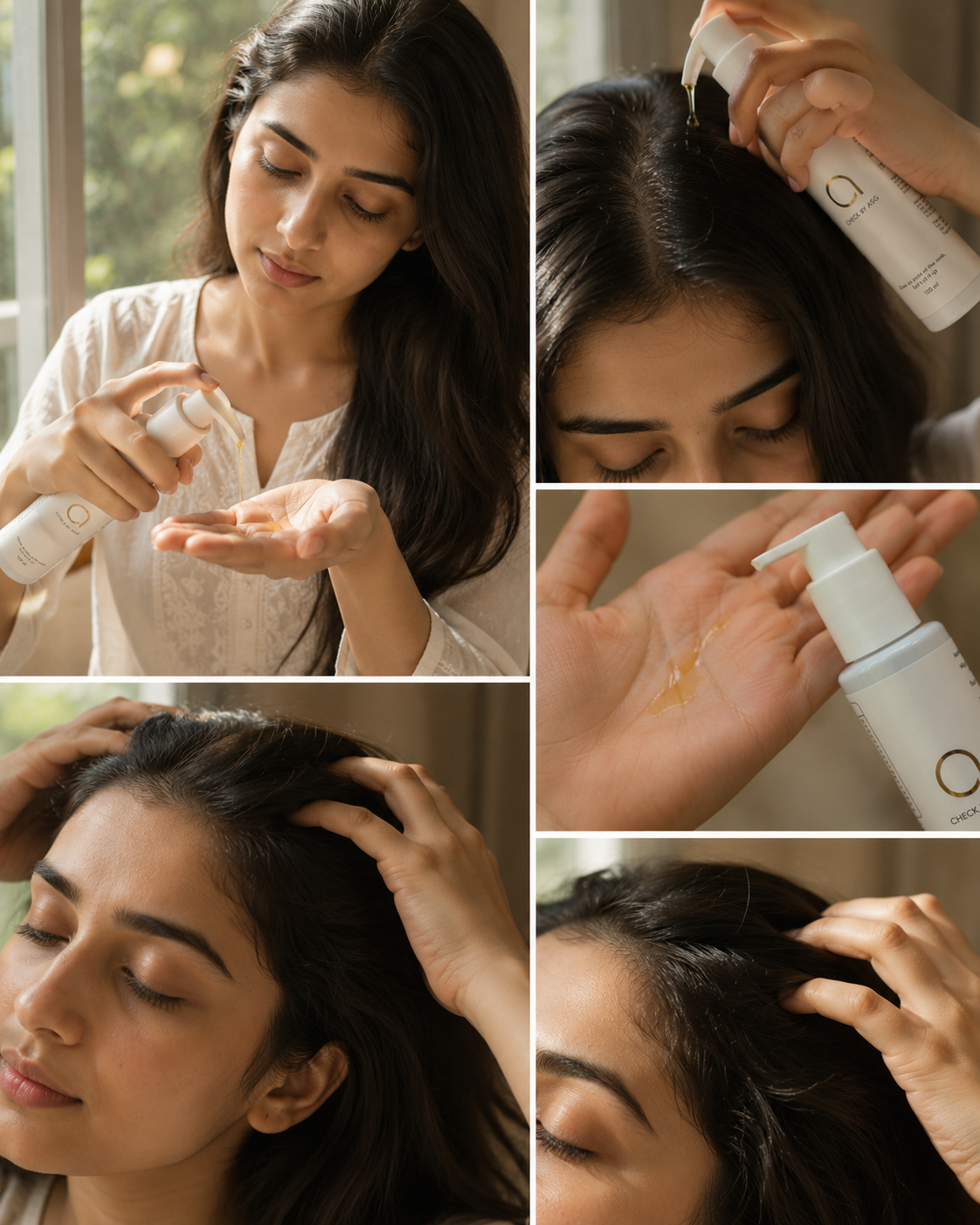
Hair oil for dandruff works in one specific situation: when the flakes come from a dry or irritated scalp, or from product buildup, and the oil you use carries herbs that calm the scalp rather than feed the problem. Neem and karanja are the two we lean on. Neem is traditionally used for itch and flaking. Karanja clears buildup and helps protect the scalp from irritation.
It does not work if you leave a heavy oil on an already oily, yeast-prone scalp for two days and wash it with lukewarm water. That makes dandruff worse, and it is the reason many people say oil “gave them dandruff”.
For the wider picture, our guide to the most common hair fall reasons explains how to tell one cause from another.
Below is the four-week routine we actually follow in winter, when Delhi air dries the scalp out and the flakes show up on dark kurtas. It is short, it is specific, and it tells you when to stop and see a doctor instead.
First, work out which dandruff you have
There are two things people call dandruff, and oil behaves differently on each.
Dry-scalp flakes are small, white, and powdery. The scalp feels tight. They get worse in November and in air-conditioned offices. This type responds well to oiling because the problem is lack of moisture and mild irritation.
Oily dandruff looks different. The flakes are larger, slightly yellow, and stick to the scalp and the hair near the root. The scalp may feel greasy by evening. This is usually linked to a yeast called Malassezia that lives on everyone’s scalp and feeds on scalp oils. Here, oil can still help, but only as a short pre-wash step, never as an overnight soak.
We wrote a longer piece on telling the two apart, with a mirror test you can do tonight, in our post on dandruff versus dry scalp and which routine suits each. If you are not sure, assume the oily type and keep the oil on for 30 minutes only.
Why neem and karanja, and not just any oil
Plain coconut oil sits on the scalp. It softens flakes, which helps you wash them away, but it does nothing about the itch, and on an oily scalp it adds to the meal the yeast is eating.
A cold-infused herbal oil is a different thing. The carrier oil is only the vehicle. What matters is what has been steeped in it for weeks.
Neem
Neem has been used across India for skin and scalp for centuries. It is traditionally used for itch, flaking and the kind of low-grade scalp irritation that makes you scratch at your desk. Research on neem for dandruff specifically is limited, but its reputation for keeping skin clear is old and widespread, and in our experience it is the herb people notice first when the itch settles.
Karanja
Karanja is the quiet one. Its traditional role is protective. It helps clear buildup from styling products and hard water, and it helps the scalp stay calm while it does. For dandruff, that matters because buildup traps flakes and gives them something to cling to.
The supporting cast
Nimbu helps balance excess oil, which is useful on the greasy type of dandruff. Reetha is a gentle cleanser, so the oil rinses out without a film. Aloe vera brings a little hydration for the dry type. Jatamansi calms a stressed scalp, and stress is a well-known trigger for a dandruff flare.
The four-week neem and karanja routine
This is the part people skip, so we have kept it plain.
| Week | Oil how often | Leave on | What to watch |
|---|---|---|---|
| Week 1 | 2 times | 30 minutes, then wash | Itch. Does it ease within an hour of washing? |
| Week 2 | 2 times | 30 to 45 minutes | Flake size on a dark towel after washing. |
| Week 3 | 2 to 3 times | 45 minutes (dry type may go overnight) | Scalp tightness in the evening. |
| Week 4 | 2 to 3 times | Same as week 3 | How many days between flare-ups. |
The method is the same each time. Warm two or three pumps between your palms. Part the hair in sections and apply to the scalp, not the lengths. Massage in slow circles for two to three minutes with the pads of your fingers, never nails. Then wait, then wash.
The wash matters as much as the oil. Use warm water, not hot. Shampoo twice if the first lather is thin, because that means the oil has not lifted. If you are on the oily side, a mild anti-dandruff shampoo on one of your two wash days is fine. The oil and the shampoo are not in competition.
If you have never oiled before, read our step-by-step on how to apply hair oil without wasting it first. The three-minute scalp method there is exactly what we use.
The 60-day rule. One 100ml bottle lasts about four weeks. Most people see the difference at week eight. Dandruff tends to settle sooner, but the scalp needs that long to stop flaring. That is why we sell it as a pair: 2 × 100ml for ₹1,999. Two bottles is one full cycle.
The herbs in our oil that matter for a flaky scalp
Our 17-Herb Hair Oil is cold-infused, which means the herbs steep in the oil without heat. For a scalp that is already irritated, we think that is the right way to make it. Nothing is scorched and nothing is added to mask a smell.
For dandruff, the herbs that do the heavy lifting are neem, karanja, nimbu, reetha and aloe vera. Jatamansi at 5 per cent calms the scalp, and amla at 5 per cent helps keep the roots in good condition while the flaking settles. We list all 17 herbs and their percentages on one page, so you can see exactly what you are putting on your head.
There is no mineral oil, no silicone and no synthetic fragrance in the bottle. That last one is worth repeating for dandruff sufferers, because fragrance is one of the most common scalp irritants in hair products.
Mistakes that make dandruff worse with oil
Most of the complaints we hear come down to one of these.
Leaving oil on for two days. Oil that sits on the scalp for 48 hours collects dust, sweat and dead skin. On an oily scalp it feeds the yeast. Thirty minutes to overnight is the window. Beyond that, you are not helping.
Applying oil to a dirty scalp and then not washing properly. The flakes are softened, the oil is half rinsed, and by the next morning there is a greasy crust. If you cannot wash the same day, do not oil.
Using hot oil. Heat irritates an already angry scalp. Warm between the palms is enough.
Scratching while massaging. Nails break the skin, and broken skin on a dandruff-prone scalp can become sore or infected. Fingertips only.
Expecting the oil to fix a shampoo problem. If your shampoo leaves your scalp squeaky and tight, it is stripping it, and the flakes will return no matter what you put on before the wash. Pick a milder one.
When oil is not enough
We would rather lose a sale than let you wait on a scalp that needs a prescription.
See a dermatologist if the flakes are thick and yellow and come with red, greasy patches around the nose or eyebrows as well. That pattern is often seborrhoeic dermatitis, and a medicated shampoo or a short course of something prescribed will do far more than any oil. See one sooner if the scalp has silvery, well-defined plaques, which can point to psoriasis, or if there are sore, crusted spots, which can mean infection.
Oil is supportive in all of these. It is not the main step. Many people use our oil as the pre-wash step on days they are not using a medicated shampoo, and that combination works well. Just tell your doctor what you are using.
Dandruff also travels with hair fall. Constant scratching and inflammation can push hair into its shedding phase early. If you have noticed more hair on the comb since the flakes began, that is likely the reason, and settling the scalp usually settles the shedding over the following two months.
Frequently asked questions
Can hair oil cause dandruff?
Not by itself, but it can make the oily type worse if it is left on too long or not washed out properly. Keep the oil on for 30 to 45 minutes if your scalp is greasy, and shampoo twice. If flakes get worse after a week of oiling, switch to pre-wash only and shorten the time.
Is neem oil alone good for dandruff?
Pure neem oil is strong, smells sharp, and can irritate some scalps when used neat. A blend where neem is infused into a carrier oil alongside calming herbs is gentler and easier to use regularly. Regular use is what matters with dandruff.
How many times a week should I oil if I have dandruff?
Twice a week to start, three times from week three if the scalp is tolerating it. Always on a day you can wash. Daily oiling is not necessary and on an oily scalp it is counterproductive.
Should I leave hair oil overnight for dandruff?
Only if your dandruff is the dry, powdery type and your scalp is not greasy. For oily or yellow flakes, 30 to 45 minutes before a wash is the limit. Our post on overnight oiling and who should skip it goes into the detail.
Can I use an anti-dandruff shampoo with a herbal hair oil?
Yes. Oil before the wash, medicated shampoo during the wash. They do different jobs. If your doctor has prescribed a ketoconazole shampoo, follow their schedule and fit the oil around it.
How long until dandruff improves with oiling?
Itch often eases in the first week or two. Visible flaking takes longer, usually three to four weeks of a consistent routine. If nothing has changed by week four, the cause is probably not dryness, and a dermatologist should take a look.
Dandruff is rarely dramatic, but it is persistent, and persistent problems need persistent, gentle habits more than strong fixes. Two oilings a week, 30 minutes each, a proper wash, and the patience to give it a month. If you want to start that month with the right herbs already in the bottle, the two-bottle pack covers the full cycle.
All 17 herbs, in one bottle
Bhringraj, amla, brahmi and 14 more cold-infused herbs — our 17-Herb Ayurvedic Hair Oil is made for hair fall, thinning and slow growth.