
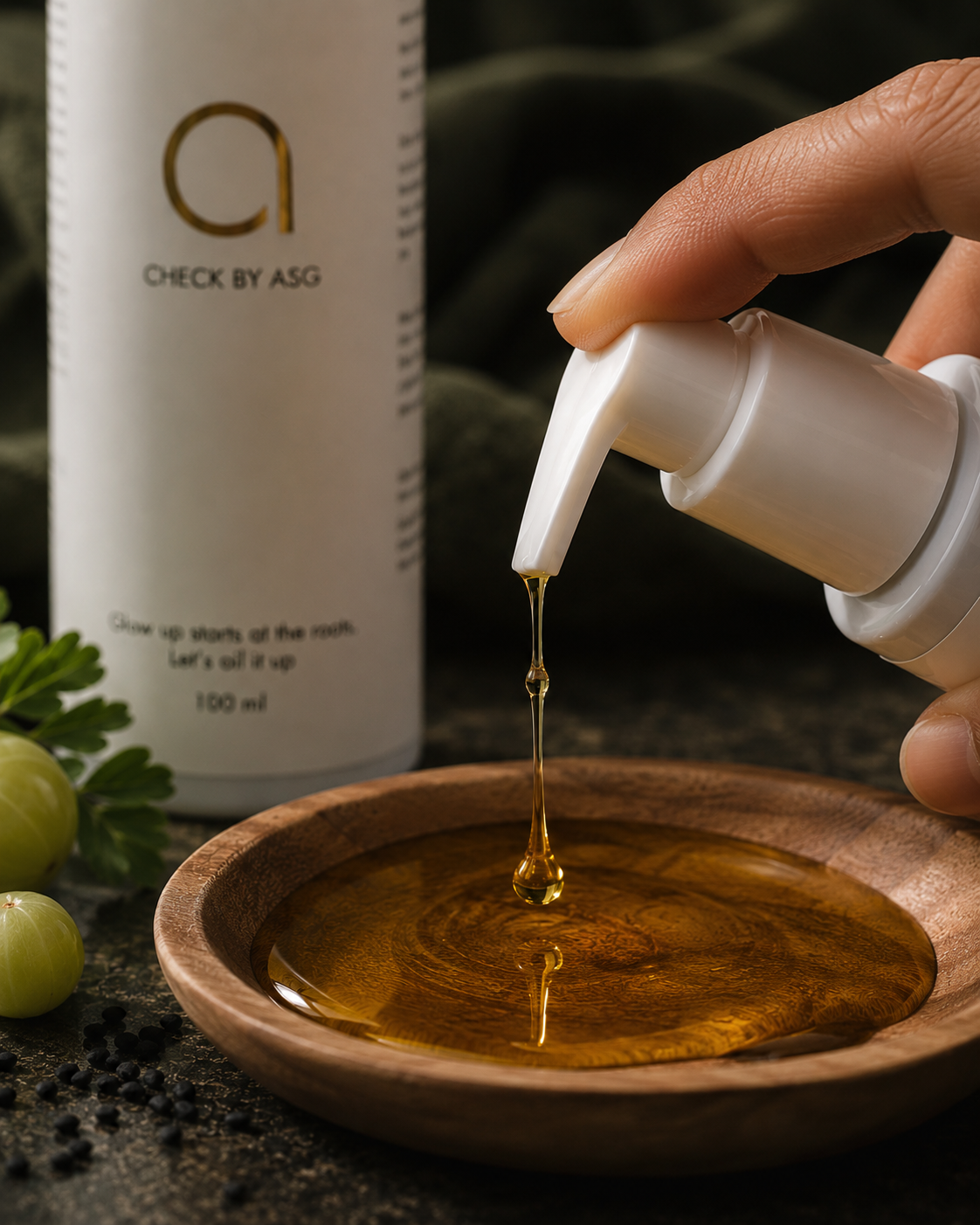
A hair oil pump bottle does one thing a cap bottle cannot: it makes the amount you use the same every time, without you thinking about it. Two pumps on a Tuesday is two pumps on a Sunday. That sounds trivial. Over eight weeks, it is the difference between a routine you keep and a bottle that sits half-full at the back of the bathroom shelf.
We chose a pump for our 100ml bottle for exactly that reason, and we are going to be honest about the trade-offs too. Pumps are not perfect. They can clog with thick oils, they leave a few millilitres at the bottom, and they do not love very cold mornings.
If you are new to oiling, start with how to apply hair oil correctly. This post builds on that method.
This post lays out both sides so you can decide what suits the way you actually oil your hair, not the way a packaging brochure imagines you do.
The problem with the cap bottle most of us grew up with
Think of the oil bottle in your grandmother’s house. A glass or plastic bottle with a screw cap, tipped into a steel katori or straight onto the palm. There was a lot to love about it. There were also three quiet problems.
The first is dosage. You tip, and either a trickle comes out or half the bottle does. Most people over-pour, because under-pouring means tipping again. Over a month, a 100ml bottle that should last four weeks is gone in two and a half, and the extra oil did nothing except sit on the lengths and need a third shampoo.
The second is contamination. Fingers go in, the katori is reused, the cap is left off while you massage. For a plain coconut oil that hardly matters. For a cold-infused herbal oil with no synthetic preservatives, it matters more. Every bit of water or skin that finds its way in shortens the oil’s life.
The third is the mess. A tipped bottle on the edge of the basin is one elbow away from an oil slick on the floor. Anyone who has cleaned mustard oil off bathroom tiles knows the feeling.
What a pump changes
A pump turns oiling into a measured act. Each press delivers roughly the same volume. That gives you a language for your routine: two pumps for a short crop, three or four for hair past the shoulders, one for a quick scalp top-up. When we tell people how to apply our oil, we can say “warm two or three pumps in your palms” and mean something precise.
It also closes the bottle between uses. No open neck, no dipping, no fingers in the oil. The herbs stay in the oil and the bathroom stays off the oil.
And it is one-handed. You can hold your sectioned hair with one hand and press with the other. Small, but it removes a reason to skip.
Consistency is the whole game
Hair oil does not work in a week, and it does not work if used in bursts. It works at six to eight weeks of two or three applications a week. Anything that makes the application faster and less messy increases the chance you are still doing it in week seven. That is the honest case for the pump. Not that it makes the oil better, but that it makes you more likely to use the oil.
If your oil has “not worked” before, consistency is usually the reason. We wrote about the pattern in why hair oil seems to stop working at week four, and the fix is almost never a different oil.
Pump vs cap: the honest comparison
| Pump bottle | Cap bottle | |
|---|---|---|
| Dose control | Same amount each press | Depends on your tipping hand |
| Hygiene | Closed system, no dipping | Open neck, fingers and katori |
| Spills | Rare | Common on a wet basin |
| Thick or cold oil | Can slow or clog | Pours slowly but always pours |
| Last 5 to 8ml | Hard to reach without unscrewing | Easy to tip out |
| Warming the oil | Warm in palms or a katori after pumping | Bottle can sit in hot water |
| Travel | Lock or tape the pump head | Cap can loosen in a bag |
| Refill and reuse | Pump head can be reused | Bottle reusable |
The row that catches people out is the last few millilitres. A pump cannot draw oil below the bottom of its tube. When the pump starts spitting air, unscrew the head and tip the remainder into your palm. It is usually two more applications. Do not throw it away.
The 60-day rule. One 100ml bottle lasts about four weeks. Most people see the difference at week eight. A pump is what keeps those four weeks honest, because every application is the same size. That is why we sell it as a pair: 2 × 100ml for ₹1,999. Two bottles is one full cycle.
How many pumps, and how to warm them
We get asked this more than anything else about the bottle.
For a scalp-focused application, which is what we recommend, two pumps is enough for short hair and three for medium. Long, thick hair may need four, but most of that fourth pump is going to the lengths, and the lengths are not where growth happens. Pumping more does not speed anything up. It only means more shampoo later.
To warm the oil, pump into one palm and rub your hands together for ten seconds. Body heat is enough. If you prefer the old way, pump into a small steel katori and float it in a bowl of hot water for a minute. Do not microwave oil, and do not heat the bottle itself, because heat is the thing our cold-infused process is designed to avoid.
Then the usual method: part the hair, apply to the scalp, slow circles for two to three minutes, leave for 30 minutes or overnight, wash. The full technique is in our guide to applying hair oil the three-minute scalp way.
What is actually in the bottle
A pump is only worth discussing if what comes out of it is worth measuring. Our 100ml bottle holds a cold-infused blend of 17 herbs. Bhringraj and amla at 5 per cent each for density and roots. Jatamansi at 5 per cent to calm a stressed scalp. Neeli indigo at 5 per cent to keep dark hair deep. Then brahmi, kalonji, karanja, neem, nimbu, onion, reetha, shikakai, heena, olive, manjistha, castor and aloe vera, each with a specific job. We list all 17 herbs and their percentages so there is nothing to guess.
The texture is medium. Olive keeps it light enough to pump cleanly, and castor is there in a small enough amount that it does not turn the oil into syrup. That balance was partly a formulation decision and partly a packaging one. A thick oil in a pump is a bad experience in a Shimla winter.
When Apoorva made the first batches in her Delhi kitchen, the oil went into whatever bottles were at hand. The pump came later, after watching family members pour far too much and then complain the bottle was over. The story of how the brand started has more on those first months.
Small habits that make a pump bottle last
Keep the bottle upright, not lying in a drawer. The pump’s tube needs to sit in the oil.
In cold weather, if the pump feels stiff, hold the bottle in your hands for a minute or stand it in a mug of warm water. Do not force the pump, and do not stand it in boiling water.
Wipe the nozzle with a tissue once a week. Dried oil on the nozzle is the usual cause of a sputter.
Store it out of direct sun and away from the geyser. Heat and light are the two things that age a herbal oil.
When the bottle is done, rinse it with warm water and a drop of dish soap, and keep the pump head. It fits a refill, and it fits a carrier oil for the days you want something plain.
And if you are wondering how often to use those pumps at all, that depends on your scalp more than on the bottle. Our guide to how often to oil by hair and scalp type goes through it.
Frequently asked questions
Is a pump bottle better than a cap bottle for hair oil?
For consistency and hygiene, yes. Each press gives the same amount, the oil stays sealed, and spills are rare. A cap bottle is easier to warm in hot water and easier to empty completely. Neither changes what the oil does. The pump changes how reliably you use it.
How many pumps of hair oil should I use?
Two for short hair, three for medium, four for long and thick hair. Apply to the scalp first. If oil is dripping, you have used too much, and the fix is fewer pumps next time rather than more shampoo.
Why does my hair oil pump stop working?
Usually one of three things: the oil is cold and thick, the nozzle has dried oil on it, or the bottle is nearly empty and the tube is drawing air. Warm the bottle in your hands, wipe the nozzle, or unscrew the head and pour out the last bit.
Can I warm the whole pump bottle in hot water?
We would rather you did not. Pump the oil out first and warm it in your palms or a steel katori. Heating the bottle can loosen the seal, and repeated heating is not good for a cold-infused oil.
How do I travel with a pump bottle of hair oil?
Most pump heads lock with a quarter turn. If yours does not, a strip of tape across the head and a zip bag do the job. Keep it upright in the bag if you can.
The bottle is the least interesting thing about a hair oil, right up until it is the reason you stopped using one. Two pumps, warm palms, three minutes on the scalp, twice a week, for eight weeks. If you want the two bottles that cover that stretch, the two-bottle pair is here.
All 17 herbs, in one bottle
Bhringraj, amla, brahmi and 14 more cold-infused herbs — our 17-Herb Ayurvedic Hair Oil is made for hair fall, thinning and slow growth.