
Premature grey hair, the kind that shows up at 22 or 26 rather than 45, has a short list of causes and a longer list of myths. The causes are mostly genetics, a few specific nutrient gaps that are common in India, thyroid, smoking, and sustained stress. The myths are that one plucked grey brings seven more, and that any oil can turn a white strand black again.
We make a hair oil, so we will be honest about where oil fits. It cannot restore pigment to a strand that has already lost its melanocytes. What it can do is keep the scalp calm and well-supplied while you fix the underlying cause, and a few of the herbs in it, amla, bhringraj and neeli indigo, have a long tradition around keeping dark hair dark.
For the wider picture, our guide to the most common hair fall reasons explains how to tell one cause from another.
This post walks through the causes in rough order of likelihood, the blood tests worth asking for, and what an Ayurvedic routine realistically offers.
Why hair goes grey at all
Every hair follicle has a small store of pigment cells called melanocytes. With each new growth cycle they inject melanin into the strand as it forms. Dark hair means the melanocytes are active and well-stocked. A grey strand means that follicle’s melanocytes have slowed down. A white strand means they have stopped, or the pigment is being bleached by hydrogen peroxide building up inside the follicle, which is a normal by-product of cell metabolism that the body usually clears.
Age wears this system down in everyone. Premature greying is when something speeds it up. Dermatologists usually call it premature when it starts before the mid-twenties in Indian skin and hair types, though the exact cut-off varies by source.
Causes of premature greying in your 20s
Genetics, first and by a distance
If a parent or grandparent went grey early, this is the most likely explanation and the one nobody can do much about. A 2016 study of more than six thousand people across Latin America identified a gene, IRF4, associated with greying. It does not act alone, but it confirmed what families already knew: the timing is largely inherited.
Vitamin B12 deficiency
This one is worth a blood test for almost everyone in India. B12 comes mainly from animal foods, and surveys have repeatedly found low B12 in a large share of Indian vegetarians. Low B12 is linked in case reports to early greying, and in some of those reports the greying slowed once levels were corrected. It is not a sure thing, but it is cheap to check.
Iron, vitamin D and copper
Ferritin (stored iron) and vitamin D are the two other deficiencies that show up often in young Indian adults, especially women. Copper is needed for melanin production, and low copper has been associated with premature greying in a few small studies. Ask for ferritin and vitamin D in the same test; copper is less commonly tested but worth mentioning to your doctor.
Thyroid
Both an underactive and an overactive thyroid can affect hair colour and hair fall. If you are tired, gaining or losing weight without trying, or feeling cold more than others, a TSH test is the first thing a doctor will order.
Smoking
Smokers go grey earlier on average. The usual explanation is oxidative stress, the same chemistry that bleaches pigment inside the follicle. This one is at least within your control.
Stress
For a long time this was dismissed as folklore. Then a 2021 study from Columbia University tracked individual strands and found that greying could, in some cases, partly reverse when a stressful period ended. The sample was tiny and the effect only showed in hairs that had greyed recently. We mention it not as a promise but because it supports something practical: a strand that has only just gone grey may still have working melanocytes, and the environment around that follicle matters.
Pollution and sun
A scalp that spends two hours a day on a bike in Delhi or Bengaluru traffic is absorbing UV and particulate matter that generate free radicals. This does not cause greying on its own, but it adds to the oxidative load the follicle is already managing.
What to ask your doctor for
If you are greying noticeably before 25, or if it is accelerating, a single blood draw covers the main suspects. Ask for vitamin B12, vitamin D, ferritin, a complete blood count, and TSH. Mention copper if you want to be thorough. This is also the panel that catches most of the common causes of hair fall, so it is a good use of one morning. Oiling is supportive. It is not a substitute for finding out what your levels actually are.
The 60-day rule. One 100ml bottle lasts about four weeks. Most people see the difference at week eight. That is why we sell it as a pair: 2 × 100ml for ₹1,999. Two bottles is one full cycle. For greying, that cycle is about protecting the pigment you still have, not reversing what is gone.
What an Ayurvedic hair oil can and cannot do
Ayurveda calls early greying palitya, and classical texts link it to excess pitta, the heat element, in the head. Whether or not you use that framework, the herbs the tradition reached for are an interesting list: cooling, antioxidant-rich, and in several cases pigment-related. Here is what is in our 17-Herb Hair Oil that is relevant, and what we can honestly say about each.
Amla (5%)
Amla is the classic Indian remedy for greying, and it is one of the richest natural sources of vitamin C. Vitamin C is an antioxidant, and the oxidative stress story above is the most plausible reason the tradition exists. Research on topical amla and greying specifically is limited. We covered the root-versus-strand logic in our post on amla oil and why vitamin C at the root matters.
Neeli indigo (5%)
Indigo is a cooling leaf that has been used to colour hair for centuries. In a leave-in oil at this concentration it does not dye the hair; it deposits a faint blue-black cast that keeps dark hair looking deep and makes early greys less stark. It is a visual support, not a pigment fix, and we say so plainly in our piece on neeli indigo and natural colour depth without dye.
Bhringraj (5%)
Its Sanskrit name, keshraja, means king of hair, and it appears in almost every traditional greying formulation. Its reputation is for density and scalp health rather than colour directly. A healthier follicle is a better environment for the melanocytes that live in it.
Jatamansi, brahmi and manjistha
These three are the calming and circulatory side of the blend. If stress is part of your picture, a slow three-minute scalp massage with a cooling oil on a Sunday evening is a small, repeatable act of lowering the temperature, in both senses.
We list all 17 herbs and their percentages on the ingredients page, including heena, which adds gloss, and kalonji, another herb with a greying tradition behind it.
What none of these can do is turn a white strand dark again. Any product that promises that is either a dye or is overstating. We would rather tell you this at the start than have you discover it at week eight.
A routine that makes sense for early greys
The goal is a calm, well-fed scalp and minimal damage to the pigmented hair you still have.
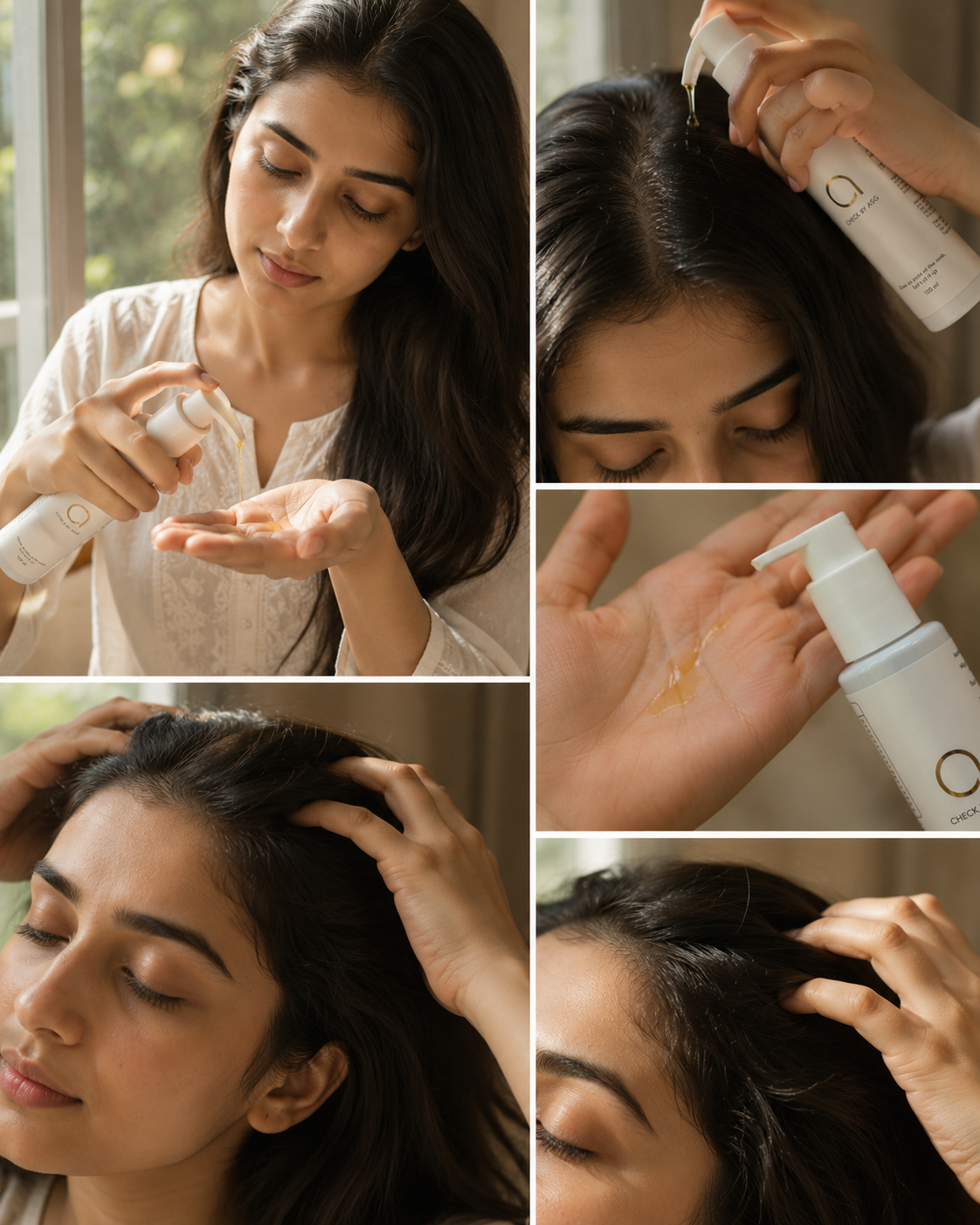
- Oil two or three times a week. Warm a few pumps in your palms, massage the scalp in slow circles for two to three minutes, leave for 30 minutes or overnight, then wash.
- Do not pluck. Plucking does not multiply greys, but repeated plucking can damage the follicle, and you lose the strand either way.
- Go easy on heat and harsh colour. If you are covering greys with dye, a cold-infused oil without mineral oil or silicones is safe on colour-treated hair and helps the lengths stay soft.
- Fix the blood test results. If B12 or D is low, supplements under a doctor’s guidance do more for greying than any oil.
- Stop smoking if you do. It is the single biggest controllable factor on this list.
- Give it eight weeks. Hair cycles are slow, and anything you notice before that is scalp comfort, not colour.
If stress is driving both greying and shedding, our post on stress hair fall and the three-month delay explains why what you see today reflects what happened a season ago.
Apoorva’s own grandfather kept a full head of mostly dark hair into his seventies, and he put it down to the oil he warmed in a steel katori every week. We do not think it was only the oil. We think it was the habit, the massage, and a life that was slower than ours. That is part of the story behind Check by ASG, and it is why we talk about checking on yourself rather than fixing yourself.
Frequently asked questions
Can premature grey hair be reversed?
Sometimes, partly, and only in strands that have greyed recently, usually when a deficiency or a period of acute stress is corrected. A strand whose melanocytes have fully stopped will not regain pigment. Early action matters more than any product.
Does plucking one grey hair cause more?
No. Each follicle is independent. Plucking does not affect the neighbours, but it can damage the follicle you pulled, so it is still better to trim or leave it.
Which blood tests should I get for greying in my 20s?
Vitamin B12, vitamin D, ferritin, complete blood count and TSH. Ask about copper if you want to be thorough. These also cover the most common causes of hair fall.
Will indigo in the oil stain my hair or skin?
No. At the concentration in a leave-in oil it does not dye. It gives dark hair a deeper cast and softens the contrast of early greys. Colour-treated hair is fine.
Can an Ayurvedic oil stop greying from spreading?
No oil can promise that. Amla, bhringraj and indigo are traditionally used to support pigment and scalp health, and research is limited. What oiling reliably does is keep the scalp calm and the existing hair in good condition while you address the cause.
Early greys are not a failure of care. They are mostly a message from your genes, and sometimes a message from your blood work. Read the second one, be kind about the first, and give your scalp a routine it can rely on. If you want that routine ready to go, two bottles for ₹1,999 is one full eight-week cycle.
All 17 herbs, in one bottle
Bhringraj, amla, brahmi and 14 more cold-infused herbs — our 17-Herb Ayurvedic Hair Oil is made for hair fall, thinning and slow growth.