
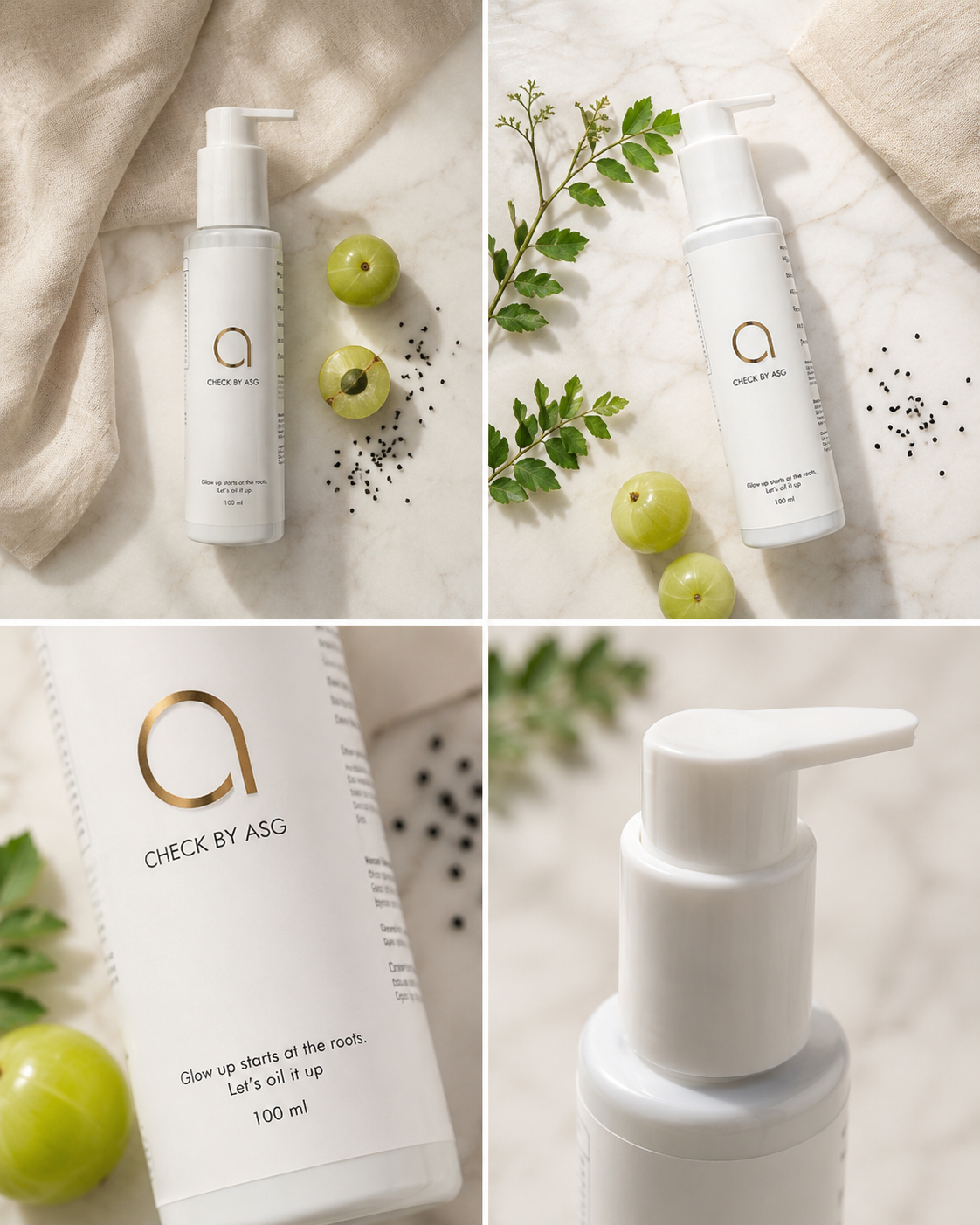
Bhringraj for hair is the herb almost every Indian grandmother would name first. Eclipta alba, called kesharaja or “king of hair” in Ayurvedic texts, is traditionally used for density, growth and a calmer scalp. Massaged into the scalp as an oil two or three times a week, many people notice less hair in the comb by week four and a fuller-looking parting by week eight.
That is the short answer. The longer one covers what bhringraj can and cannot do, why the amount in the bottle matters, and why eight weeks is the honest timeline rather than eight days.
We use bhringraj at 5% in our 17-Herb Hair Oil, cold-infused alongside sixteen other herbs. This post explains the thinking behind that.
What bhringraj actually is
Bhringraj is a small, low-growing plant with white daisy-like flowers. It grows wild in wet fields and along paddy bunds across India, which is partly why it has been so easy to use for so long. Its botanical name is Eclipta alba, also written Eclipta prostrata. In Hindi it is bhringraj, in Tamil karisalankanni, in Marathi maka.
Classical Ayurvedic formulations such as Bhringraj taila and Nilibhringadi taila are built around it. The traditional preparation is slow: the fresh herb or its juice is simmered in a base oil until the oil darkens. We do a version of the same thing without the heat, steeping the dried herb for weeks so that the cooler extraction keeps the more delicate plant compounds intact.
The plant contains compounds such as wedelolactone and a range of flavonoids. Researchers have studied these in lab settings for anti-inflammatory activity. Human hair trials are still thin on the ground, which is worth saying plainly before we go any further.
Bhringraj benefits for hair: tradition and what research supports
Density and growth
This is the claim bhringraj is famous for. The evidence we have is a mix of long tradition and early-stage research. A 2008 lab study on rats found that an Eclipta alba extract shortened the time it took for hair to come back after shaving and increased the number of follicles in the growth phase. That is a promising signal. Rats are not people, though, and we have not seen a large human trial, so we describe bhringraj as supporting density rather than anything stronger.
In practice, the people who write to us about bhringraj usually describe the same two things: fewer strands on the pillow and in the drain, and baby hairs along the hairline after a couple of months. Both are consistent with a scalp that is calmer and better fed, which is where the next benefit comes in.
A calmer scalp
Ayurveda classifies bhringraj as cooling. In modern terms, its compounds have shown anti-inflammatory activity in the lab. An irritated, hot, itchy scalp tends to shed more, so anything that helps settle it is doing useful groundwork. This is why we pair bhringraj with jatamansi and neeli indigo, two other cooling herbs, rather than making it carry the load alone.
Premature greying
Bhringraj is traditionally used to keep hair dark, and it is the base of several old formulations for early greys. We will be honest: research here is limited. If you are greying in your twenties, we would point you to stress, vitamin B12 and family history first, and think of bhringraj oil as a supportive habit rather than a fix.
How to use bhringraj oil so it has a chance to work
Most people use hair oil the way they use conditioner: a quick coat along the length, a rinse, done. Bhringraj does very little for the strand. It needs to reach the scalp and stay there.
- Take two or three pumps and warm the oil between your palms for a few seconds. Warm oil spreads more easily and feels better on a tight scalp.
- Part your hair in sections and apply with your fingertips directly to the skin, not the hair.
- Massage in slow circles for two to three minutes. Fingertips, not nails. Think of it as moving the skin over the skull rather than rubbing the surface.
- Leave it for at least 30 minutes. Overnight is fine if your scalp is not oily.
- Wash with a mild shampoo. Repeat two or three times a week.
If you want the full technique, including the mistakes we see most often, we have written it up in our guide to applying hair oil the right way. Patch-test on the inner arm the first time, as you would with any new product.
The 60-day rule. Bhringraj works on the follicle cycle, and follicle cycles are slow. One 100ml bottle lasts about four weeks. Most people see the difference at week eight. That is why we sell it as a pair: 2 × 100ml for ₹999, buy one get one free. Two bottles is one full cycle.
What to expect in 8 weeks
A hair follicle does not respond to a single application. The growth cycle runs in months, so the honest timeline looks something like this.
| Weeks | What many people notice | What is likely happening |
|---|---|---|
| 1 to 2 | Scalp feels calmer, less itch. Hair feels softer after a wash. | Cooling herbs settling irritation; the oil conditioning the strand. |
| 3 to 4 | Fewer strands in the comb. No visible new growth yet. | Existing hair shedding less as the scalp environment improves. |
| 5 to 6 | Fine baby hairs at the hairline or parting, visible in good light. | Follicles that were resting beginning a new growth phase. |
| 7 to 8 | Parting looks a little fuller. Ponytail feels slightly thicker. | New growth gaining length; shedding has stabilised. |
Two things about this table. First, it describes what is typical, not what is promised. Hair that is falling because of a thyroid issue or low iron will not follow it. Second, the week-four stretch is where most people quit, because they expected growth and got “only” less shedding. Less shedding is the result. Growth follows it. We see this week-four trap often enough that we wrote a separate post about it.
A simple way to track it: on a Sunday evening, before you oil, comb your dry hair over a white towel and count what comes out. Write the number down. Do it again every Sunday. The number tells you more than the mirror does.
Bhringraj works better with company
A single-herb bhringraj oil is a fine thing. We chose to blend it because hair fall rarely has one cause, and a scalp usually needs more than one kind of help at the same time.
In our oil, bhringraj sits at 5% alongside amla, which brings vitamin C to the root, and jatamansi, the Himalayan root that calms a stressed scalp. Brahmi supports the follicle and helps with breakage. Onion adds sulphur, which the hair shaft uses for strength. Manjistha is traditionally used for scalp circulation, which is the delivery system for everything else. Neem and karanja keep the scalp clear so the active herbs are not fighting through buildup. Castor and olive seal the ends so the length does not undo the work at the root.
We list all 17 herbs and their percentages on our ingredients page, including the ones we use in smaller amounts. If you are comparing oils, that page is where we would start. The percentage of bhringraj in a bottle matters more than the word on the label.
When bhringraj will not be enough
We would rather lose a sale than mislead you. Oil, however carefully made, works on the scalp. It does not work on the thyroid, on iron levels, on PCOS, or on the hormonal shift after childbirth. If your hair fall came on suddenly, if it is patchy, or if it has lasted more than six months without change, please see a doctor and ask for a basic blood panel: ferritin, vitamin D, B12 and thyroid. Oiling is a good supportive habit in all of those situations. It is not a substitute for finding the cause. Our post on the hair fall reasons dermatologists see most in your 20s and 30s walks through how to tell them apart.
Apoorva, who started Check by ASG, grew up with her father and grandfather oiling her hair on Sunday evenings in a small town. Her view, which we share, is that the ritual is as much about checking on yourself as about any single herb. You can read how the brand began in a Delhi kitchen if you are curious about where the 17 herbs came from.
Frequently asked questions
Does bhringraj help hair grow back?
It is traditionally used for exactly this, and early animal research points the same way. We have not seen strong human trials, so the honest answer is that bhringraj supports a scalp environment in which growth is more likely. Give it eight weeks of consistent use before judging.
Can I use bhringraj oil every day?
You can, but you do not need to. Two or three applications a week, massaged in properly, do more than a daily smear. Daily oiling can also leave an oily scalp heavier and more prone to buildup.
Is bhringraj oil good for grey hair?
It is traditionally used to keep hair dark, and it is a key herb in older formulations for early greys. Research is limited, and genetics play a big role. We would use it as a supportive habit alongside checking B12 and stress levels.
How much bhringraj should a hair oil contain?
Look for a brand that states a percentage. Ours is 5%, and we publish the full list. Many oils put bhringraj on the front label and use a trace of it at the back.
Can men use bhringraj oil?
Yes. Male-pattern thinning has a hormonal driver that oil cannot change, but a calmer, cleaner scalp supports the hair you have. Our oil is made for men and women and for all hair types, including colour-treated.
Does bhringraj oil smell strong?
Bhringraj on its own is grassy and slightly bitter. In a blend with amla, henna and neem the smell is earthy rather than sharp. We use no synthetic fragrance, so what you smell is the herbs.
Bhringraj earns its reputation, as long as it reaches the scalp, stays there, and is given time. Two or three evenings a week, a few warm pumps, three minutes of slow circles, and an honest eight weeks. If you want to try it the way we think it works best, start with the two-bottle pair, 2 × 100ml for ₹999, which covers one full cycle.