
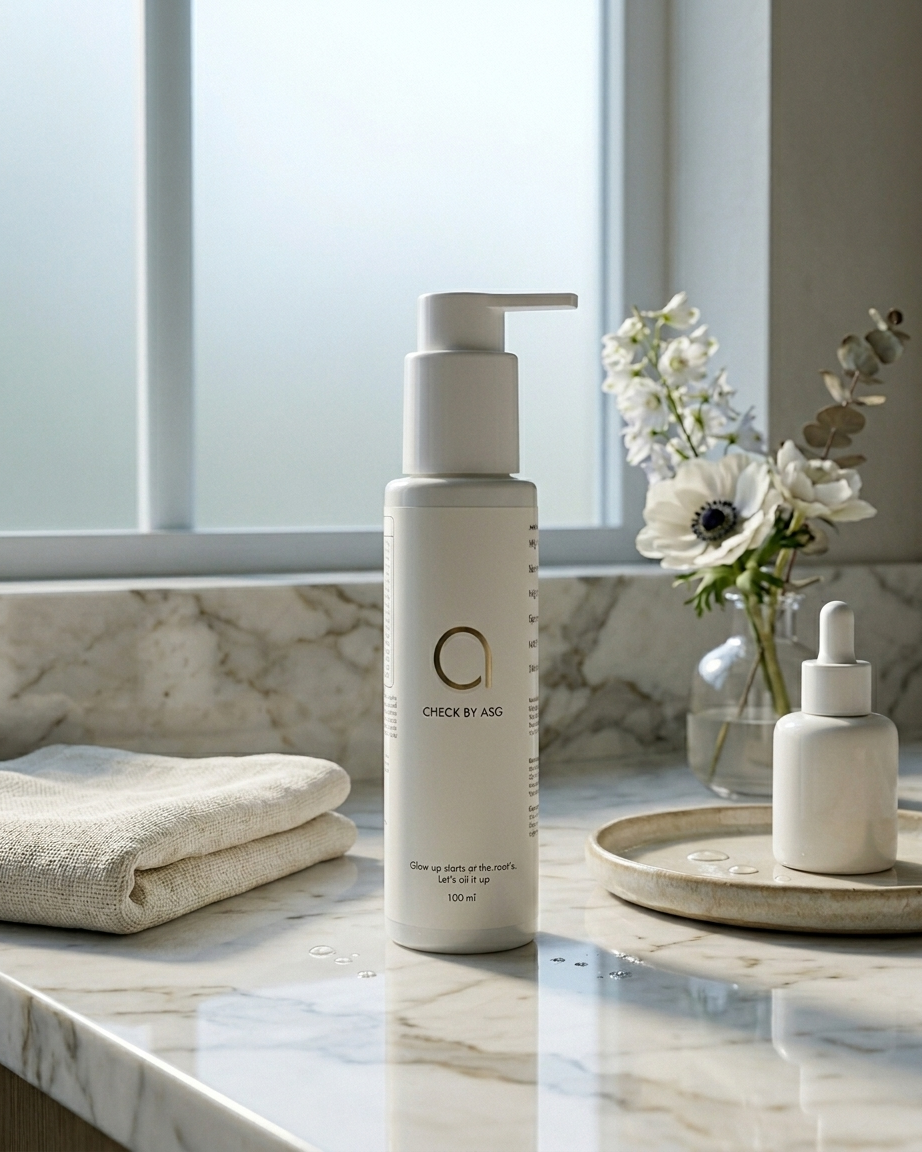
Indigo for hair means two different things, and most of the confusion online comes from mixing them up. Indigo powder, made from the dried leaf of Indigofera tinctoria, is a plant dye that colours grey hair brown to black when used after henna. Indigo in a hair oil is not a dye at all. Steeped in oil, the leaf is traditionally used to cool the scalp and keep naturally dark hair looking deep and glossy, and it will not stain hair, skin or clothes blue.
We use neeli indigo at 5% in our 17-Herb Hair Oil for the second reason. If you are looking to cover greys, this post will tell you plainly that an oil cannot do it. If you have dark hair that has gone dull, or a scalp that runs hot, read on.
This is the herb that gives the old formulation Nilibhringadi taila its name. Nili is indigo. It has been paired with bhringraj for a very long time, and there is a reason for that pairing which we will get to.
What neeli indigo is
Indigo is a leafy shrub in the pea family, grown across Tamil Nadu, Karnataka and parts of Andhra for its leaves. In Hindi it is neel, in Tamil avuri, in Sanskrit nili. For centuries it was India’s great export dye, the blue in every pair of jeans before synthetic indigo replaced it.
The dye chemistry is worth understanding, because it explains the whole powder-versus-oil question. The fresh leaf does not contain blue pigment. It contains a colourless compound called indican. When the leaf is crushed and meets water and air, indican breaks down and oxidises into indigotin, the blue dye. That reaction needs water. It is why indigo powder is mixed into a paste and why it darkens as it sits.
Leaves steeped slowly in oil, with no water, do not go through that reaction in any meaningful way. The oil takes on the leaf’s green-brown colour and its cooling properties, and leaves the dye behind. That is the short answer to whether indigo oil will turn your hair or your pillowcase blue. It will not.
Indigo powder versus indigo in oil
| Indigo powder (paste) | Indigo in hair oil | |
|---|---|---|
| What it is | Dried, powdered leaf mixed with water | Leaf steeped in a carrier oil |
| Main use | Dyeing grey hair, after a henna step | Cooling the scalp; keeping dark hair deep and glossy |
| Covers grey | Yes, brown to black depending on the henna base | No |
| Stains | Yes: hands, nails, towels, bathroom tiles | No colour stain; oil marks like any oil |
| Time per use | Two to four hours, often two sessions | Thirty minutes to overnight |
| Frequency | Every three to six weeks | Two or three times a week |
| Safe on coloured hair | Risky; can react with chemical dye | Yes |
Both are good at their own job. The mistake is buying one expecting the other. If you want to cover grey without chemical dye, go and find a good indigo powder and a good henna powder, and set aside a Sunday. If you want a calm scalp and dark hair that catches the light, that is what the oil is for.
What indigo does in a hair oil
It cools the scalp
Ayurveda classes indigo as cooling, and it has been used that way on the scalp and skin for a very long time. In practice, people with a hot, itchy or tight-feeling scalp notice the difference within a few applications. Heat and irritation on the scalp are quiet contributors to shedding, so taking the temperature down is useful groundwork, not a cosmetic nicety. We pair it with jatamansi, another cooling herb, so the two share the job.
It keeps dark hair looking deep
This is the use indigo oil is best known for in Indian households. Naturally black or dark brown hair goes dull and faintly reddish with sun, hard water and heat. Oil with indigo in it is traditionally used to keep that depth, and repeated use does leave dark hair looking richer. The effect is on the surface and on the light the hair reflects; it is not a dye, and it does nothing visible to grey strands. We say that twice because it is the question we get most.
It is traditionally used for early greying
Indigo, like bhringraj and amla, turns up in old formulations for premature greys. We will be straightforward: research here is limited, and greying is largely genetic, with stress and vitamin B12 playing a part. We think of indigo in oil as a supportive habit for people who are starting to see greys in their twenties, alongside a B12 test and better sleep, and not as a fix.
The 60-day rule. Depth and scalp calm build up over weeks of use, not in one application. One 100ml bottle lasts about four weeks. Most people see the difference at week eight. That is why we sell it as a pair: 2 × 100ml for ₹999, buy one get one free. Two bottles is one full cycle.
How to use indigo oil, and who it suits
Same method as every herb in our blend, because the goal is the scalp. Warm two or three pumps in your palms, press onto the scalp in sections, massage in slow circles for two to three minutes, run the rest down the length, leave for 30 minutes or overnight, wash with a mild shampoo. Two or three times a week. Our guide to applying hair oil correctly has the full method.
Indigo oil suits dark hair best, simply because that is where the depth shows. It suits hot, itchy scalps of any hair colour. It is fine on colour-treated hair, because it does not dye and does not react with chemical colour; it only conditions and cools. It is also fine on light or grey hair if what you want is the scalp benefit. You will not get a tint, which is the point.
Because the oil is dark, it can mark fabric the way any oil does. An old towel on the pillow handles that. Patch-test on the inner arm the first time, as with every new product.
Why indigo and bhringraj belong together
Nilibhringadi taila pairs indigo with bhringraj, and the logic holds up. Bhringraj is traditionally used for density and growth. Indigo cools and settles the scalp that growth has to come from. One works on the follicle, the other on the ground around it. We keep both at 5% for that reason.
Around them, amla brings vitamin C to the root and its own tradition of keeping hair dark. Henna in the oil conditions and adds gloss, and like indigo it does not stain when steeped in oil rather than mixed with water. Jatamansi shares the cooling work. Neem and karanja keep the scalp clear. Castor seals the ends so the depth indigo gives has a smooth surface to show on. We list all 17 herbs and their percentages on our ingredients page.
Indigo oil is one of the things Apoorva’s grandfather kept in the house, in a bottle that stained the shelf but never the hair. That contradiction is how she first learned the difference between the powder and the oil. Her story, and how the 17 herbs came together in a Delhi kitchen, is here.
Frequently asked questions
Does indigo hair oil dye hair?
No. The blue dye in indigo forms when crushed fresh leaves meet water and air. Leaves steeped in oil do not go through that reaction in the same way, so the oil does not colour hair or stain skin. For dye, you need indigo powder mixed with water and applied after henna.
Can indigo oil cover grey hair?
No, and we would be cautious of any oil that says it can. Indigo oil is traditionally used to keep naturally dark hair looking deep and to support a cooler scalp. Covering grey needs the powder, applied as a paste, and even then the result depends on the henna step before it.
Is indigo oil safe on colour-treated hair?
Yes, because it does not dye. It conditions the strand and cools the scalp without interacting with the colour. Our oil is made for all hair types, including colour-treated. Patch-test first, as with any new product.
Will indigo oil stain my pillow or skin?
The oil is dark because of the herbs in it, and like any oil it can mark fabric, so cover the pillow with an old towel. It does not leave a blue or black tint on skin or hair the way indigo paste does.
Can I be allergic to indigo?
Any plant can cause a reaction in someone. Indigo allergy is uncommon but real, and most reported cases involve powder dyes, which sometimes contain added chemicals. Patch-test any indigo product, powder or oil, on the inner arm for 24 hours before use.
Indigo in an oil is a quieter thing than indigo in a dye. It cools the scalp, keeps dark hair deep, and asks for nothing more than three minutes twice a week. If that is what you were looking for rather than a grey cover, the two-bottle pair at ₹999 covers one full eight-week cycle.