
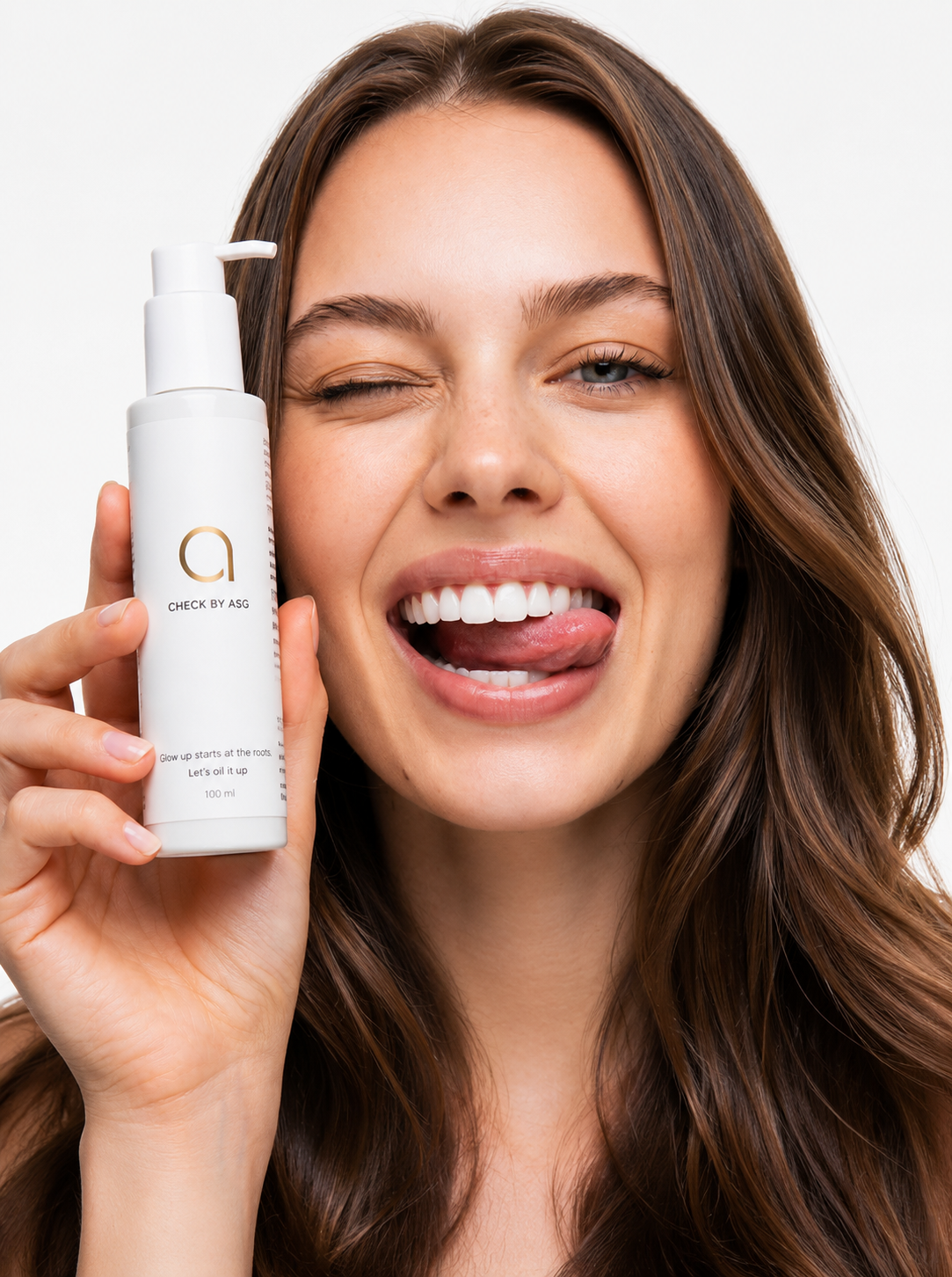
If your hair oil is not working, the most likely explanation is timing. Most people judge an oil at week four, when the only visible change is less shedding, and quit just before the part they were waiting for. The second most likely explanation is that the oil never reached the scalp. The third is that the cause of your hair fall is something no oil can reach.
All three are fixable, or at least knowable. This post goes through the week-four mistake first, because it is the one we see most, and then seven other reasons an oil can seem to fail even when it is doing its job.
We sell a hair oil, so we have an interest in you not giving up early. We also have an interest in you not wasting eight weeks on something that cannot help you. Both are covered here.
The week-4 mistake
A hair follicle runs in a cycle: a growth phase that lasts years, a short transition, a resting phase of about three months, and then release. When a scalp calms down and gets better fed, the first thing that changes is that fewer follicles are tipped into rest. The first thing you see, therefore, is fewer strands in the comb. That shows up at around week three or four.
New growth is a separate event. The follicles that were already resting when you started still have to finish their rest and start a new hair, and that new hair has to grow long enough to be visible. That takes until week six to eight at the earliest. So the honest timeline has two parts, and the first part looks like nothing is happening.
Here is what most people actually do. They start oiling because the comb looked alarming. For a month they oil, and the comb slowly looks less alarming, but they are watching the mirror for growth and the mirror shows nothing. At week four they conclude the oil did not work and stop. Two weeks later the shedding creeps back up, which confirms the verdict in their mind. The oil did exactly what it was supposed to do; the measurement was wrong.
The fix is to measure the right thing. Before you start, comb dry hair over a white towel and count what comes out. Write it down. Do it every Sunday evening. If the number is falling by week four, the oil is working, and growth is on its way. If it is not falling, keep reading.
Seven other reasons hair oil seems not to work
1. The oil went on the hair, not the scalp
This is the big one after timing. A palmful of oil smoothed along the length makes hair shiny for a day and does nothing for the follicle. The herbs in a good oil are there for the skin of the scalp, and they need fingertip contact and a few minutes of slow circles to get there. Our three-minute scalp method is the fix, and it changes results more than switching brands does.
2. Too much oil, then a harsh wash
Five pumps where three would do, followed by two rounds of a strong sulphate shampoo to get it all out, leaves the scalp drier than before you started. Use less oil, apply it to the scalp, and wash once with a mild shampoo applied before the water.
3. It was once a fortnight, not twice a week
A scalp routine needs a rhythm. Two or three times a week, on the same days, is the dose. Oiling when you remember, which in practice is every ten days, does not give the scalp enough continuity to change. If you are unsure what frequency suits your scalp, our guide to how often to oil hair by hair and scalp type sets it out.
The 60-day rule. The oil that “did not work” is often the oil that was judged at day 28. One 100ml bottle lasts about four weeks. Most people see the difference at week eight. That is why we sell it as a pair: 2 × 100ml for ₹999, buy one get one free. Two bottles is one full cycle.
4. The bottle was mostly mineral oil
Turn it over. If the first ingredient is paraffinum liquidum, light liquid paraffin or mineral oil, the herbs on the front label are riding on a base that coats the scalp rather than feeding it. Mineral oil is not dangerous, but it sits on the skin as a film, which is the opposite of what you want from a scalp oil. The same goes for silicones, which make the hair feel better at once and do nothing underneath. We use neither, and we would suggest checking any oil you have already tried before deciding herbs do not work for you.
5. The scalp was blocked
Hard water in Bengaluru, Gurugram or Hyderabad, Delhi winter smog, dry shampoo, gels and months of old product leave a layer on the scalp that oil has to fight through. If your scalp is flaky, itchy, or feels waxy, a few weeks of clearing it, with the help of herbs such as neem, reetha and karanja, may be what lets everything else start. Sometimes the oil was fine and the ground was not ready.
6. The cause is inside, not on the scalp
Low ferritin, a thyroid imbalance, PCOS, a crash diet, the months after childbirth, certain medicines. None of these can be reached by oil. In all of them, oiling is a supportive habit that keeps the scalp calm while the real fix happens, and the real fix needs a doctor and a blood test. If your hair fall has lasted more than three months, or came with tiredness, weight change or irregular periods, please read our guide to the hair fall reasons dermatologists see most and then get tested. No oil, ours included, should be your only plan.
7. It was breakage, not fall
Look at what is in the comb. Hairs with a small white bulb at one end fell from the root. Short pieces with no bulb snapped along the length, usually from heat, bleach, straightening, tight styles or rough towel-drying. Oil conditions the strand and helps here, slowly, but the main fix is to stop the damage. A scalp-focused oil cannot repair a strand that is being broken twice a week by a straightener.
How to tell if it is working before you decide it is not
Four cheap measurements, taken on the same day each week, settle the question better than the mirror does.
| Measure | How | What “working” looks like |
|---|---|---|
| Comb count | Dry comb over a white towel, count, write it down | Falling by week 3 to 4, stable and low by week 8 |
| Parting photo | Same light, same spot, same parting, every two weeks | Fine new hairs along the parting by week 6 to 8 |
| Scalp feel | Press fingertips on the crown and temples | Less heat, itch and tightness within 2 weeks |
| Pillow and drain | Rough count on wash days | Visibly fewer strands by week 4 |
The parting photo is the one people skip and the one that convinces them. A phone photo under the bathroom light, taken every second Sunday, shows baby hairs that you will never notice day to day.
What a fair 60-day trial looks like
Day one: patch-test on the inner arm, and take your baseline comb count and parting photo. Week one to four: two or three scalp massages a week, three minutes each, 30 minutes or overnight, mild wash. Expect the scalp to feel calmer and the count to start falling. Week five to eight: keep going, and start looking at the hairline in good light. Day 60: compare the count and the photos to day one, and decide.
That is the trial we would ask anyone to run with our 17-Herb Hair Oil. Bhringraj and amla, both at 5%, do the work at the root. Jatamansi calms a stressed scalp. Neem and karanja clear the ground. Onion brings sulphur to the strand. Castor and olive seal the ends. We list all 17 herbs and their percentages on our ingredients page, and we would rather you compare labels than take our word for it.
Apoorva’s promise when she started the brand was simple: if she would not use it, she would never ask you to. She also would not ask you to judge it in four weeks, because she did not see her own results in four weeks either. Her story is here.
Frequently asked questions
How long should I use a hair oil before deciding it does not work?
Eight weeks of consistent use, two or three times a week, with a comb count taken before you start and every week after. That covers one full shedding-to-new-growth window. Four weeks tells you about shedding only, and two weeks tells you almost nothing.
My hair fall increased after I started oiling. Is the oil causing it?
Usually not. Oiling and the wash that follows loosen hairs that were already in the resting phase and about to fall, so the first two or three washes can look alarming. If the count is still rising at week four, or the scalp is itchy or sore, stop and patch-test; a genuine reaction is possible with any product.
Does oiling more often make it work faster?
No. The follicle cycle does not speed up with more oil. Two or three applications a week, massaged into the scalp, is the dose. Daily oiling mostly adds buildup and extra washing.
Can hair oil work for hair fall caused by thyroid or PCOS?
It supports the scalp, and a calmer, cleaner scalp sheds less, but it does not change the underlying cause. If a blood test or a doctor has found a medical reason, oiling is a companion to that care, not a replacement for it.
What should I see at week eight if it is working?
A comb count noticeably lower than your baseline, fine new hairs along the hairline or parting visible in good light, a scalp that feels calmer, and hair that breaks less along the length. A dramatically fuller head at week eight is not realistic for anyone, and we would not promise it.
Most hair oils that “did not work” were never given a fair test: wrong place, wrong rhythm, wrong measurement, or the wrong problem. Fix those four and give it sixty days with a comb count in hand. If you want to run that test properly, the two-bottle pair at ₹999 is exactly one full cycle.