
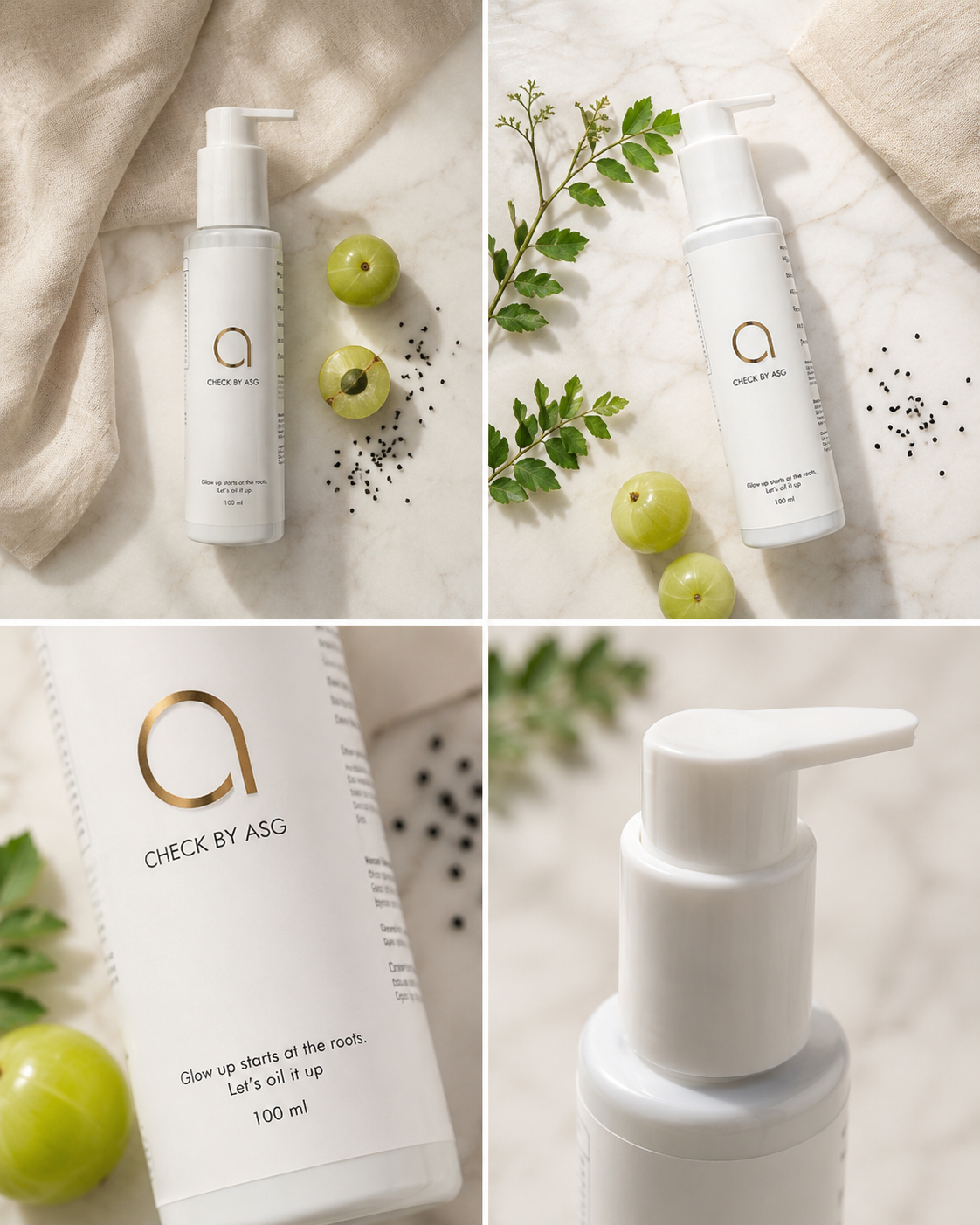
Onion hair oil benefits come down mostly to one element: sulphur. Hair is made of keratin, and keratin is one of the most sulphur-rich proteins in the body. The bonds that give a strand its strength are sulphur bonds. Onion is unusually high in sulphur compounds, and applied to the scalp it is traditionally used to strengthen and thicken thin hair and support growth.
Onion is in every second hair oil on the shelf now, often with claims that run well ahead of the evidence. This post goes through what sulphur actually does for a thinning strand, what the one small human study found, why onion juice and onion in oil are not the same thing, and the question everyone asks, which is whether it smells.
We use onion in our 17-Herb Hair Oil for the strand, and we pair it with herbs that do the other jobs. By the end you will know why.
Why sulphur matters for a thinning strand
A hair strand is a bundle of keratin proteins held together by several kinds of bonds. The strongest and most durable are disulphide bonds, which form between sulphur atoms in an amino acid called cysteine. They are what a chemical straightening breaks and re-forms, and what heat and bleach damage. A strand with its sulphur bonds intact is springy and hard to snap. A strand with them damaged is brittle, frizzy and breaks halfway.
Thinning hair is often two problems wearing one name. Fewer strands, which is a scalp and follicle matter. And thinner, weaker strands that break before they reach their full length, which is a shaft matter. Onion’s contribution is to the second. Its sulphur compounds, delivered to the scalp where new hair is being built, support stronger keratin. In practice, hair feels thicker because less of it is snapping off.
We are careful with the word thicken. Onion does not widen the follicle. It helps the strand that comes out of it hold together, which is a real and visible difference over two months, and a more honest one than most onion-oil marketing offers.
What the research actually says
There is one small human study that everyone in this market quotes, usually without saying how small it was. In 2002, researchers in Iraq had people with alopecia areata, a patchy autoimmune hair loss, apply raw onion juice to the scalp twice a day. After a few weeks, a majority of the onion group had hair growing back in the patches, compared with far fewer in a group using tap water. Around sixty people took part, and the condition they had is one that often comes and goes on its own.
So it is a genuine and interesting result, and it is a thin base for the claims built on it. Alopecia areata is not the diffuse thinning most people are oiling for, and the study used juice, not oil. We would also say plainly that alopecia areata needs a dermatologist, not a kitchen remedy.
Beyond that study, onion has lab-documented antimicrobial activity from its sulphur compounds and antioxidant activity from quercetin, a flavonoid it contains in good amounts. Both are plausible helps for the scalp. Neither has been tested on hair growth in a large human trial. That is where the evidence stands, and we have not seen any brand move it since.
Onion juice versus onion in oil
| Raw onion juice | Onion steeped in oil | |
|---|---|---|
| Strength of sulphur compounds | High, and volatile | Lower, gentler, more stable |
| Irritation | Common; stings on cuts, can redden a sensitive scalp | Uncommon; still patch-test |
| Smell | Strong, lingers for hours | Faint, usually hidden by other herbs |
| Convenience | Grate, squeeze, strain, every time | A pump |
| Shelf life | Same day | Months |
| Comes with | Nothing else | Carrier oil, massage, other herbs |
If you want the strongest possible dose and do not mind the rest, juice is it. For a habit you will keep for eight weeks, oil wins. The study’s result came from twice-daily application for weeks, which almost nobody sustains with a grater.
The 60-day rule. Stronger strands are built at the root and take weeks to grow out far enough to notice. One 100ml bottle lasts about four weeks. Most people see the difference at week eight. That is why we sell it as a pair: 2 × 100ml for ₹999, buy one get one free. Two bottles is one full cycle.
Who onion in hair oil suits most
People whose hair breaks. If the comb holds short pieces with no white bulb, your problem is the shaft, and sulphur is the right help. People with fine hair that has lost body. People who straighten, colour or heat-style and want the strand to hold up better between appointments.
It is less of an answer for hair fall from the root with a medical cause. Low iron, thyroid imbalance, PCOS and the months after childbirth all shed hair at the follicle, and no amount of sulphur on the scalp changes a blood test. Oiling is supportive in those cases and a doctor is essential. If you are not sure which kind of hair fall you have, our guide to the hair fall reasons dermatologists see most will help you tell.
Onion can irritate a sensitive scalp even in oil form. Patch-test on the inner arm for 24 hours, and if your scalp stings on application, stop. Apply with the three-minute scalp method, two or three times a week, 30 minutes to overnight, then wash.
Why onion should not be alone in the bottle
The single-ingredient onion oil is a marketing success more than a formulation one. Onion does one job well, strand strength, and nothing for a hot scalp, a blocked scalp, or a follicle that needs feeding. The reason classical oils are blends is that hair fall rarely has one cause.
In our oil, onion works beside bhringraj, which is traditionally used for density and growth, and brahmi, which supports the follicle and is the other herb we rely on for breakage. Amla brings vitamin C and antioxidants to the root. Castor and olive seal the ends, so the stronger strand onion helps build is also protected along its length. Neem and karanja keep the scalp clear enough for any of it to reach the skin. Jatamansi calms a stressed scalp. We list all 17 herbs and their percentages on our ingredients page.
We added onion after Apoorva tested the blend on herself for months in a Delhi kitchen and found the strands held up better with it. Her promise, that she would never ask you to use something she would not, is the reason it is in there at all. Her story is here.
And the smell
Raw onion juice smells of raw onion, for hours, and it comes back when the hair gets wet. Onion steeped slowly in oil, with no heat, is a different thing. The sharp volatile compounds are mostly what makes onion smell; the steeping mellows them, and in a blend with sixteen other herbs the result is a faint savoury note under the earthier smell of jatamansi, henna and bhringraj. Most people cannot pick the onion out.
We use no synthetic fragrance, so we have not covered anything up. If a hair oil smells of roses and claims a high onion content, something in that sentence is doing more work than the onion.
Frequently asked questions
Does onion oil help hair grow back?
One small 2002 study found raw onion juice helped hair grow back in people with patchy autoimmune hair loss, and onion is traditionally used for growth. That is a thin base. We describe onion as strengthening and thickening the hair you have, which is the effect people most reliably notice, and supporting growth beyond that.
Does onion hair oil smell of onion?
Raw onion juice does, strongly. Onion steeped slowly in oil and blended with sixteen other herbs smells faintly savoury under the earthier notes of jatamansi, bhringraj and henna. Most people cannot pick it out. We use no synthetic fragrance to cover it, so what you smell is simply the herbs.
Can I use raw onion juice instead of onion oil?
You can, and the study used juice. It is harsh on the scalp, stings on any small cut, smells for hours and has to be made fresh every time. Onion in oil is gentler, keeps, and comes with the massage and the other herbs. If you try juice, patch-test and do not leave it on longer than 30 minutes.
Is onion oil good for dandruff?
Onion’s sulphur compounds have some antimicrobial activity, which may help a scalp where flaking has a microbial cause. For dandruff, though, neem and karanja are the herbs we would lean on. Onion is in the blend for the strand, not the flakes.
Can onion oil cause hair fall at first?
The first two or three washes after starting any oiling routine can show more hair in the drain, because the massage and wash loosen hairs that were already about to fall. It settles within a couple of weeks. If the scalp burns or itches, that is a reaction, not shedding; stop and patch-test.
Onion earns its place in a hair oil for a specific, modest reason: sulphur for a stronger strand. It does not earn the claims printed on most bottles that carry it. Use it on the scalp, in a blend that does the other jobs, for eight weeks, and judge by the comb. If you want to start there, the two-bottle pair at ₹999 covers the full cycle.