
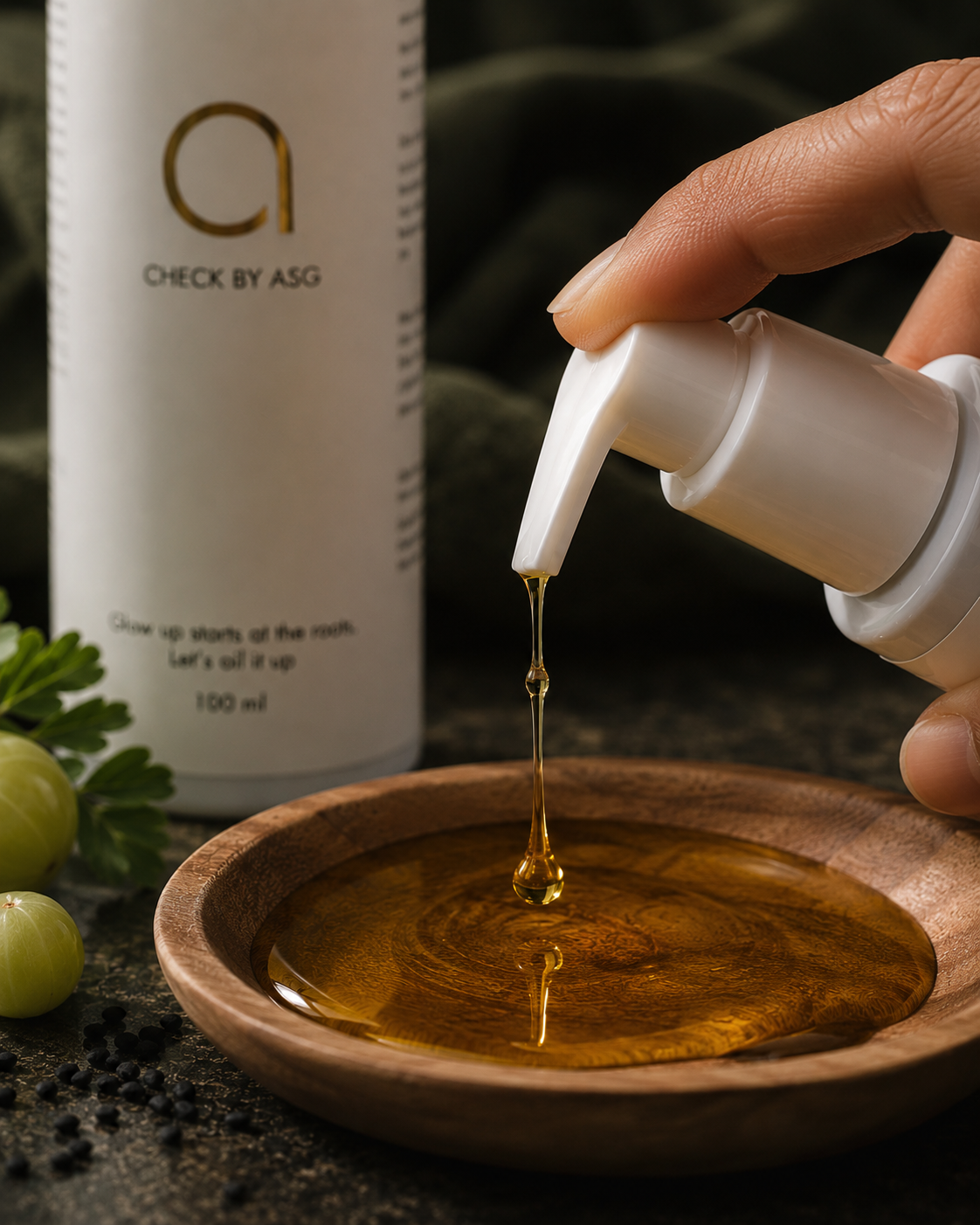
The shikakai benefits for hair that actually hold up are softness, fewer tangles, and a clean scalp that does not feel stripped afterwards. That is it. Shikakai is a conditioner before it is anything else, and for a few hundred years in south India it was the conditioner, long before anyone put one in a plastic bottle.
It is not a growth herb and it will not darken greys, whatever a label says. What it does is make hair that is already growing easier to live with: softer to the hand, smoother under the comb, and less likely to snap when you detangle it wet. If your main complaint is rough, knotty, dull hair rather than hair fall, shikakai is the herb to look for.
This is one of seventeen ingredients in our blend. For how they work together, see our complete guide to all 17 herbs in our hair oil.
Here is what it is, how it works, where it belongs in a routine, and the one or two things it is bad at.
What shikakai is
Shikakai is the dried pod of Acacia concinna, a thorny climbing shrub that grows across the warm parts of India. The name is usually traced to Tamil, where it means something close to “fruit for hair”, which tells you how long people have been using it for this.
The pods are rich in saponins, the same family of natural soap-like compounds found in reetha. Crushed and soaked, they produce a low, mild lather. Unlike most shampoos, that lather is gently acidic rather than alkaline, which is the reason shikakai cleans without roughing up the cuticle. Hair washed with it feels soft rather than squeaky, and that softness is not a coating left behind. It is simply the cuticle lying flat.
Our grandmothers in Chennai and Coimbatore soaked the pods overnight with reetha and dried amla, boiled the water in the morning, and used it as a wash. Many households still do. In an oil, shikakai plays a different role, which we will come to.
Shikakai as a wash versus shikakai in an oil
The same pod does two quite different jobs depending on how you use it.
| Shikakai wash (powder or decoction) | Shikakai infused in oil | |
|---|---|---|
| Main job | Gentle cleansing, replaces shampoo | Conditioning and softening the strand |
| Feel afterwards | Clean, soft, slightly matte | Smooth, more slip, glossy |
| Who it suits | Oily to normal scalp, fine to medium hair | Dry, rough, frizzy or colour-treated hair |
| Risk | Can dry out very dry hair if used alone and often; stings eyes | Minimal; patch-test as with any oil |
| Effort | Soak overnight, strain, messy to rinse | Two pumps, three minutes |
The honest summary: the wash is a wonderful thing if you have the patience, and the oil is how most people actually get shikakai into their week.
The benefits, ranked by how sure we are
1. Softness and fewer tangles
This is the one everybody notices and the one we are most confident about. Shikakai helps the cuticle lie flat, which is what “soft” means at the level of the strand. Flat cuticles slide over each other instead of catching, so there are fewer knots and less breakage when you comb. Many people feel this from the first few washes.
2. Cleansing that does not strip
The mild, slightly acidic lather lifts sweat, dust and excess sebum without taking the scalp’s own oils with it. This matters more than it sounds, because a stripped scalp overproduces oil to compensate, and that is how people end up washing every day. Shikakai breaks the loop.
3. A calmer scalp
Traditionally used for an itchy or flaky scalp, partly because it cleans well and partly because what it leaves behind is not irritating. Research here is limited. We would say it helps and leave it there.
4. Shine
A side effect of point one. Light bounces off a flat cuticle. No coating, no silicone, just the hair’s own surface behaving.
What it does not do
Shikakai does not grow hair. It does not darken grey. It does not stop hair fall that is coming from inside the body. If a product promises any of that on the strength of shikakai alone, be sceptical.
The 60-day rule. One 100ml bottle lasts about four weeks. Most people see the difference at week eight, though with shikakai the softness tends to arrive much sooner. That is why we sell it as a pair: 2 × 100ml for ₹1,999. Two bottles is one full cycle.
What shikakai is paired with in our oil
In our 17-Herb Hair Oil, shikakai is one of the conditioning herbs, the ones that look after the length of the hair while others look after the root. We list all 17 herbs and their percentages on our ingredients page. Its closest partners are:
- Reetha (soapnut), its traditional partner in every south Indian hair wash. Reetha does the cleansing and leaves no residue; shikakai does the softening. We go into it in our post on reetha for a clean scalp with zero residue.
- Amla (5%), the third member of the old trio, for vitamin C at the root and shine along the strand. Our post on amla oil for hair explains why we care about the root more than the strand.
- Heena (henna), for conditioning and a glossy finish, without staining at the quantities used in an oil. More on that in our post on henna in hair oil.
- Castor, which seals the ends shikakai has smoothed.
- Olive, a light emollient that locks moisture in.
Everything is cold-infused, with no heat, so the pods give up their compounds slowly into the base over days rather than being boiled. The result is an oil that leaves hair soft without feeling coated, which is the whole point of using shikakai rather than a silicone.
How to use shikakai
As part of an oil routine
Warm two or three pumps in your palms. Apply to the scalp first and massage in slow circles for two to three minutes. Then run whatever is left on your hands down the lengths, paying attention to the last few inches. Leave for 30 minutes or overnight, and wash with a mild shampoo. Two or three times a week is enough. The softening is cumulative; the ends in particular get better over a few weeks.
As a traditional wash
If you want to try the old way: soak a handful of shikakai pods and a few reetha with a spoon of dried amla in water overnight. Boil for ten minutes in the morning, cool, and strain. Pour over wet hair, work through the scalp with your fingertips, and rinse well. It will not lather like shampoo. It will clean. Keep it out of your eyes, because it stings badly.
A powder paste works too, mixed with water or curd, but it is harder to rinse out of long hair and tends to leave grit if you rush it.
Two cautions
First, shikakai used alone as a wash, several times a week, can be drying on hair that is already dry or chemically treated. Pair it with reetha and amla, or use it in oil form instead, where the base oil balances it.
Second, as with any plant, patch-test before you use a new product with it. Reactions are rare but real, and the fact that something has been used for centuries does not mean your skin has met it before.
Apoorva, who started Check by ASG in a Delhi kitchen after years of her father and grandfather oiling her hair on Sunday evenings, will tell you that shikakai is the smell of her childhood bathroom. It is in the blend because it earned its place, not because it is fashionable. You can read that story on our founder’s page.
Frequently asked questions
Is shikakai good for hair growth?
Not directly. Shikakai conditions and cleanses; it is not traditionally used for the follicle the way bhringraj or amla are. Hair that breaks less does get longer over time, so there is an indirect effect, but if growth is the goal, look for a blend that also has the root herbs.
Can shikakai replace shampoo completely?
For many people with normal or oily scalps, yes, especially combined with reetha. Very dry or chemically treated hair may find it drying if used alone. A reasonable middle path is a mild shampoo on most wash days and a shikakai wash once a week.
Does shikakai darken grey hair?
No. That is a common claim and there is nothing behind it. Shikakai can make hair look glossier and therefore slightly richer in tone, but it does not change pigment. Neeli indigo is the herb traditionally used for colour depth.
Is shikakai safe for colour-treated hair?
In oil form, yes. Its mild acidity actually helps keep the cuticle closed, which protects colour. As a frequent standalone wash it may be a little drying on bleached hair, so go gently. Our oil is suitable for colour-treated hair and contains no mineral oil or silicones.
How often should I use shikakai?
In an oil, two or three times a week along with the rest of your oiling routine. As a wash, once or twice a week is plenty. More than that is unnecessary and, on dry hair, counterproductive.
Shikakai will not transform your hairline, and we would rather tell you that than sell you on it. What it does is make hair soft, smooth and easy to comb, using a pod our grandmothers trusted, without a single silicone. If you want it in a full blend that looks after the root as well as the strand, the two-bottle pack is one eight-week cycle for ₹1,999.
All 17 herbs, in one bottle
Bhringraj, amla, brahmi and 14 more cold-infused herbs — our 17-Herb Ayurvedic Hair Oil is made for hair fall, thinning and slow growth.