
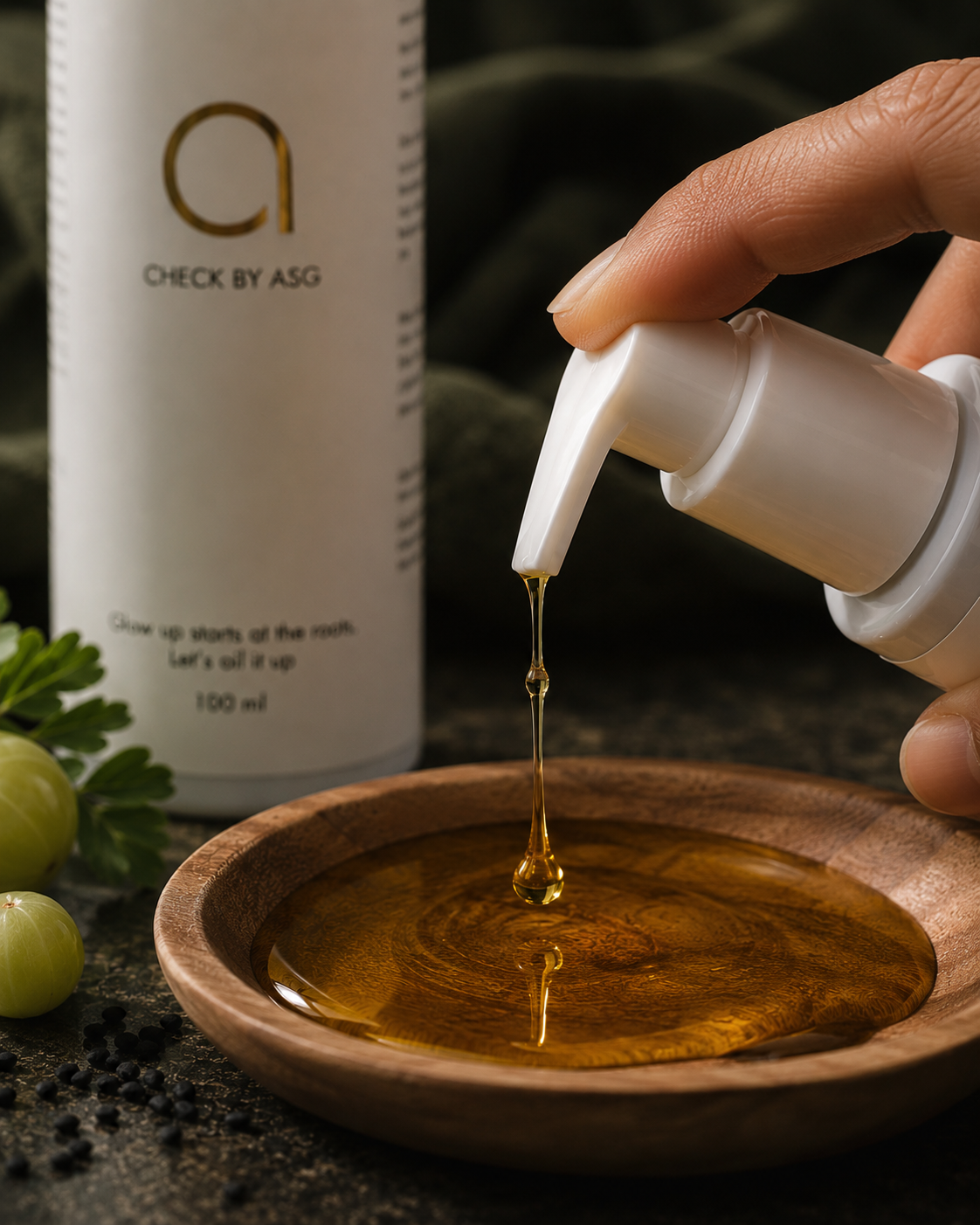
Jatamansi for hair is mostly about what stress does to the scalp. Nardostachys jatamansi, a root that grows above 3,000 metres in the Himalayas, is traditionally used to calm the mind and cool the skin, and in hair oil it is the herb for a hot, tight, stressed scalp and the shedding that follows a hard few months. It supports growth by settling the ground the hair grows from.
Most hair oils leave it out. It is slow-growing, protected, expensive, and it smells of earth rather than flowers. We use it at 5% anyway, because the scalps we hear about most are stressed ones.
This post covers what jatamansi is, why stress shows up on the scalp months after the stress itself, what the root does about it, and how to use it so it has a chance to work.
What jatamansi is
Jatamansi is the rhizome, the knotted underground stem, of a small flowering plant that grows on alpine slopes in Uttarakhand, Himachal, Sikkim and Nepal. The root is dark, hairy and strongly aromatic. In English it is Indian spikenard; the nard of ancient perfumery was most likely this plant, carried west along trade routes at a price that made it a luxury.
In Ayurveda it is classed as a medhya herb, one that supports the mind, and it is traditionally used for sleep, restlessness and a racing head. The classical hair preparations that include it, such as Nilibhringadi taila, use it alongside bhringraj and indigo for a cooling, calming blend.
Its chemistry is dominated by sesquiterpenes such as jatamansone, which have been studied in lab and animal settings for calming and anti-inflammatory activity. As with most herbs in this space, human hair studies are limited, and we will say so again before the end.
Why stress shows up on the scalp three months late
Here is the pattern we hear most often. A difficult quarter at work, an exam season, a breakup, a parent in hospital. Things settle. Then, eight to twelve weeks later, hair starts coming out in the comb in numbers that are hard to ignore.
This is telogen effluvium, and the delay is built into how follicles work. A sustained stress response pushes a larger-than-usual share of follicles out of their growth phase and into rest. Resting follicles hold the hair for about three months, then release it. So the shedding arrives after the stress has passed, which is why so many people cannot connect the two.
The scalp itself changes during this period too. It often feels hot, tight, or faintly sore, and sometimes itches without flakes. That is the scalp jatamansi is traditionally used for. If your hair fall came with other symptoms, or you are not sure stress is the cause, our guide to the hair fall reasons dermatologists see most will help you narrow it down.
What jatamansi does in a hair oil
It cools and settles the scalp
Ayurveda calls jatamansi cooling, and the skin agrees. Massaged in, it takes the heat out of a tight scalp within a few applications, which is the first thing most people notice. A calmer scalp sheds less, and a scalp that sheds less has more follicles available for the next growth phase. That is the honest mechanism: not forcing growth, but removing one of the brakes on it.
It supports growth, within limits
A small animal study found a jatamansi extract shortened the time for hair to grow back after shaving in rats, which is the same kind of early signal that exists for bhringraj. We have not seen a large human trial. So we describe jatamansi as supporting growth through scalp calm, and we do not describe it as a growth stimulant.
The smell is part of the point
Jatamansi smells of earth, musk and damp forest. It is not a fragrance most brands would choose. We kept it because the three minutes of massage are themselves a small calming ritual, and the scent makes that ritual land. People tell us it is the part of the week they look forward to. That matters more than it sounds.
Why most oils leave it out
Three reasons. It is costly, because it grows slowly at altitude and is a protected plant with regulated harvest. It is awkward to source well. And it does not smell like a shampoo advertisement. A brand optimising for price and shelf appeal will reach for something cheaper and sweeter, which is why jatamansi shows up at the bottom of long ingredient lists in trace amounts, if at all.
The 60-day rule. Stress shedding runs on a three-month clock, and recovery takes at least as long. One 100ml bottle lasts about four weeks. Most people see the difference at week eight. That is why we sell it as a pair: 2 × 100ml for ₹999, buy one get one free. Two bottles is one full cycle.
How to use jatamansi oil, and who it suits most
The method is the one we use for every herb in the blend: warm two or three pumps in your palms, press onto the scalp in sections, massage in slow circles for two to three minutes, leave for 30 minutes or overnight, wash with a mild shampoo. Two or three times a week. Our step-by-step guide to applying hair oil covers the details and the common mistakes.
With jatamansi specifically, we would add one thing. Do it in the evening. The scent and the massage make it a better wind-down than a morning rush, and a calmer night is part of what a stressed scalp needs.
Who it suits most: anyone whose hair fall followed a hard stretch; people whose scalp feels hot or tight; those in long exam or deadline seasons; and new mothers in the months after delivery, with the firm note that postpartum shedding is hormonal, oiling is supportive, and a doctor should be in the loop. The same applies to thyroid issues and low iron. Jatamansi calms the scalp. It does not change a blood test.
Jatamansi’s partners in the blend
Jatamansi settles the scalp. The herbs around it do the rest. Bhringraj, also at 5%, is traditionally used for density and growth, and the two have been paired in classical oils for centuries. Neeli indigo adds its own cooling and keeps dark hair looking deep. Brahmi supports the follicle and reduces breakage, and is itself a calming herb in the same tradition. Amla brings vitamin C and antioxidants to the root. Neem and karanja keep the scalp clear so the calming herbs are not working through buildup. Manjistha is traditionally used for scalp circulation.
We list all 17 herbs and their percentages on our ingredients page. If a hair oil you are considering lists jatamansi, it is worth asking how much. At trace levels, it is a word on a label rather than a herb in a bottle.
There is a personal reason jatamansi is in ours at 5%. Apoorva came back to India from the UK after her grandfather passed, and the months that followed were the kind that show up in the comb a season later. The brand’s motto, before waiting for someone else to check on you, learn to check on yourself, came out of that time. Her story is here.
Frequently asked questions
Is jatamansi good for hair growth?
It is traditionally used for it, and a small animal study found a jatamansi extract shortened the time for hair to grow back after shaving. Human research is thin. We describe it as supporting growth by calming the scalp, which is where its effect is most reliable.
Does jatamansi help with stress-related hair fall?
This is the use it is best known for. Stress shedding is a scalp that has been through a hard few months, and jatamansi is a cooling, calming herb for exactly that scalp. It supports recovery; it does not shorten the biological delay, which is roughly three months either way.
What does jatamansi smell like?
Earthy, musky, a little like a forest floor after rain. It is the dominant note in any oil that contains a meaningful amount of it. Some people love it at once; others take a week. We did not cover it with fragrance.
Can I use jatamansi oil every day?
You can, but two or three scalp massages a week do more than daily use. The herb works through the scalp over weeks, not through the quantity applied on any single day.
Is jatamansi safe during pregnancy or postpartum?
Applied to the scalp in a hair oil, it is generally considered gentle, but we are not doctors. If you are pregnant, breastfeeding or on medication, ask your doctor before starting any new herbal product, and patch-test first.
Jatamansi will not make hair grow faster than the follicle allows. What it does is quieter: it takes the heat out of a stressed scalp, turns three minutes of massage into something you want to do, and gives the next growth cycle a calmer place to start. If that sounds like the scalp you have, the two-bottle pair at ₹999 covers the full eight weeks.