
Hair fall after fever is one of the most common and least explained things that happens to a body. You recover from typhoid, dengue, COVID or a bad viral fever, feel fine for six to ten weeks, and then hair starts coming out in handfuls in the shower. It feels like a new illness. It is not. It is the tail end of the old one, and in almost every case it stops on its own.
The medical name is telogen effluvium. The fever pushed a large number of hair follicles into their resting phase at once, and those hairs are now being released on schedule, two to three months later. Oiling helps the scalp through it and keeps the hair that stays in better condition. It does not shorten the cycle, and anyone who tells you otherwise is selling something.
Here is why it happens, how to be sure, and what a sensible routine looks like for the next three months.
Why a fever makes hair fall months later
Every hair on your head is either growing (anagen), which lasts years, or resting (telogen), which lasts around three months before the hair sheds and a new one starts underneath. On a normal day roughly a tenth of your hair is resting, and the fifty to a hundred strands you lose daily are those hairs finishing their turn.
A high fever that lasts days and takes your appetite with it is a shock to the whole system. The body triages. Hair is not essential, so a much larger share of follicles than usual is switched from growing to resting at once. Nothing visible happens yet. About ten to twelve weeks later, all those resting hairs reach the end of their phase together and let go.
The hair is not damaged, the follicles are not dead, and the scalp is usually fine. It is a timing problem: too many hairs shedding at once because too many paused at once.
Typhoid, dengue, COVID, malaria: the same story
People in India ask about this most after typhoid and dengue, because both bring long, high fevers, and after COVID, because so many of us had it. The illness itself does not matter much. What matters is how high the fever ran, how long it lasted, how much weight you lost, and how stressed and under-fed the body was during recovery. A week of 103°F with no appetite will do it. A two-day mild viral may not.
Dengue clusters in the monsoon, so much of the shedding people notice in November and December in Delhi, Mumbai and Kolkata is from September’s fever. Typhoid hits the appetite for weeks, which adds a nutrition gap on top of the shock. COVID added the stress of the illness itself.
How to tell it is post-fever shedding and not something else
Telogen effluvium has a recognisable shape. Compare what you are seeing against this.
| Sign | Post-fever shedding | Something else to check |
|---|---|---|
| Timing | Started 2–3 months after the illness | Started gradually, no clear event |
| Pattern | All over the head, evenly, parting a little wider everywhere | Patches, or only the temples and crown |
| What comes out | Full-length hairs with a small white bulb at the root | Short broken pieces (breakage), or hairs with no bulb |
| Amount | Dramatic for 4–8 weeks, then eases | Steady and continuing past 6 months |
| Scalp | Usually normal, maybe slightly dry | Red, scaly, painful, or itchy |
Do the comb test. Run a clean comb through dry hair and look at what you get. If most of it is long strands with a tiny white bulb, that is resting-phase hair, and after a fever it is almost always this. Unsettling, and temporary.
If you were already under heavy stress before the fever, the two can stack. We explain the overlap in our post on stress hair fall and the three-month delay.
What oiling can and cannot do here
Oil cannot stop a telogen hair from shedding. That hair was released by the follicle weeks ago and is only held in place by friction. It is going to come out whether you oil or not, and in fact a gentle oil massage will often loosen a few more of them, which can be alarming on the first evening. That is not the oil causing hair fall. It is the oil bringing forward hair that was already gone.
What oil does is take care of the follicle and the scalp during the three months in which new hair is being made underneath. A scalp that is dry and tight after illness, which is common because people wash more and eat less during recovery, grows hair less comfortably than a scalp that is calm and supplied with blood. Slow massage supports circulation. Herbs like amla and bhringraj are traditionally used for the root. Aloe and olive keep the skin from drying. And doing something gentle, two or three evenings a week, is good for a person who has just been ill and is now watching their hair go.
The 60-day rule. One 100ml bottle lasts about four weeks. Most people see the difference at week eight, which for a post-fever shed is roughly when the loss slows and the new growth starts showing at the hairline. That is why we sell it as a pair: 2 × 100ml for ₹999, buy one get one free. Two bottles is one full cycle.
A gentle three-month routine
The scalp is fine; the body is recovering. Everything below is about being kind to both.
Weeks 1 to 4: during the heaviest shedding
Oil twice a week, not more. Warm two or three pumps in your palms, apply to the scalp with fingertips, and massage in slow circles for two minutes. Keep it light. Leave for 30 to 60 minutes and wash with a mild shampoo. No scrubbing, no hot water, no tight hairstyles. More hair in the drain on oil days is the already-shed hair coming out, and it is expected. If you have never oiled properly before, our guide to applying hair oil the three-minute way walks through it.
Weeks 5 to 8: as it eases
Move to two or three times a week. You can leave the oil overnight now if your scalp is dry. Around here many people notice short, soft new hairs at the hairline and parting. Those are the replacements. Leave them alone.
Weeks 9 to 12: recovery
Keep the routine. The new hairs are short and will take months to catch up, so the parting may still look thin even as the shedding stops. Density returns slowly.
Which herbs matter in this situation
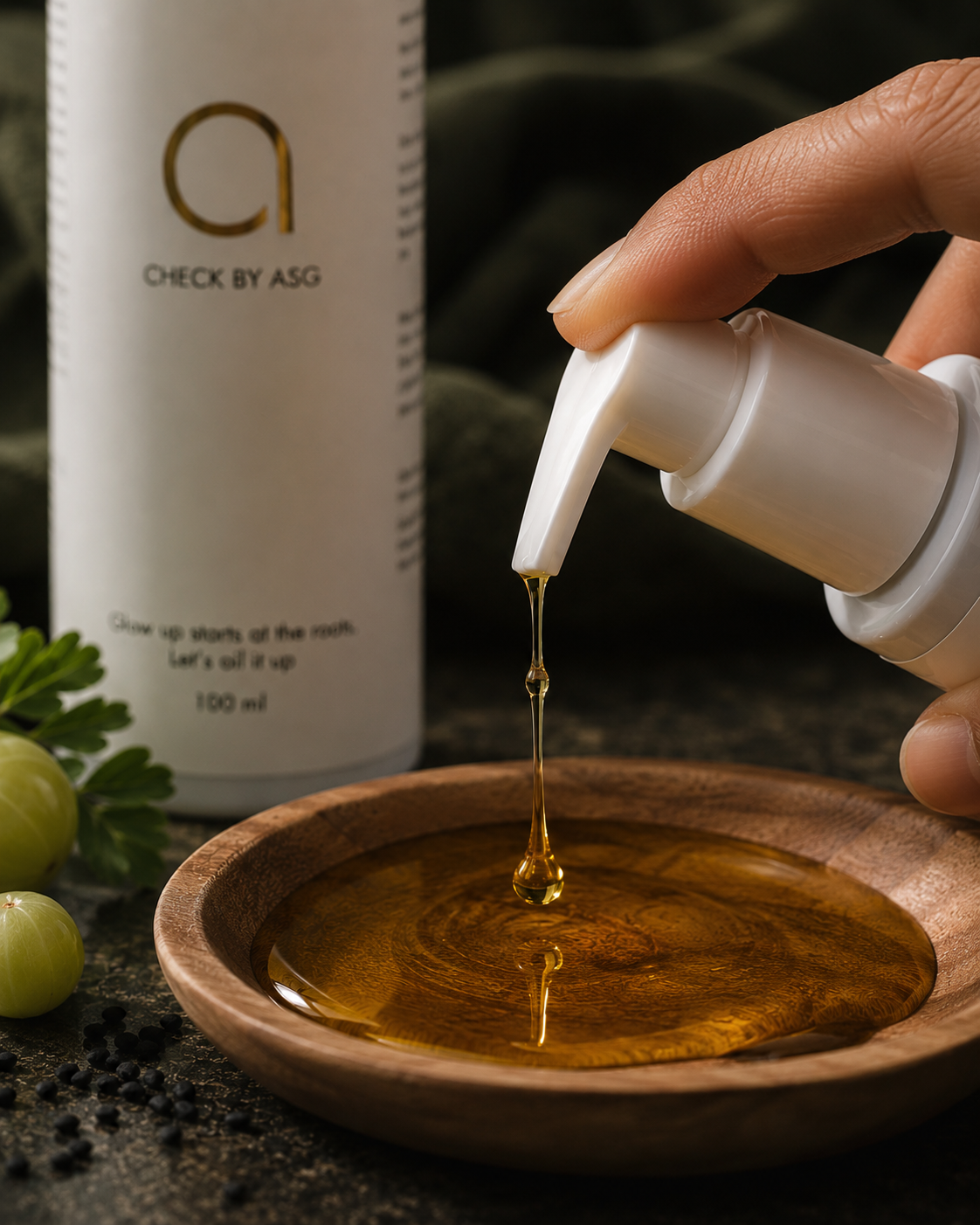
We built our 17-Herb Hair Oil to cover the scalp, the root and the strand at the same time, and after a fever all three need attention. Amla (5%) for vitamin C at the root. Bhringraj (5%) for density and the scalp. Jatamansi (5%) to calm a scalp that has been through a stressful few weeks. Brahmi for follicle support. Aloe vera and olive to keep a dry, post-illness scalp hydrated. We list all 17 herbs and their percentages on our ingredients page. The oil is cold-infused without heat, handmade in small batches, and free of mineral oil, silicones and synthetic fragrance, which matters when the scalp is already a little sensitive.
Eat for the hair you are growing now
The hair you will have in six months is being built this month, out of what you eat this month. Fever and the weeks after are usually a nutritional hole: no appetite, khichdi and toast, maybe weight loss. Restarting follicles need protein and iron.
Get a protein source at every meal (dal, eggs, paneer, curd, chicken, fish), eat iron-rich food with something sour to help absorption, and do not skip meals to catch up on missed work. If you were already borderline on iron before the fever, this is when it shows. Our post on iron deficiency and hair fall in Indian women goes deeper.
When to see a doctor
Most post-fever shedding resolves by itself within three to six months and needs nothing from a doctor beyond patience and decent food. See a doctor, and ask for a blood test that covers haemoglobin, ferritin, thyroid, vitamin D and B12, if any of these apply:
- The shedding is still heavy six months after the illness
- Hair is coming out in patches rather than evenly
- The scalp is red, scaly, painful, or has sores
- You feel unusually tired, cold, or have noticed weight or period changes
- You had hair fall before the fever and it has simply got worse
A fever can uncover an iron or thyroid problem that was quietly there already. Oiling supports recovery in every one of those cases. It does not replace the test. Apoorva, our founder, started this brand in a Delhi kitchen with one promise: if she would not use it, she would never ask you to. The same honesty applies to what we claim it can do. There is more of that story on our founder’s page.
Frequently asked questions
How long does hair fall last after typhoid or a viral fever?
Shedding usually begins two to three months after the illness, is heaviest for four to eight weeks, and then eases. Most people are back to normal shedding within six months of the fever. Regaining the lost density takes longer because new hair grows about a centimetre a month.
Will the hair grow back after post-fever hair fall?
In telogen effluvium the follicles are resting, not dead, so new hair grows in as the shed hair leaves. If you look closely at the hairline around month three, you can usually see the short new growth coming in.
Does oiling make post-fever hair fall worse?
No. A gentle massage may bring out hairs that were already released by the follicle and only held by friction, which can look like more loss on oil days. It is the same hair that would have come out in the next wash. Keep the massage light and avoid pulling.
Can I use hair oil after COVID?
Yes. Post-COVID shedding follows the same telogen effluvium pattern and the same gentle routine applies. Keep to a mild blend without synthetic fragrance, since some people find their scalp more sensitive for a while after the illness, and patch-test first.
Hair fall after a fever is the body catching up on a pause it took while it was busy keeping you alive. It is frightening and it is temporary. Eat properly, be gentle with the scalp, and give the new hair twelve weeks of calm to come in. If you want a blend to do that with, the two-bottle pack is one full eight-week cycle for ₹999.