
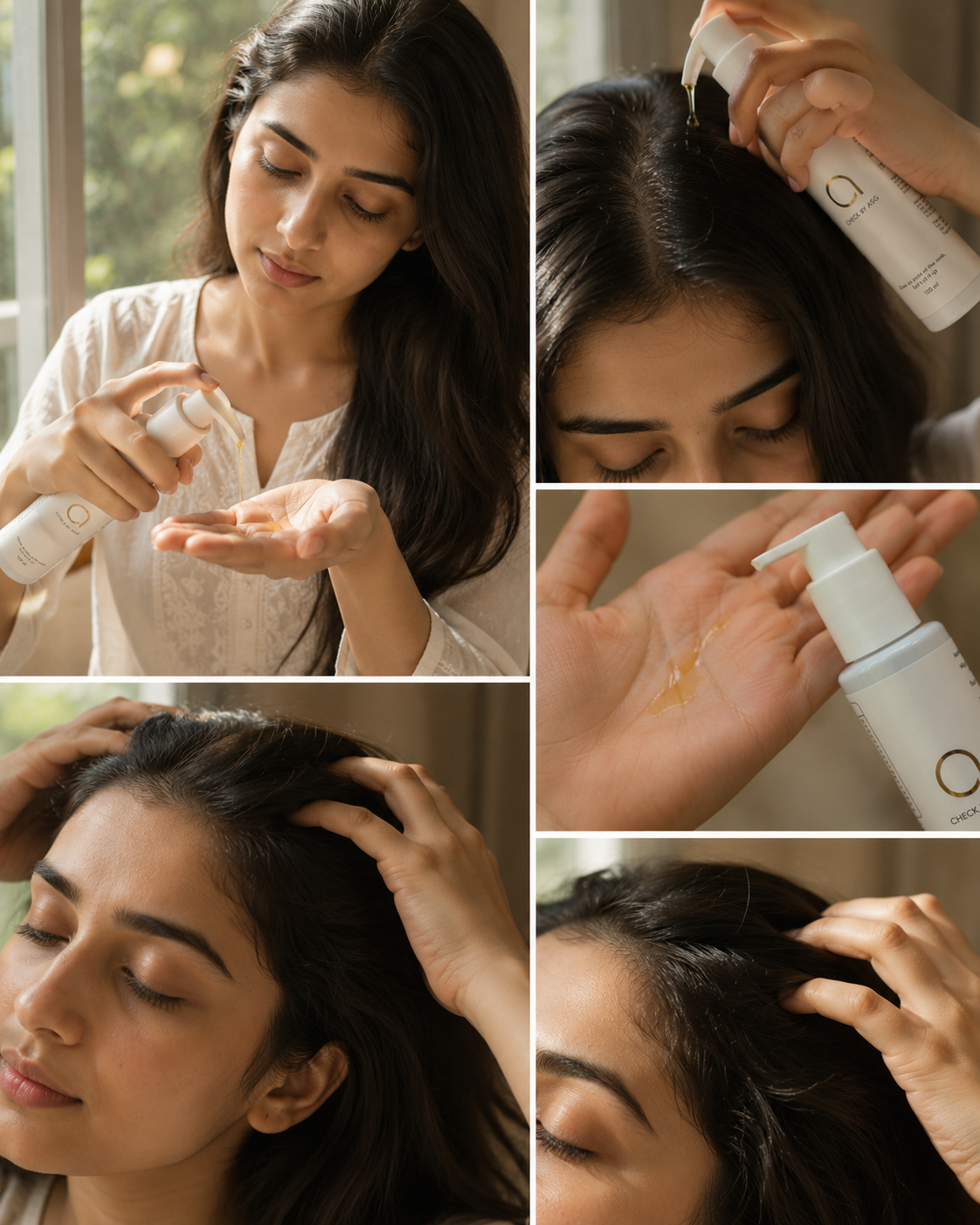
Dandruff vs dry scalp is the most common mix-up in Indian bathrooms, and getting it wrong is why so many routines fail. Dandruff flakes are oily, yellowish, larger, and come with an itchy, sometimes greasy scalp. Dry scalp flakes are small, white and powdery, and the scalp feels tight rather than greasy. They look similar on a black shirt. They are nearly opposite problems.
The difference matters because the fix for one makes the other worse. Heavy overnight oiling soothes a dry scalp and feeds dandruff. A strong anti-dandruff shampoo calms dandruff and strips a dry scalp raw. So before any routine, you need to know which one you have.
For the wider picture, our guide to the most common hair fall reasons explains how to tell one cause from another.
Here is how to tell in a week, what each one is actually caused by, and the oiling routine we would suggest for each.
Dandruff and dry scalp side by side
| Dandruff | Dry scalp | |
|---|---|---|
| Flake size and colour | Larger, yellowish or off-white, sometimes clumped | Small, white, powdery |
| Flake texture | Oily, sticks to the scalp and hair | Dry, falls away easily |
| How the scalp feels | Itchy, often greasy by day two | Tight, itchy, sometimes stings after washing |
| Where else it shows | Eyebrows, sides of the nose, behind the ears | Dry skin on arms, legs, face |
| When it is worse | Humidity, sweat, stress, skipped washes | Winter, air conditioning, hot water, harsh shampoo |
| Response to oil | Often worse after heavy oiling | Better within a day or two |
| Likely cause | Excess sebum plus a yeast called Malassezia | Low moisture in the skin, a stripped barrier |
If most of your ticks land in the left column, you have dandruff, which dermatologists usually file under mild seborrhoeic dermatitis. If they land on the right, your scalp is dry, in the same way the skin on your shins goes dry in a Delhi January.
The one-week test
If the table leaves you unsure, run this. It costs nothing and it is more reliable than guessing.
- Wash your hair with a mild shampoo on a Sunday. Do not condition the scalp.
- On Sunday night, apply a light cold-infused oil to the scalp only, massage for two minutes, and leave it overnight.
- Monday morning, before washing, look at the scalp in good light and run a comb through over a dark towel.
- If the flakes are fewer and the scalp feels calmer, it was dry. Moisture helped.
- If the flakes are the same or worse and the scalp feels greasier and itchier, it is dandruff. The oil fed the yeast.
Repeat once more midweek if the first result was ambiguous. Two readings are enough. This is the whole idea behind the Check by ASG name and Apoorva’s line about learning to check on yourself before waiting for someone else to; you can read that story behind the brand if you are curious. A week of paying attention tells you more than a month of guessing.
Why the wrong routine makes it worse
Malassezia is a yeast that lives on every scalp. It feeds on the fatty acids in sebum. On an oily scalp it multiplies, and the by-products it leaves behind irritate the skin, which sheds faster than it should. That is a dandruff flake. Add a thick coat of oil overnight and you have given the yeast a buffet.
A dry scalp has the opposite problem. The skin barrier has lost moisture, usually from hot water, strong surfactants, winter air or air conditioning. It flakes because it is cracking, not because anything is growing on it. Reach for a medicated anti-dandruff shampoo, which is built to strip sebum and suppress yeast, and you remove what little oil the scalp had left.
So the sequence is: identify first, then choose. We cover the neem side of this in detail in our post on neem for scalp, dandruff, itch and buildup.
The 60-day rule. One 100ml bottle lasts about four weeks. Most people see the difference at week eight. That is why we sell it as a pair: 2 × 100ml for ₹1,999. Two bottles is one full cycle. Whichever scalp you have, the routines below run on the same bottle; only the timing changes.
Oil routine for a dry scalp
The goal is to put moisture back and stop stripping it out. Oil is your friend here, and more of it is fine.
Oil two or three times a week. Warm a few pumps in your palms, massage the scalp in slow circles for two to three minutes, and leave it overnight. The longer sit lets the lighter oils, olive and aloe vera, settle into the skin. A Sunday evening and a Wednesday evening is a rhythm most people can keep.
Wash with lukewarm water, not hot. Choose a mild shampoo, or alternate with a reetha and shikakai soak. Shampoo once, not twice. Skip clarifying shampoos entirely until the scalp settles.
Inside the blend, the herbs doing the work for a dry scalp are aloe vera at 2% for hydration, olive to lock moisture in, castor to seal the ends, shikakai to soften, and jatamansi to calm the tight, prickly feeling. If overnight oiling is new to you, our post on overnight hair oiling, its benefits and who should skip it covers the pillow logistics.
Many people notice the tightness ease within a week. Flaking takes two to three weeks to settle, because the skin that is already damaged has to shed before the new layer shows.
Oil routine for dandruff
The goal is a clean scalp with less for the yeast to eat, and herbs that are traditionally used to keep it that way. Oil still helps, but the method changes.
Oil two or three times a week, but leave it for 30 to 45 minutes, not overnight. Massage the scalp for two to three minutes to loosen the flakes that are stuck down, then wash thoroughly. The point of the oil here is the herbs, not the moisture, and the short sit gives them time to work without giving the yeast a night to feed.
Wash fully. Reetha in the blend helps the oil lift in one go, so you should not need to shampoo twice. If your dandruff is moderate or stubborn, alternate your normal shampoo with a medicated one containing ketoconazole or zinc pyrithione, which are the two ingredients with the strongest evidence. Oil on an oiling day, medicated wash on a non-oiling day.
The herbs relevant here are neem for purifying and itch, karanja for buildup and irritation, nimbu to balance excess oil, and reetha for a residue-free rinse. Our dedicated post lays out a four-week neem and karanja dandruff routine step by step.
Expect itch to ease first, usually within one to two weeks. Flakes take longer, and dandruff tends to come and go with weather and stress, so this is maintenance rather than a one-time fix.
The herbs, and when to see a doctor
Our 17-Herb Hair Oil was built so one bottle could serve both scalps. Neem, karanja, nimbu and reetha look after an oily, flaky scalp. Aloe vera, olive, castor, shikakai and heena look after a dry one. Underneath both sit the root herbs, bhringraj, amla, jatamansi and manjistha, which are about growth rather than flakes. We list all 17 herbs and their percentages on the ingredients page.
Some scalps are neither. If you see thick silvery scales, red raised patches, flakes that extend onto the forehead or neck, weeping or crusting, or hair fall in defined patches, that is beyond dandruff and beyond dry scalp. Psoriasis, a fungal infection and some forms of eczema all mimic dandruff and need a dermatologist, not an oil. Oiling is supportive in all these cases, and it is not a diagnosis.
Frequently asked questions
How do I know if I have dandruff or a dry scalp?
Look at the flakes. Dandruff flakes are larger, oily and yellowish, on a scalp that feels greasy and itchy. Dry scalp flakes are small, white and powdery, on a scalp that feels tight. If still unsure, oil overnight once: a dry scalp improves, dandruff does not.
Does oiling make dandruff worse?
Heavy overnight oiling can, because the yeast behind dandruff feeds on oil. A short 30 to 45 minute oiling with herbs like neem and karanja, washed out fully, is a different thing and many people find it helps.
Can I use the same oil for dandruff and dry scalp?
Yes, if the blend covers both, which ours is built to do. What changes is how long you leave it on and how you wash. Overnight for a dry scalp, under an hour for dandruff.
Why is my dandruff worse in the monsoon?
Humidity and sweat raise sebum on the scalp and give the yeast more to feed on. Wash more often in the monsoon, keep oiling sessions short, and dry your hair fully before tying it up.
When should I see a dermatologist?
If flakes are thick and silvery, the scalp is red or weeping, the problem spreads to your face or neck, or hair is falling in patches. Also if six to eight weeks of a sensible routine has changed nothing.
Most flaky scalps are one of two simple things, and a week of honest looking will tell you which. Pick the routine that fits, give it a full cycle, and adjust with the seasons. If you want one bottle that can do both jobs, two bottles for ₹1,999 gives you the eight weeks it takes to see.
All 17 herbs, in one bottle
Bhringraj, amla, brahmi and 14 more cold-infused herbs — our 17-Herb Ayurvedic Hair Oil is made for hair fall, thinning and slow growth.