
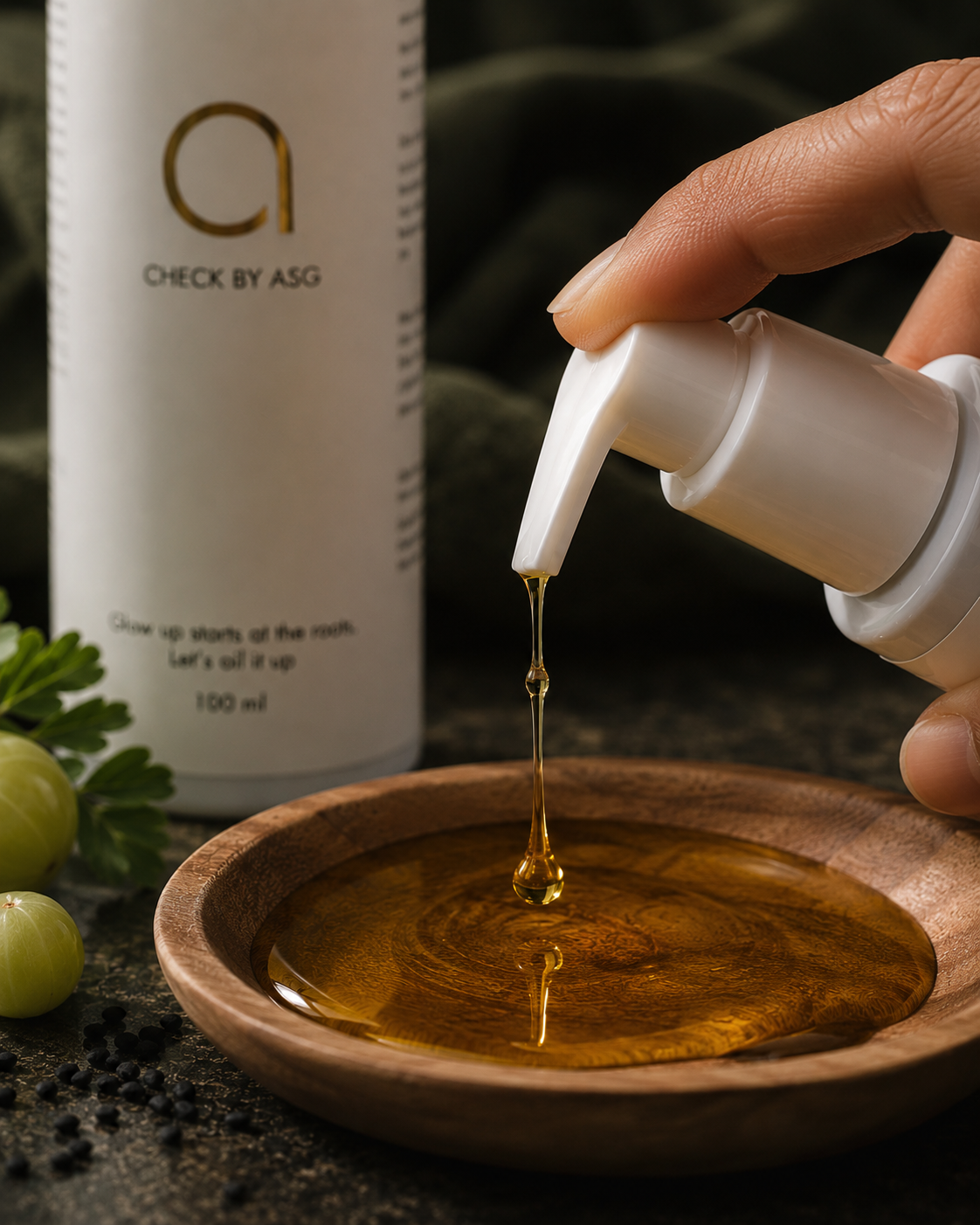
Karanja oil for hair is the herb nobody puts on the front of the bottle. It does not promise growth, shine or colour. What karanja does is quieter: it helps keep the scalp clear of buildup and protected from the everyday irritation of dust, sweat, sun and city air. In a blend built around growth, it is the herb that keeps the ground clean so growth can happen.
Karanja is the seed oil of the Pongamia tree, a hardy native of the Indian plains that you have probably walked under without noticing. It has been used on skin for centuries, usually alongside neem, and the two are often confused. They are cousins, not twins.
This is one of seventeen ingredients in our blend. For how they work together, see our complete guide to all 17 herbs in our hair oil.
This post covers what karanja is, what it does on the scalp, how it differs from neem, what the research honestly says, and how we use it in our 17-Herb Hair Oil.
What karanja is
Karanja is Pongamia pinnata, sometimes listed as Millettia pinnata, a medium-sized tree with glossy leaves and clusters of pale pink flowers that line roads across Maharashtra, Karnataka, Tamil Nadu and the Gangetic plain. It is planted for shade and for its seeds, which are pressed into a thick, amber-to-brown oil with a strong, bitter smell.
That smell is the first thing anyone notices about pure karanja oil, and it is why nobody uses it neat on their hair. The oil is rich in flavonoids, especially two called karanjin and pongamol, which are the compounds most of the traditional uses are built around. In Ayurveda and in village practice, karanja oil went on skin that was itchy, flaky or bitten, and it was rubbed into the scalp when neem alone was not enough.
What karanja does on the scalp
It helps clear buildup
Buildup on a scalp is a mix of dead skin, dried sebum, sweat salts, dust and the leftovers of styling products. It sits in and around the follicle opening and, over weeks, makes the scalp feel coated and the hair feel flat at the root. Karanja is traditionally used to loosen this layer so it washes away, which is why it pairs well with reetha in the same bottle.
It helps protect from irritation
A scalp that reacts easily, to heat, sweat, a new shampoo, or a motorcycle helmet worn through a Mumbai summer, is a scalp with a tired barrier. Karanja has a long tradition of use on reactive skin, and the flavonoids it carries are studied for soothing and antioxidant activity. In our experience it is the herb that makes the oil feel calming on a scalp that stings.
It is traditionally used against the things that live on skin
Karanja oil is a common ingredient in natural insect repellents and in veterinary skin preparations, and lab work has looked at its activity against several microbes. Whether that carries over to the yeast behind dandruff on a human scalp is not well studied. We include it for buildup and irritation first, and regard any effect on flakes as a bonus.
It sits on the scalp through a city day
Pongamol, one of karanja’s main flavonoids, has been examined for its ability to absorb part of the UV spectrum, and karanja oil shows up in some natural sun-care formulations for that reason. We are not calling our oil a sunscreen, and you should not either. But a herb that is at home in sun and pollution is a reasonable one to have on a Delhi scalp. We go into the city side of this in our post on hair fall from pollution in Delhi, Mumbai and Bengaluru.
Karanja vs neem: cousins, not twins
Both are bitter Indian tree oils with a reputation for skin. Both show up in the same traditional recipes. Here is how we think about the difference.
| Karanja | Neem | |
|---|---|---|
| Source | Seed of Pongamia pinnata | Seed and leaf of Azadirachta indica |
| Key compounds | Karanjin, pongamol (flavonoids) | Azadirachtin, nimbin, nimbidin |
| Traditional scalp use | Buildup, irritation, reactive skin | Dandruff, itch, purifying |
| Smell | Strong, bitter, nutty | Strong, bitter, garlicky |
| Feel on scalp | Thicker, more emollient | Lighter, more drying |
| Best for | A scalp that stings and feels coated | A scalp that itches and flakes |
In practice they work better together than apart. Neem handles the itch and flake side; karanja handles the coating and the reactivity. Our post on neem for scalp, dandruff, itch and buildup covers the other half of the pair.
The 60-day rule. One 100ml bottle lasts about four weeks. Most people see the difference at week eight. That is why we sell it as a pair: 2 × 100ml for ₹1,999. Two bottles is one full cycle. Scalp herbs like karanja are the ones you stop noticing first, because a calm scalp is a quiet one.
What the research says
We want to be straight about this. Most published work on karanja looks at the oil as a biodiesel feedstock, as an insect repellent, or in lab studies of its flavonoids. There is a modest body of research on karanjin and pongamol for skin, including antioxidant and anti-inflammatory activity in cell and animal models. Human studies on karanja oil for scalp or hair are limited, and we have not found a trial that measures hair growth with karanja alone.
So we do not claim growth from karanja. We claim what tradition claims and what the chemistry supports: a herb traditionally used to keep skin clear and calm, with compounds that are plausibly useful on a scalp exposed to sun and dust. That is enough reason to include it, and not enough reason to put it on the label as a hero.
Karanja in the blend
Karanja is one of five herbs in our oil whose job is the scalp surface. Neem purifies and settles itch. Nimbu, or lemon, balances a scalp that over-produces oil. Reetha cleans without residue. Karanja clears buildup and keeps irritation down. Between them, they prepare the ground.
Below that layer are the root herbs, bhringraj at 5%, amla at 5%, jatamansi at 5% and manjistha, which are the ones that support growth and density. Above it sit the conditioners, aloe vera, shikakai, heena, olive and castor. We list all 17 herbs and their percentages on the ingredients page.
Karanja is a small part of the blend by volume, and that is deliberate. On its own the oil is too thick and too strongly scented to wear. Cold-infused with sixteen other herbs it becomes a note rather than a shout, and the blend stays light enough to wash out in one go. If you are building a dandruff routine around these herbs, we laid one out in our four-week neem and karanja routine.
How to use it, and who should be careful
Karanja works best with contact time and a thorough wash. Warm a few pumps in your palms, massage the scalp in slow circles for two to three minutes, and leave it for 30 minutes or overnight. If your scalp is oily or flaky, keep it to 30 to 45 minutes. Wash fully. Two or three times a week is enough. One 100ml bottle lasts about four weeks, and results typically show at six to eight weeks. Patch-test first.
Pure karanja oil is a different matter. If you buy it neat from a local shop, dilute it heavily in a carrier oil, use it only on the scalp, and expect the smell to linger. We would not recommend it undiluted on skin, and never near the eyes.
People with very sensitive skin or a history of reacting to tree-nut oils should patch-test with extra care. If your scalp is red, broken, weeping or losing hair in patches, see a dermatologist before using any oil; karanja is supportive, not a diagnosis. And if the hair fall itself is the worry, a blood test for thyroid, iron and vitamin D tells you more than any herb can.
Apoorva did not grow up with karanja by name. She grew up with the oil her grandfather warmed in a steel katori, and only later, in a Delhi kitchen, found out which herbs were in it. Karanja was one of them, and the story of how that bottle became Check by ASG is on our site.
Frequently asked questions
Is karanja oil good for hair growth?
Not directly. Karanja is traditionally used for the scalp surface, to clear buildup and calm irritation. Growth support in our blend comes from bhringraj, amla, jatamansi and manjistha. A clear scalp is the ground they work on.
Does karanja oil help with dandruff?
It may help, mainly by clearing the buildup that flakes stick to and by calming a reactive scalp. Neem carries more of the dandruff tradition, and the two work best together. Severe or persistent dandruff needs a dermatologist.
Does karanja oil smell?
Neat, yes, strongly. In a cold-infused blend of 17 herbs it is a faint bitter note under the others and does not linger after washing.
Can I apply pure karanja oil to my scalp?
We would not. It is thick, strongly scented and can be too much for sensitive skin. Dilute it well in a carrier oil, or use a blend where it is one herb among many.
Is karanja safe for colour-treated hair?
Yes. Our oil is made for all hair types including colour-treated, and contains no mineral oil, silicones or synthetic fragrance.
Karanja is the herb you will never notice, which is the point. A scalp that is clear and calm does not announce itself; it simply stops interrupting. If you want to give it a full cycle alongside the other sixteen, two bottles for ₹1,999 is the eight weeks it takes.
All 17 herbs, in one bottle
Bhringraj, amla, brahmi and 14 more cold-infused herbs — our 17-Herb Ayurvedic Hair Oil is made for hair fall, thinning and slow growth.