
Castor oil for hair growth is one of the most searched phrases in Indian hair care, and the honest answer is that castor does not grow hair. There is no good human study showing it does. What castor oil does, and does very well, is seal the ends, add shine, and cut breakage, so hair that is already growing keeps its length instead of snapping off. Over a few months that looks like growth. It is really retention.
That is why castor is in our 17-Herb Hair Oil, in a measured amount, at the strand end of the formula. It is also why we would never sell castor on its own. Neat castor oil is too thick to massage into the scalp properly, too hard to wash out, and in the wrong hands it causes the exact problems people are using it to fix.
This is one of seventeen ingredients in our blend. For how they work together, see our complete guide to all 17 herbs in our hair oil.
Here is what it does, what it does not, and the right way to use it.
What castor oil actually is
Castor oil is pressed from the seeds of Ricinus communis, the arandi plant, which grows wild along roadsides across Gujarat, Rajasthan and Andhra Pradesh. India produces most of the world’s supply. The oil is unusual because almost all of it is a single fatty acid, ricinoleic acid, which is what makes it so thick and sticky compared with coconut or olive. That thickness is the whole personality of the oil, for better and worse.
You will see two kinds sold. Cold-pressed castor oil is pale and relatively clean-smelling. “Jamaican black” castor oil is made from roasted seeds and comes out dark and smoky. They behave similarly on hair; the difference is mostly marketing and smell.
What it does for hair
Castor is a humectant and an occlusive at the same time. It draws a little moisture toward the hair and then seals it there under a heavy film. On the last few inches of hair, which are the oldest, driest and most damaged part of every strand, that is exactly what you want. The ends stop fraying, splits are slowed, and the hair reflects light again.
Less breakage at the ends means hair holds its length. If you have been stuck at shoulder length for years because the ends keep snapping, a bit of castor on the ends is a real help. That is the retention effect, and it is the honest version of the growth claim.
On the scalp, castor has a traditional reputation for thickening hair, and ricinoleic acid has some anti-inflammatory activity in laboratory work. We would not say more than that. Research on castor and the follicle is limited, and the thick texture makes it a poor carrier for a scalp massage on its own.
Why castor should not be used alone
| Neat castor oil | Castor in a balanced blend | |
|---|---|---|
| Texture | Very thick, sticky, hard to spread; tends to sit on top of the scalp | Thinned by lighter oils, spreads and absorbs |
| Washing out | Often needs two or three shampoos, which strips the scalp and dries the hair | Washes out with one mild shampoo |
| Buildup | Common with regular use; hair goes limp and dull | Minimal at the proportion used |
| Tangling | Can glue strands together; there are case reports of long hair matting into a felt after heavy castor use | Not an issue |
| Scalp massage | Too heavy to do a proper fingertip massage; drag pulls hair | Massage is comfortable and the circulation benefit is real |
| Scalp herbs | None; it is one oil doing one job | Bhringraj, amla, jatamansi and the rest work on the root while castor works on the ends |
The pattern we see most often is someone who read that castor grows hair, used it neat twice a week on the scalp, needed three shampoos each time to get it out, and ended up with a drier, more irritated scalp and more breakage than before. The oil was not the problem. The dose and the method were.
The 60-day rule. One 100ml bottle lasts about four weeks. Most people see the difference at week eight, and with castor the first sign is usually ends that stop splitting. That is why we sell it as a pair: 2 × 100ml for ₹1,999. Two bottles is one full cycle.
Where castor sits in our blend
Think of a hair oil as having three jobs: the scalp, the root, and the strand. Castor is a strand herb. In our 17-Herb Hair Oil it is there to seal the ends and give a glossy finish, while other ingredients handle what castor cannot. We list all 17 herbs and their percentages on our ingredients page. Its closest neighbours are:
- Olive, the light emollient that locks moisture into the mid-lengths without weight. Castor seals, olive softens. Our post on what olive oil is doing in an Ayurvedic blend explains why.
- Shikakai and heena, which condition the shaft so the cuticle lies flat under castor’s seal.
- Bhringraj (5%) and amla (5%), the root herbs that are traditionally used for density and growth, which is the part people wrongly expect castor to do. See our post on bhringraj for hair.
- Onion, for sulphur, which supports the keratin hair is built from.
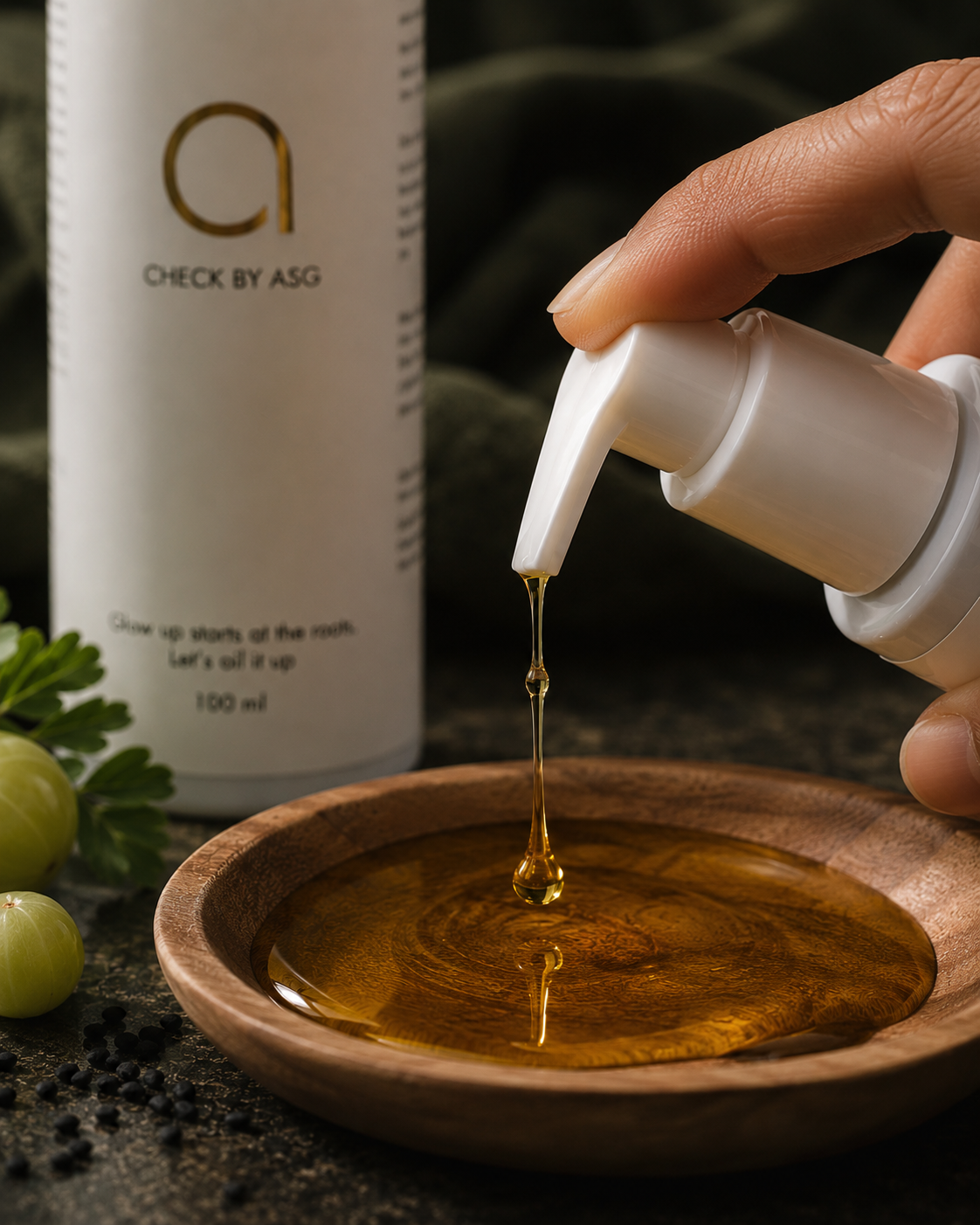
The whole blend is cold-infused, with no mineral oil, silicones or synthetic fragrance. The result pours from a pump and massages into the scalp like a light oil, while still carrying enough castor to do its job on the ends. That balance is the reason a multi-herb blend tends to outperform any single oil used neat, which we go into in our post on 17-herb oil versus single-ingredient oils.
How to use castor oil the right way
If you are using a blend that contains it
Warm two or three pumps in your palms. Scalp first: fingertips, slow circles, two to three minutes. Then run what is left on your hands down the lengths, spending the most time on the last few inches. Do not add more oil for the ends; the residue is enough. Leave for 30 minutes or overnight with a loose plait, then wash once with a mild shampoo. Two or three times a week.
If you insist on neat castor oil
Keep it to the ends only. Dilute it one part castor to two or three parts olive or coconut. Use a small amount, the size of a one-rupee coin for shoulder-length hair, and apply to the last two inches an hour before washing. Never on the scalp neat, never overnight on long hair, and stop if your hair starts to tangle more than usual. Patch-test, as with any plant oil.
When castor is not what you need
If your hair is falling from the root, with a small white bulb on each strand, castor is not the herb for you. That pattern points to shedding, which has causes inside the body: stress, a fever a few months back, low iron, thyroid, hormones, pregnancy. Sealing the ends does nothing about any of those. Oil the scalp with a blend that has the root herbs, by all means, and get a blood test if it has lasted more than three months.
Apoorva, who started Check by ASG in a Delhi kitchen, grew up with castor oil in the house and will tell you it was never used alone there either. It went into the blend her father and grandfather warmed on Sunday evenings, in the proportion that did the job and no more. You can read that story on our founder’s page.
Frequently asked questions
Does castor oil really make hair grow faster?
No good human evidence shows castor speeds growth. What it does is cut breakage at the ends, so hair keeps its length and appears to grow faster over a few months. The growth rate itself, about a centimetre a month, does not change.
Can I leave castor oil in my hair overnight?
In a balanced blend, yes, with a loose plait. Neat castor overnight on long hair is a bad idea; it is difficult to wash out and can tangle or mat the hair. If you use it neat, keep it to the ends and an hour before washing.
Is castor oil good for a receding hairline?
Not on its own. A receding hairline in men is usually hormonal and needs a dermatologist’s input. Castor can make the hair that remains look healthier and shinier, but it does not act on the cause.
Why does my hair feel worse after using castor oil?
Almost always because it was used neat, on the scalp, and needed several shampoos to remove. That strips the scalp’s own oil and leaves hair dry and limp. Switch to a blend where castor is one ingredient among many, and wash once with a mild shampoo.
Which is better, castor oil or coconut oil for hair?
They do different jobs. Coconut penetrates the strand and reduces protein loss; castor sits on the surface and seals. Neither does much for the scalp alone. A blend that uses light oils for spread, castor for the ends, and herbs for the root covers all three.
Castor oil is a fine ingredient and a poor product. On its own it is too heavy, too sticky and asked to do a job it cannot do. In a balanced blend, at the right proportion, it quietly keeps your ends together while the root herbs do their work. If you would like it that way, the two-bottle pack covers one full eight-week cycle for ₹1,999.
All 17 herbs, in one bottle
Bhringraj, amla, brahmi and 14 more cold-infused herbs — our 17-Herb Ayurvedic Hair Oil is made for hair fall, thinning and slow growth.