
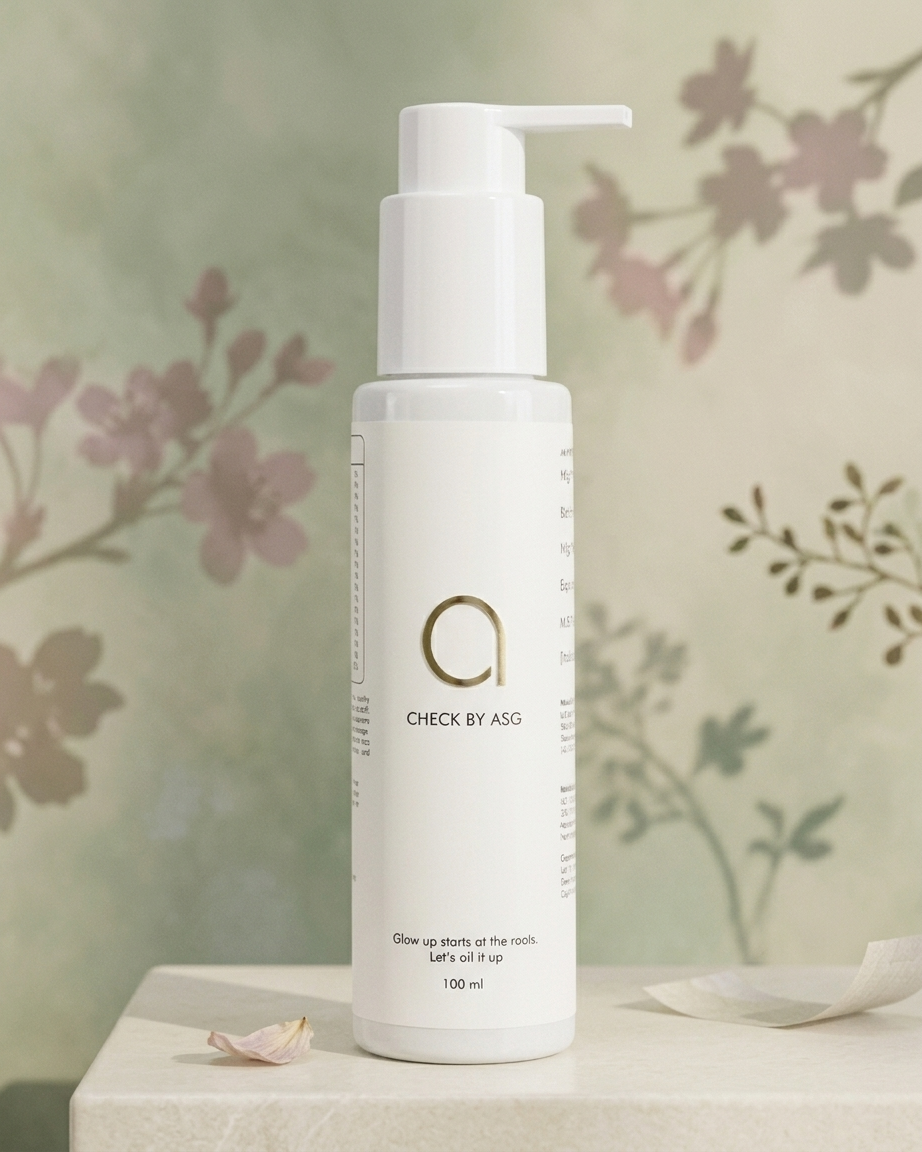
A multi herb hair oil is not automatically better than a single-ingredient one. Seventeen herbs on a label can mean a carefully layered blend, or it can mean a drop of each thrown into mineral oil so the box looks impressive. The number tells you almost nothing. What matters is whether each herb has a job, whether the amounts are meaningful, what the base oil is, and how it was made.
We make a 17-herb oil, so we have an obvious interest here. We also think the honest case for a blend is narrower than most brands make it, and that plenty of people are well served by a single bottle of coconut or castor. This guide lays out both sides, gives you a checklist for reading any label, and explains how we built ours so you can judge it by the same standard.
For the full checklist, see how to choose the best Ayurvedic hair oil for hair fall.
If you are deciding between a ₹150 single oil and a ₹1,150 blend, read the whole thing. The answer depends on what your hair actually needs.
What single-ingredient oils do well
A single oil does one thing, and the good ones do it reliably. That is a real advantage. You know exactly what is on your scalp, patch-testing is simple, and if something goes wrong you know what caused it. They are also cheap, widely available, and most Indian households already have one in the kitchen.
| Oil | What it does best | Where it stops |
|---|---|---|
| Coconut | Penetrates the strand, reduces protein loss during washing; good for dry lengths | Does little for the scalp or the root; can feel stiff on fine or low-porosity hair |
| Castor | Thick, seals ends, adds shine and apparent thickness | Too heavy to use alone on the scalp; hard to wash out; no root-level tradition on its own |
| Almond | Light, pleasant, softens lengths | Mostly cosmetic; little scalp benefit |
| Bhringraj (in a carrier) | Strongest traditional growth herb; density and scalp | Usually heat-extracted; no cleansing or conditioning layer |
| Onion | Sulphur for strength; some small studies on growth | Smell; can irritate; addresses one mechanism |
| Amla | Vitamin C at the root, shine, greying tradition | No conditioning; often sold in mineral oil base |
If your only problem is dry ends, coconut or almond on the lengths twice a week is a complete routine and you do not need a blend. If your only problem is a dull, thin-looking finish, castor on the ends does the job, and we explained why castor is in our blend and why it should not be used alone.
Where single oils fall short
The trouble is that hair fall, which is what most people are actually trying to fix, is rarely a single-layer problem.
Think of the scalp in three layers. The root, where the follicle lives and growth is decided, needs circulation and the kind of herbs tradition reached for: bhringraj, amla, jatamansi, manjistha. The surface, where flakes, oil, buildup and itch live, needs cleansing and calming: neem, karanja, reetha, nimbu. The strand, which has already grown and only needs looking after, needs conditioning: shikakai, heena, aloe, olive, castor.
A single oil addresses one layer. Castor on a flaky scalp seals the flakes in. Coconut on thinning hair makes the lengths feel better and does nothing at the root. Pure bhringraj oil, usually heat-extracted into sesame or coconut, works the root but leaves the scalp surface and the strand to fend for themselves. People then stack three bottles, which is fine, but it is more expensive and more work than one blend that covers all three.
The other limitation is the base. A large share of cheap single-ingredient hair oils sold in India are built on mineral oil, a petroleum by-product that sits on the skin and does not carry anything into it. Check the back of the bottle. If the first ingredient is liquid paraffin or mineral oil, the herb on the front is a small passenger.
What a multi-herb oil is actually for
A well-built blend is for coverage, not multiplication. We want to be careful here, because “synergy” is one of the most overused words in hair care. Research on herb combinations for hair is limited, and nobody has shown that seventeen herbs together do seventeen times the work. What a blend does is put a root herb, a scalp herb and a strand herb on your head in one sitting, in one massage, from one bottle.
That has three practical effects. You are more likely to keep the routine, because it is one step rather than three. You are addressing the layer you did not know was the problem, which for most people with hair fall is the scalp surface. And a blend can be lighter than any single thick oil, because the emollients are balanced by cleansers like reetha, which means it washes out in one go and can be worn.
What a blend is not for is replacing a diagnosis. If your hair fall is thyroid, iron, PCOS or a fever three months ago, no number of herbs changes that. A blood test does.
The 60-day rule. One 100ml bottle lasts about four weeks. Most people see the difference at week eight. That is why we sell it as a pair: 2 × 100ml for ₹1,999. Two bottles is one full cycle. Whether you choose a blend or a single oil, give it that long before you judge.
Six questions to ask before buying any multi-herb oil
1. Are the percentages disclosed?
A brand that tells you bhringraj is 5% is telling you something you can check against your results. A brand that lists twenty herbs with no amounts may have 0.1% of each. Look for at least the headline herbs with numbers.
2. What is the base?
Mineral oil or liquid paraffin as the first ingredient is the most common shortcut. The herbs may be real, but the carrier does not absorb. Plant oils, sesame, coconut, olive, castor, are what you want to see first.
3. How was it made?
Most herbal oils are made by boiling herbs in oil until the water cooks off. It is fast and it extracts a lot, but heat changes delicate compounds and the oil often smells cooked. Cold infusion steeps the herbs in oil over weeks without heat. It is slower, costs more, and keeps more of the plant intact. We compared the two in our post on cold-infused vs heat-extracted hair oil.
4. Is there synthetic fragrance or silicone?
A hair oil that smells like a perfume counter has fragrance added, which is the most common cause of scalp reactions. Silicones (anything ending in -cone) make the hair feel smooth on day one and build up by week three.
5. How big is the batch, and when was it made?
Small-batch oils without preservatives have a shorter life and should carry a manufacturing date. A bottle with a two-year shelf life and no preservative listed is a question worth asking.
6. Does the brand admit limits?
This is the one we would weight most. A brand that says its oil will stop hair fall in two weeks is not describing a hair oil. Hair cycles are measured in months. Look for a brand that tells you when to see a doctor.
How we built ours
We will describe our 17-Herb Hair Oil by the same six questions, so you can hold us to them.
Percentages: the four headline herbs are each at 5%, amla, bhringraj, jatamansi and neeli indigo, with aloe vera at 2%. The other twelve, brahmi, kalonji, karanja, neem, nimbu, onion, reetha, shikakai, heena, olive, manjistha and castor, are listed with their roles. We list all 17 herbs and their percentages on the ingredients page.
Base: no mineral oil. Olive and castor are the emollients in the blend, and there are no silicones and no synthetic fragrance. The smell is the herbs.
Method: cold-infused, no heat, in small batches, by hand. It is dermatologically tested and made for men and women, all hair types, including colour-treated hair.
Limits: we say throughout this site that oiling is supportive, that results typically take six to eight weeks, and that a blood test does more for most hair fall than any bottle. One 100ml lasts about four weeks. Patch-test first.
The reason it is seventeen herbs and not five is not marketing. Apoorva’s grandfather’s oil, the one he warmed in a steel katori and worked into her hair on Sunday evenings in a small town, was a multi-herb oil before anyone used the phrase. When she came back from the UK and started making it in a Delhi kitchen, she rebuilt that bottle. The story behind the blend explains why the list is as long as it is. If you want the full breakdown of each herb and what it is for, our complete guide to all 17 herbs goes one by one.
Side by side, and who should pick which
| Single oil (e.g. coconut) | Two or three single oils stacked | Cold-infused 17-herb blend | |
|---|---|---|---|
| Layers covered | One, usually the strand | Two or three, if chosen well | Root, scalp surface and strand |
| Routine effort | Low | High; mixing, separate bottles | Low; one pump bottle |
| Wash-out | Easy to moderate | Hard if castor is involved | One wash; reetha and shikakai in the blend |
| Cost per four weeks | Roughly ₹100 to ₹250 | Roughly ₹400 to ₹900 | About ₹500 with the two-bottle pair at ₹1,999 |
| Patch-test clarity | Very clear | Moderate | Test the blend as a whole |
| Best for | One clear need: dry ends, shine | People who enjoy a ritual and know their hair | Hair fall with a scalp component, or anyone who wants one routine |
Who should pick which
Pick a single oil if you have one clear, simple need and your scalp is healthy. Dry lengths, a bit of frizz, a dull finish. Coconut, almond or castor on the lengths will do it for a fraction of the price, and you should not feel sold short.
Pick two or three single oils if you like the ritual, you know your hair, and you are happy to mix a katori of sesame, castor and a spoon of bhringraj powder on a Sunday. Many people in India do exactly this and it works. Budget for the time and the wash.
Pick a multi-herb blend if you have hair fall and you are not sure which layer is the problem, which is most people. Or if your scalp flakes or itches as well as sheds. Or if you have tried single oils and found the routine too fiddly to keep up, because a routine you keep beats a better routine you abandon.
Whichever you choose, run it for eight weeks before deciding. Take a photo of your parting on the first of the month. Count the strands in the comb on the same day each week. That is the only comparison that means anything. Our broader guide to choosing an Ayurvedic hair oil for hair fall covers what to look for across brands.
Frequently asked questions
Is a multi-herb hair oil better than coconut oil?
For dry lengths, coconut is excellent and cheaper. For hair fall with a scalp component, a blend covers the root and scalp surface, which coconut does not. Better depends on what you are fixing.
Do more herbs mean more results?
No. More herbs mean more coverage, if each herb has a job and the amounts are meaningful. Seventeen herbs at trace levels in mineral oil is worse than one good herb in a plant oil. Read the percentages and the base.
Can I mix my own multi-herb oil at home?
Yes, and many people do, usually by warming herbs in sesame or coconut oil. The limits are heat, which changes delicate compounds, and shelf life, since home oils without preservatives should be used within a few weeks.
How do I know if a blend uses mineral oil?
Read the ingredient list, not the front. Mineral oil, liquid paraffin, paraffinum liquidum or petrolatum anywhere in the first three ingredients means the base is petroleum-derived.
Is ₹1,999 for a hair oil worth it?
With the two-bottle pair at ₹1,999 it works out to roughly ₹500 per four-week bottle, which is comparable to stacking two or three decent single oils. Whether it is worth it depends on whether you keep the routine for eight weeks. An oil you do not use is expensive at any price.
More herbs is not the point. The right herbs, at honest amounts, in a base that absorbs, made without heat, in a bottle you will actually pick up three times a week, is the point. If a bottle of coconut oil will do, we would rather you bought that. If it will not, two bottles for ₹1,999 is one full eight-week cycle.
All 17 herbs, in one bottle
Bhringraj, amla, brahmi and 14 more cold-infused herbs — our 17-Herb Ayurvedic Hair Oil is made for hair fall, thinning and slow growth.