
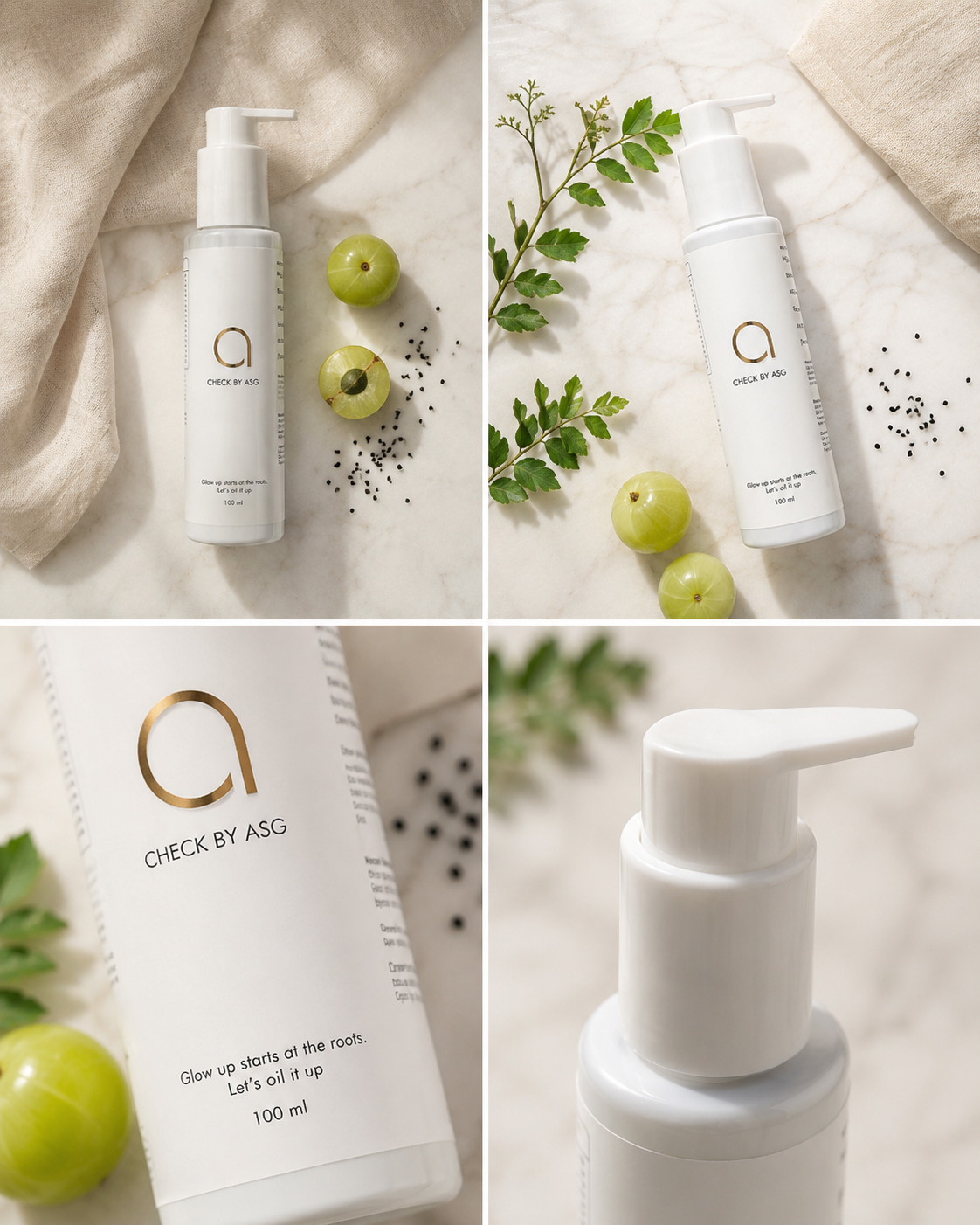
Olive oil for hair works mainly as an emollient. It coats the strand, slows the loss of water from the hair shaft, and makes dry, rough hair feel softer and look glossier. It does not make hair grow. It will not fix a scalp problem. What it does, it does reliably, and that is why a Mediterranean oil has earned a small, specific place in our Ayurvedic 17-herb blend.
If you came here wondering whether to pour kitchen olive oil over your head, the short answer is: you can, but you probably do not want to. Used neat, it is heavy, it clings to fine hair, and it takes two shampoos to remove. Used in a blend at a modest proportion, it gives you the conditioning without the weight.
This is one of seventeen ingredients in our blend. For how they work together, see our complete guide to all 17 herbs in our hair oil.
Below we explain what olive oil actually does on hair, why it sits alongside seventeen Indian herbs, who should be careful with it, and how to use it without looking like you forgot to wash.
What olive oil actually does on the hair strand
Olive oil is roughly three-quarters oleic acid, a monounsaturated fatty acid, with smaller amounts of palmitic and linoleic acid, plus squalene and a little vitamin E. On hair, that composition means two things.
First, it is a good occlusive. Spread thinly along the lengths, it forms a soft film that slows water from evaporating out of the cortex. Dry hair is mostly hair that cannot hold on to moisture; olive oil helps it hold on a little longer.
Second, it smooths the cuticle. The outer layer of each strand is made of overlapping scales. When those scales lie flat, light reflects evenly and the hair looks shiny. When they lift, from heat, hard water, colour, or simple friction, hair looks dull and tangles more. A light oil film helps the scales sit down.
What olive oil does not do is penetrate deeply into the hair shaft. Lab studies on oil penetration have generally found coconut oil gets further inside the fibre than olive oil, because of its smaller, straight-chain lauric acid. Olive oil sits more on the surface. That is not a flaw. For an ingredient whose job is to lock moisture in, surface is exactly where you want it.
Why a Mediterranean oil is in an Ayurvedic blend
Ayurveda is a way of thinking about ingredients, not a list of permitted ones. Classical texts describe oils by their qualities: heavy or light, warming or cooling, how they move through tissue. Olive oil, by those measures, is a light-to-medium emollient with a cooling, soothing nature. It belongs in the same family of thinking as sesame and coconut, even if it grew up in a different kitchen.
In practical terms, we wanted a carrier that would do three jobs. It had to spread the heavier herb extracts evenly so a few pumps cover a whole scalp. It had to leave the lengths softer without the tackiness that pure castor oil leaves. And it had to behave well in cold infusion, where there is no heat to thin things down. Olive does all three quietly.
It also pairs well with castor oil, which seals the ends but is too thick to use alone. Olive thins it, castor thickens olive, and the two together give a texture that absorbs in a few minutes rather than sitting on top of the hair.
Olive oil alone vs olive oil in a blend
This is the comparison most people actually need. A bottle of extra virgin olive oil from the kitchen and a blended hair oil are not doing the same thing, even though both contain olive.
| Question | Kitchen olive oil, used neat | Olive oil inside a herb blend |
|---|---|---|
| Feel on fine hair | Heavy, flattens roots | Light, because the proportion is small |
| Washing out | Usually two shampoos | One wash, helped by reetha and shikakai |
| Scalp benefit | Emollient only | Emollient plus scalp herbs (bhringraj, neem, jatamansi) |
| Smell | Grassy, sometimes strong | Masked by the herb infusion |
| Cost per use | Low | Higher, but covers both scalp and strand |
| Best for | Occasional deep conditioning on lengths | Twice-weekly scalp-and-length routine |
Neither column is wrong. If you have thick, dry, wavy hair and simply want softer ends on a Sunday evening, warm two spoons of olive oil in a steel katori and apply it to the lower half of your hair. If you are oiling for scalp health, hair fall, or density, olive on its own is not enough, and the blend column matters.
The 60-day rule. One 100ml bottle lasts about four weeks. Most people see the difference at week eight, and the softness olive brings to the lengths is usually the first thing people notice. That is why we sell it as a pair: 2 × 100ml for ₹1,999. Two bottles is one full cycle.
How to use olive oil on hair without the grease
Most complaints about olive oil are really complaints about quantity. The hair does not need to be dripping.
- Start with dry or barely damp hair. Oil on soaking wet hair just slides off.
- Take a small amount. For a blend, two to four pumps for shoulder-length hair. For neat olive oil, a teaspoon for the lengths only.
- Warm it between your palms for ten seconds. Warm oil spreads thinner.
- If using a blend, massage the scalp first in slow circles for two to three minutes. If using neat olive oil, skip the scalp and go straight to the mid-lengths.
- Run what is left on your palms through the ends. Do not add more.
- Leave for 30 minutes to a few hours. Overnight is fine if your scalp is not oily.
- Wash with a gentle shampoo. If it still feels coated, the problem was the amount, not the oil.
We wrote a fuller version of this for people who need to oil in the morning and still go to work, which covers timing and how to tie hair up while the oil sits.
Who should be careful with olive oil
Olive oil is gentle, but gentle is not the same as suitable for everyone.
Oily scalps
If your roots look greasy by the second day, adding a rich oil directly to the scalp rarely helps. Keep olive on the lengths, or use a blend where it is balanced by nimbu (lemon) and reetha, which are there precisely to manage excess sebum.
Dandruff and seborrheic dermatitis
The Malassezia yeast linked to dandruff is believed to feed on certain fatty acids, and oleic acid is one of them. Some dermatologists therefore advise against olive oil on a flaky scalp. If you have visible flakes and itch, a neem and karanja-led routine makes more sense, and persistent cases need a doctor, not a kitchen remedy.
Very fine or low-density hair
Olive oil used neat will flatten fine hair. In a blend at a low proportion it behaves differently, but still use the smallest amount that spreads, and wash it out the same day.
Allergies
True olive allergy is uncommon but exists. Patch-test any new oil on the inner forearm for 24 hours before putting it on your scalp.
The herbs that work alongside olive in the blend
On its own, olive is a conditioner. In our oil it is the base that carries the herbs that do the scalp work. Bhringraj and amla, each at 5%, are there for density, roots, and shine. Jatamansi, also 5%, calms a stressed scalp. Neem and karanja handle buildup and itch. Shikakai and heena condition the lengths alongside olive, and castor seals the ends. Reetha keeps the whole thing washable so you are not left with residue.
We list all 17 herbs and their percentages on one page, because we think you should know what is in the bottle before you put it on your head. If you want the long version of what each herb does and why it is there, read our complete guide to all 17 herbs.
Apoorva, who founded Check by ASG, grew up with her father and grandfather oiling her hair with whatever the house had, which was sometimes mustard, sometimes coconut, and occasionally, after a relative came back from abroad, a bottle of olive oil that was treated like treasure. Her rule for the blend was simple: if she would not use it on her own hair, it does not go in. The story of how the oil started in a Delhi kitchen explains the rest.
Frequently asked questions
Does olive oil make hair grow faster?
No. Olive oil conditions the strand and helps it hold moisture, which means less breakage and fewer split ends. That can make hair look fuller over a few months, but it does not change how fast the follicle grows hair. For growth support, the scalp-focused herbs like bhringraj and amla matter more.
Can I use kitchen olive oil on my hair?
You can, and many people in India have. Extra virgin olive oil is unrefined and closer to the fruit. The downside is weight: used alone it can sit heavy on fine hair and is hard to wash out. In a blend, a smaller amount does the same conditioning job with less residue.
Is olive oil good for an oily scalp?
Used on its own, directly on the scalp, it is usually too rich for people who already produce a lot of sebum. It is better suited to the lengths and ends. If your scalp is oily, look for a blend where olive is balanced by lighter, cleansing ingredients like nimbu and reetha.
Can olive oil worsen dandruff?
It can for some people. The yeast associated with dandruff is thought to feed on certain fatty acids, including the oleic acid that olive oil is rich in. If you have flaking and itch, keep olive oil off the scalp and use a blend with neem and karanja, or speak to a dermatologist.
How much olive oil is in Check by ASG 17-Herb Hair Oil?
Olive is one of the supporting oils in the blend rather than a headline herb, so it is present in a smaller proportion than the 5% herbs like amla and bhringraj. The full list of all 17 herbs and the percentages we disclose is on our ingredients page.
Olive oil is not the hero of any hair routine, and it was never meant to be. It is the ingredient that makes the heroes easier to live with: softer lengths, less tangling, a finish that looks like hair rather than oil. If you want to see how it behaves inside a full blend, over a full cycle, start with the two-bottle pack and give it the eight weeks it needs.
All 17 herbs, in one bottle
Bhringraj, amla, brahmi and 14 more cold-infused herbs — our 17-Herb Ayurvedic Hair Oil is made for hair fall, thinning and slow growth.