
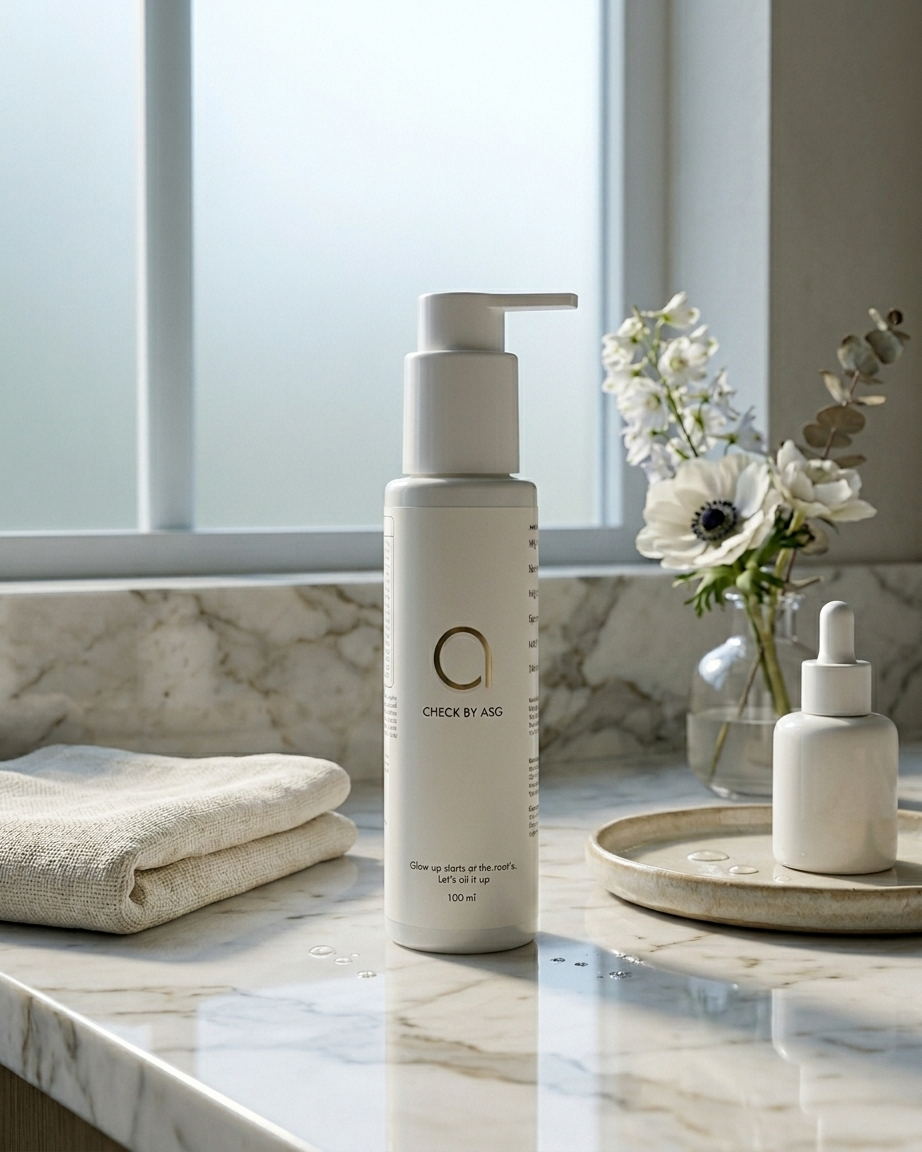
The dermatologically tested meaning is narrower than the phrase sounds. It means the product was applied to the skin of human volunteers under a dermatologist’s supervision, usually as a patch test, and the dermatologist recorded whether it caused irritation or an allergic reaction. That is all. It does not mean the product works, that a dermatologist endorses it, or that nobody will ever react to it.
Our 17-Herb Hair Oil carries the phrase, so we have an interest in you taking it seriously. We also have an interest in you not over-reading it. A tested oil is one that was checked for irritation on real skin before it reached yours. It is a floor, not a ceiling, and it is still followed by a patch test behind your own ear.
For the full checklist, see how to choose the best Ayurvedic hair oil for hair fall.
Below is what the testing usually involves, what the phrase does not cover, how it compares with the other label phrases that sound similar, and the questions worth asking any brand that uses it.
What the test usually involves
There is no single law in India that defines the words “dermatologically tested”, so the detail varies by brand and by the lab they use. The common shape, though, is consistent.
A group of adult volunteers, often somewhere between twenty and fifty people, has a small amount of the product applied to a patch of skin, usually on the upper back or inner forearm. The patch is covered and left in place for a set period, typically twenty-four or forty-eight hours. A dermatologist then examines the site for redness, swelling, itching, bumps or any other reaction and scores it. Some protocols repeat the application over several weeks to check for sensitisation, which is a reaction that develops only after repeated exposure.
If the reactions are nil or within an accepted low threshold, the lab issues a report and the brand can say the product was dermatologically tested. That report is the thing. If a brand cannot show you one, or at least name the lab and the year, the phrase on the box is just a phrase.
What the phrase does not mean
This is the part that matters more, because the gap between what people assume and what was actually tested is wide.
It does not mean the product works. An irritation test checks safety on skin. It measures nothing about hair growth, hair fall, dandruff or shine. A bottle of plain water would pass a dermatological irritation test with full marks.
It does not mean a dermatologist recommends it. Supervising a test and endorsing a product are different things. The dermatologist who ran the patch test may never have used the product or formed any view on it beyond “it did not irritate these volunteers.”
It does not mean no one will react. Twenty to fifty volunteers cannot represent every scalp in India. If you are allergic to a specific plant, it will not matter what fifty strangers’ forearms did. This is why we ask for a patch test every time, and why we wrote a whole post on how to patch-test a new hair oil even when it is natural.
It does not mean the test was on the scalp. Most patch tests use the back or forearm. The scalp has more oil glands, more hair follicles and is often already irritated by dandruff or buildup, so it can react where the forearm did not.
It does not say how long ago. Formulas change. A test from one version of a product does not automatically cover a reformulated one. Ask when it was done.
The 60-day rule. One 100ml bottle lasts about four weeks. Most people see the difference at week eight. That is why we sell it as a pair: 2 × 100ml for ₹1,999. Two bottles is one full cycle.
Similar phrases on the label, and what each one is worth
Labels are full of words that sound like testing. Here is how to read the common ones.
| Phrase | What it usually means | What to ask |
|---|---|---|
| Dermatologically tested | Checked for skin irritation on volunteers under a dermatologist. Says nothing about results. | Which lab, what year, how many people, was it a repeat test. |
| Hypoallergenic | Formulated to be less likely to cause allergy. No legal standard in India for the word. | Which common allergens were left out. Fragrance is the big one. |
| Clinically tested | Some test was done in a clinical setting. Could be an irritation test, could be more. | Tested for what, on how many people, over how long, and can you see the summary. |
| Non-comedogenic | Less likely to block pores. Usually a claim about the ingredients, not a scalp test. | Mostly relevant for face products. For scalp oil, ask about buildup instead. |
| Paraben-free, sulphate-free, mineral-oil-free | Specific ingredients are absent. Useful and checkable on the ingredient list. | Read the back of the bottle and confirm it. |
| Ayurvedic, herbal, natural | Descriptive words with loose definitions. Natural ingredients can still irritate. | Which herbs, at what percentage, and how were they extracted. |
Notice the pattern. Each phrase is only as useful as the answer you get when you ask a follow-up question. A brand that answers quickly and specifically is one that has the paperwork. We cover the ingredient-side questions in our post on mineral oil and silicones in hair products.
Why we tested, and what we still ask of you
We had the 17-Herb Hair Oil dermatologically tested because it has seventeen plant ingredients, and more ingredients means more things a scalp could react to. We wanted to know, before the first bottle sold, that the blend did not irritate skin at the concentrations we use. The test told us that. It did not tell us the oil grows hair, and we do not use the phrase to suggest it does.
What we still ask of every customer is a patch test. A little oil behind the ear or on the inner forearm, left for a day, before the first full application. It takes no effort and it catches the one-in-many person who reacts to a specific plant. Neem, Henna, Kalonji and Nimbu are all herbs some people are sensitive to, and no volunteer study replaces your own skin.
Apoorva’s promise when she started the brand was “If I wouldn’t use it, I’d never ask you to.” Testing was part of keeping that promise. So is telling you plainly what the test does and does not cover. The rest of that story is on our about page.
The herbs, and why testing a blend matters more than testing a single oil
A plain coconut oil has one ingredient and a very long safety record. A seventeen-herb blend has seventeen ingredients plus the base, and a reaction to any one of them is a reaction to the oil. That is the honest reason multi-herb oils should be tested and single oils rarely need to be.
In ours, the herbs with the most scalp-facing roles are Neem, traditionally used for itch and dandruff; Karanja, which clears buildup and helps protect the scalp from irritation; Jatamansi, the Himalayan root traditionally used to calm a stressed scalp; and Aloe Vera for hydration. The root herbs are Bhringraj, Amla, Manjistha and Onion. Reetha and Shikakai cleanse and condition. Henna, Olive and Castor work on the strand. Neeli Indigo keeps dark colour deep, Brahmi supports the follicle, Kalonji brings antioxidants, and Nimbu balances excess oil. There is no mineral oil, no silicone and no synthetic fragrance, which removes the three ingredients most often behind reactions to hair products.
We list all 17 herbs and their percentages on the ingredients page. If you know your skin reacts to any of them, that list is more useful to you than any phrase on the front of the box. Our post on ayurvedic hair oil side effects, real and myth goes through the reactions people actually report.
Questions to ask any brand that says “dermatologically tested”
Five short questions sort the brands with a report from the brands with a phrase.
- Which lab or clinic ran the test, and in which year.
- How many volunteers, and were any of them people with sensitive or reactive skin.
- Was it a single patch test or a repeated one over several weeks.
- Does the test cover the current formula, or an earlier version.
- Can you share a summary of the report.
You will not always get a full answer, and a small brand may share a summary rather than the whole document. But a brand that bristles at the question has told you something, and a brand that answers has told you more.
Frequently asked questions
What does dermatologically tested mean on a hair oil?
It means the oil was applied to the skin of human volunteers under a dermatologist’s supervision, usually as a patch test, and checked for irritation or allergic reaction. It does not mean the oil was shown to grow hair or reduce hair fall, and it does not mean a dermatologist recommends it.
Is dermatologically tested the same as hypoallergenic?
No. Tested means an irritation study was done. Hypoallergenic means the formula was designed to leave out common allergens, and the word has no legal standard in India. Neither phrase means you cannot react.
Do I still need a patch test if the oil is dermatologically tested?
Yes. The test was done on a few dozen other people, not on you. A small dab behind the ear for a day catches individual sensitivities to specific herbs that no volunteer study can rule out.
Is dermatologically tested regulated in India?
There is no single legal definition of the phrase. Advertising standards require claims to be substantiated, which in practice means the brand should be able to produce a test report. Ask for the lab, year and number of volunteers.
Does dermatologically tested mean the oil is safe for sensitive scalps?
It means it did not irritate the volunteers in the study, which is reassuring but not a promise. If your scalp is sensitive or you have eczema or psoriasis, patch-test first and check with your doctor before using any herbal oil.
Read “dermatologically tested” as “checked for irritation on real skin before it reached you”. Nothing more, nothing less, and always followed by your own patch test. If that is the level of honesty you want from an oil, two bottles of our 17-Herb Hair Oil for ₹1,999 comes with the test done and the ingredient list in full.
All 17 herbs, in one bottle
Bhringraj, amla, brahmi and 14 more cold-infused herbs — our 17-Herb Ayurvedic Hair Oil is made for hair fall, thinning and slow growth.