
Short answer
Sometimes. You are paying for the base oil, the number and quality of herbs, and weeks of cold infusion instead of an afternoon of boiling. That part is real cost. You are not paying for a prettier bottle, a famous face, or a promise no oil can keep. The label tells you which.
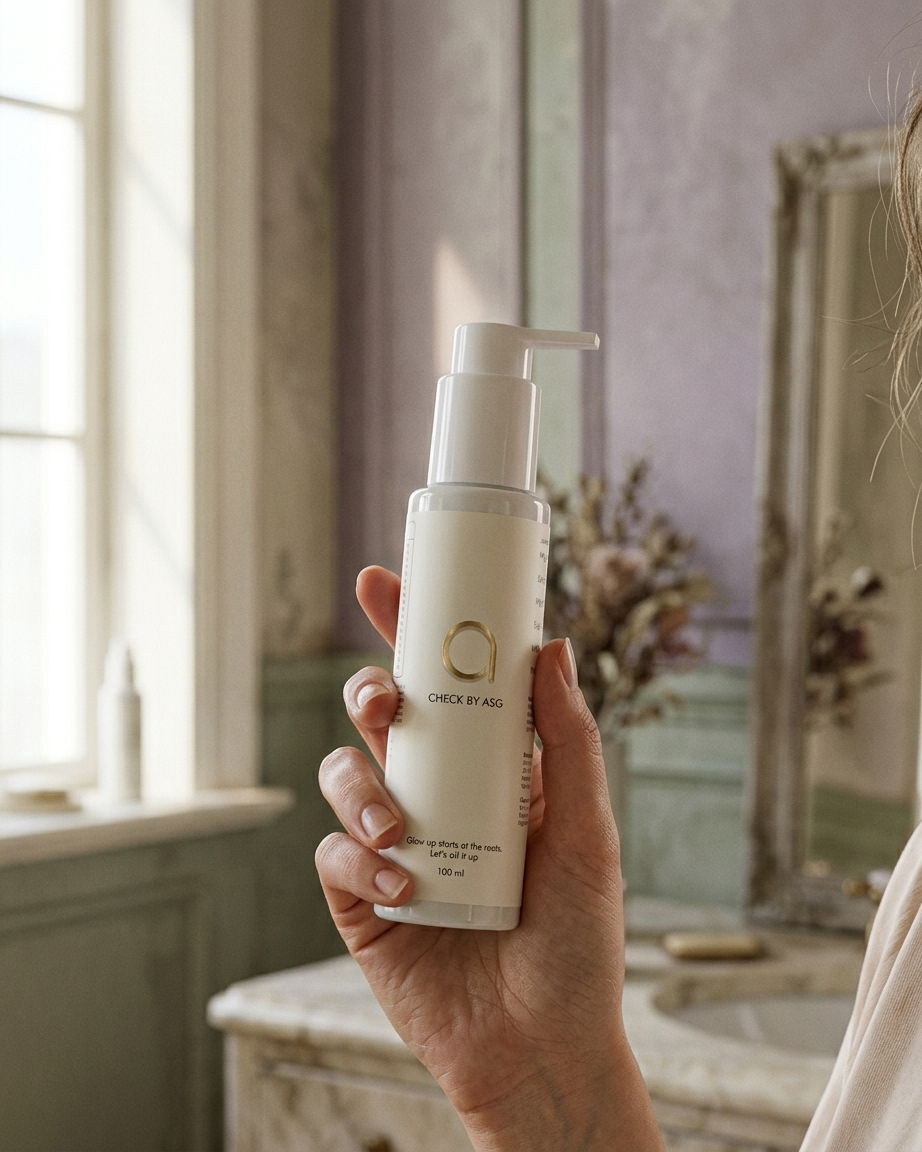
An expensive hair oil is worth it sometimes, not worth it often, and the label tells you which. Our 17-Herb Hair Oil is ₹1,150 for 100ml, which is many times the price of a plain coconut oil from the kirana store. We think it is fair to explain exactly where that money goes, and just as fair to tell you when the ₹150 bottle is the better buy.
The short version: you are paying for seventeen separately sourced herbs, weeks of cold infusion instead of an afternoon of boiling, small handmade batches, a pump bottle, and dermatological testing. Those are real costs with real benefits. They are not the right costs for everyone.
For the full checklist, see how to choose the best Ayurvedic hair oil for hair fall.
Here is the full breakdown, with the maths done per application, because that is the only honest way to compare a ₹1,150 bottle with a ₹150 one.
Where the ₹1,150 actually goes
Every cost below is one we could cut. Each cut would make the oil cheaper and, in our view, worse at the one thing it is for.
Seventeen herbs, sourced separately
A two-herb oil needs two suppliers. Ours needs seventeen, and some of them are not cheap or easy. Jatamansi is a Himalayan root that most oils leave out precisely because of its price. Bhringraj, Amla and Neeli Indigo each go in at 5%, which is a meaningful amount rather than a trace for the label.
Buying these at useful percentages and checking each lot for quality is the single largest line in our cost. It is also the whole point of the product. We list all 17 herbs and their percentages so you can see what you are paying for herb by herb.
Cold infusion takes weeks, not hours
The fast way to make a herbal oil is to heat the base oil and boil the herbs in it. It takes hours, and the oil is ready to bottle the same day. The slow way is to steep the herbs in the oil at room temperature and let time do the extraction. We use the slow way. It ties up stock and money for weeks before a bottle is sold.
The reason is simple. Heat can change some of the delicate plant compounds, and a cold infusion keeps the oil closer to what went into it. We go into the trade-offs in our post on cold-infused versus heat-extracted hair oil. For cost purposes, the point is simple: time is expensive, and we chose to spend it.
Small batches, by hand
A factory makes thousands of litres in one run and the cost per bottle drops with every litre. We make small batches by hand, the way the oil was first made in Apoorva’s Delhi kitchen. Every batch is checked and every bottle filled by a person. There is no year-old vat waiting for a label, and there are no economies of scale.
The pump bottle
A pump costs more than a screw cap. We chose it anyway, because a pump gives you the same two or three pumps every time, keeps air and fingers out of the oil, and stops the over-pouring that empties a cap bottle in two weeks. It is the reason one bottle lasts about four weeks. The packaging is part of the dose, which is why we wrote about it separately in our post on pump bottles versus cap bottles.
Dermatological testing
Testing a product on human volunteers under a dermatologist’s supervision costs money per product, and it has to be done before the first sale. It does not make the oil work better. It tells you the oil was checked for irritation on real skin before it reached yours, and it is a fixed cost spread over a small number of bottles.
No fillers, which means a costlier base
The easiest way to make a cheap herbal oil is to use mineral oil as the base and add a little fragrance so it smells like herbs. We use plant oils (Olive and Castor among them) and no mineral oil, no silicones and no synthetic fragrance. Plant base costs more per litre, and fragrance-free costs more because the smell has to come from actual herbs.
The 60-day rule. One 100ml bottle lasts about four weeks. Most people see the difference at week eight. That is why we sell it as a pair: 2 × 100ml for ₹1,999. Two bottles is one full cycle.
The maths per application
Sticker price is misleading because bottles are used at different rates. A cap bottle gets poured, a pump bottle gets measured. Here is the fair comparison.
| Plain coconut oil, ₹150 for 100ml | Check by ASG, 2 × 100ml for ₹1,999 | |
|---|---|---|
| Applications per 100ml | Roughly 8 to 10, poured by hand | Roughly 10 to 12, by pump |
| Cost per application | About ₹15 to ₹20 | About ₹85 to ₹100 |
| Covers an 8-week cycle | Two to three bottles | Two bottles, in the pair |
| What it does | Conditions the strand, reduces breakage | Conditions the strand, and works on scalp itch, buildup, oil balance and root support |
So the real question is not “₹150 or ₹1,150”. It is “₹20 or ₹90 per session, and what do I need the session to do”. If all you need is a pre-wash conditioner, ₹20 is the right answer. If you are oiling because of hair fall, a flaky scalp or thinning, the extra ₹70 is buying the seventeen herbs that address those, and the whole eight-week cycle costs less than a single salon hair treatment.
When the cheaper oil is the right choice
We would rather sell you nothing than sell you the wrong thing. Buy the plain, cheaper oil if any of these are true.
Your hair is fine and your scalp is calm. You have no itch, no flakes, no unusual shedding, and you oil because it feels good and keeps your hair soft. A good cold-pressed coconut or sesame oil does that job well, and a seventeen-herb blend is more than you need.
You are oiling a small child. Young scalps do best with the simplest oil possible. We talk about this in our post on hair oiling for kids and teenagers, and our honest advice is a single plain oil until the teenage years.
You will not use it consistently. A ₹1,150 bottle used twice and forgotten is worse value than a ₹150 bottle used every week. Consistency beats ingredients. If you know yourself, buy accordingly.
You want a fragrance. Our oil smells like herbs, which is earthy and a little bitter. If a perfumed oil is what makes the ritual pleasant for you, there are cheaper oils that give you that, and a pleasant ritual you keep is better than a serious one you skip.
Money is tight this month. A plain oil, two to three minutes of scalp massage and a decent diet will get you a long way. Come back to a herbal blend when it fits.
When the price is worth paying
The case for a premium oil is strongest when you have a specific problem and have already tried the plain option. Shedding that has not slowed after two months of coconut oil. A scalp that itches and flakes no matter how often you wash. Hair fall after a fever, a stressful quarter, a pregnancy or a move to a city with hard water.
In those cases the herbs matter. Neem and Karanja for the scalp, Bhringraj, Amla and Onion at the root, Jatamansi for a stressed scalp, Reetha and Shikakai so nothing is left behind after wash. A plain oil does not carry any of them. The price buys the blend, the time it took to make, and the testing that went before it.
It also buys honesty about limits. No oil, at any price, fixes a thyroid problem or iron deficiency. If your hair fall has a medical cause, the most valuable ₹1,150 you spend is on a blood test and a doctor. Oil is supportive after that, not instead of it.
Why we did not make it cheaper
We could have. Drop to seven herbs, heat the extraction, switch to a cap bottle, skip the testing, and the oil could sell for a third of the price.
Apoorva’s rule when she started was “If I wouldn’t use it, I’d never ask you to.” She grew up having her hair oiled by her father and grandfather with oil made at home, and she wanted the bottled version to be the one she would put on her own scalp. That story is on our about page, and it explains the price better than any cost table. We made the oil we wanted to use, then worked out what it had to cost.
Frequently asked questions
Is expensive hair oil better than cheap hair oil?
Not automatically. An expensive oil is only better if the price is explained by what is in it: many named herbs in real quantities, a plant base rather than mineral oil, slow extraction, testing and good packaging. A cheap plain oil is excellent for conditioning. A premium herbal oil earns its price for scalp and hair fall concerns.
Why does a herbal hair oil cost ₹1,150?
In our case: seventeen separately sourced herbs at meaningful percentages, cold infusion that takes weeks, small handmade batches with no economies of scale, a pump bottle, dermatological testing, and a plant oil base with no fillers. Each could be cut to lower the price, and each would change the oil.
What is the cost per use of a ₹1,150 hair oil?
With the two-bottle pair, two bottles for ₹1,999 cover roughly eight weeks at two or three applications a week, which is about ₹85 to ₹100 per session. A plain oil is about ₹15 to ₹20 per session. The difference is what the herbs cost.
Can I mix a cheap oil with an expensive one to save money?
You can, but you dilute the herb percentages, which is what you paid for. A better saving is to use the herbal oil on the scalp, where it works, and a plain oil on the lengths, which only need conditioning.
Should I buy an expensive hair oil for a child?
No. Young scalps do best with a single plain oil. A multi-herb blend is more suited to teenagers and adults with specific scalp or hair fall concerns, and always after a patch test.
A good hair oil should be able to explain its price in plain words. We have tried to. If the breakdown makes sense for your hair, two 100ml bottles for ₹1,999 is one full eight-week cycle at about ₹90 a session, and if it does not, a ₹150 bottle used every week is a perfectly good decision.
All 17 herbs, in one bottle
Bhringraj, amla, brahmi and 14 more cold-infused herbs — our 17-Herb Ayurvedic Hair Oil is made for hair fall, thinning and slow growth.