
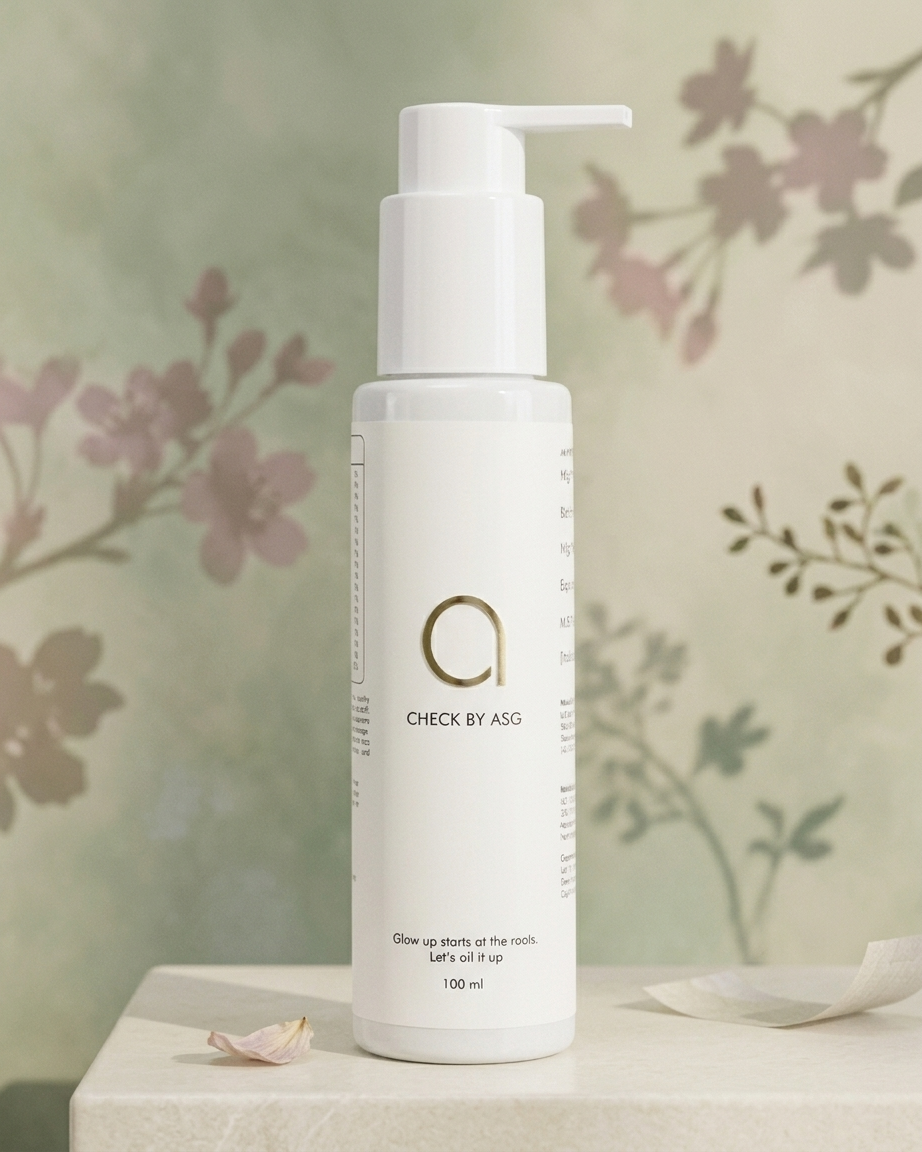
Hair oil vs serum is not a fair fight, because they are not competing for the same job. A hair serum is a cosmetic finish for the strand: usually silicone-based, it coats the hair, smooths the cuticle, and gives shine and frizz control for the rest of the day. A hair oil is a scalp and strand treatment that absorbs rather than coats: it works at the root over weeks, conditions the lengths, and washes out. You can use both. Many people should.
The confusion comes from marketing. Serums are sold next to oils, in similar bottles, with similar promises, and some products labelled “hair oil” are in fact serums with a drop of argan for the label. Once you know what each category actually contains, the choice is simple.
For the full checklist, see how to choose the best Ayurvedic hair oil for hair fall.
This guide explains what is in each, where each goes, when to use which, how to use them together without one cancelling the other, and the cases where only one of them will do.
What a hair serum actually is
Turn a serum bottle over. The first ingredient is almost always a silicone: dimethicone, cyclopentasiloxane, amodimethicone, or a cousin. Silicones are synthetic polymers that are clear, slippery, and inert. On hair they form an extremely thin film that lies the cuticle flat, reflects light, reduces friction between strands, and resists humidity. That is why a serum works in thirty seconds and why it survives a Mumbai monsoon afternoon.
Some serums add a plant oil, argan being the fashionable one, in small amounts. Some add UV filters or a heat-protectant polymer. A few newer “scalp serums” are water-based and contain actives like peptides or caffeine, but those are a different category with the same word on the label, and this post is about the strand serums most people own.
A serum does not absorb. It is not meant to. It sits on the surface until it is washed off, and some silicones take more than a mild shampoo to remove. It does nothing for the scalp and should not go there.
What a hair oil actually is
A proper hair oil is plant oil, sometimes one, sometimes a blend, sometimes with herbs infused in. Plant oils are made of fatty acids that hair can take up to varying degrees. Coconut oil penetrates the shaft well; olive sits more on the surface; castor is thick and seals. Herbs add what the base oil cannot: amla’s vitamin C, bhringraj’s traditional use for density, neem for a flaky scalp.
The job of a hair oil is twofold. On the scalp, it is the carrier for massage and for herbs, working at the follicle over weeks. On the lengths, it conditions and helps the strand hold moisture, which over time reduces frizz at the source rather than hiding it.
A hair oil washes out. It is meant to. Oil left on for 30 minutes or overnight and then shampooed away has done its job; oil left on for a week has become buildup.
The catch is that not everything sold as hair oil is plant oil. Many mass-market “hair oils” are mineral oil with fragrance and a trace of herb extract. We wrote about what mineral oil and silicones do in hair products, and the short version is: a mineral oil hair oil behaves like a serum, not like an oil.
Oil and serum side by side
| Hair oil (plant-based) | Hair serum (silicone-based) | |
|---|---|---|
| Main ingredient | Plant oils, herbs | Silicones, sometimes a little plant oil |
| Where it goes | Scalp and lengths | Lengths and ends only |
| When | Before wash, 30 min to overnight | After wash, on damp or dry hair |
| Absorbs or coats | Absorbs, to varying degrees | Coats |
| Speed of visible effect | Weeks | Seconds |
| Scalp benefit | Yes: massage, herbs | None; should not be applied there |
| Frizz | Reduces over time | Controls immediately |
| Heat protection | Limited | Often formulated for it |
| Buildup | Washes out | Can accumulate; needs clarifying |
| Hair fall or thinning | Supportive, with scalp massage | No effect |
The question underneath: scalp or strand
Almost every hair oil vs serum decision becomes clear once you ask where the problem is.
If the problem is at the scalp, hair fall, thinning, dandruff, itch, an oily or dry scalp, then oil is the only one of the two that even reaches it. Serum has nothing to offer the follicle.
If the problem is on the strand, frizz, dullness, tangling, heat damage, split ends, then both have something to offer, on different timescales. Serum fixes the look today. Oil, used consistently, tends to make the strand itself better able to hold moisture so that there is less to fix.
Most people in their twenties and thirties have both problems at once: some shedding, some frizz, ends that have seen a straightener. That is why the answer to “which one” is so often “both, in their own slots”.
The 60-day rule. One 100ml bottle lasts about four weeks. Most people see the difference at week eight, which is also around the time many of them notice they are reaching for the serum less. That is why we sell it as a pair: 2 × 100ml for ₹1,999. Two bottles is one full cycle.
How to use both without one cancelling the other
The order matters, because silicone is a barrier. Put serum on first and the oil cannot get past it.
Oil: before the wash
Two or three evenings a week, or one long Sunday session. Warm two to four pumps in your palms, massage the scalp in slow circles for two to three minutes, run the rest through the lengths. Leave 30 minutes or overnight. Wash. Our guide to applying hair oil properly covers the technique.
Serum: after the wash
Towel-dry. Take a pea-sized amount, less than you think, rub it between your palms, and smooth it over the lower two-thirds of the hair. Never the roots. If you are going to blow-dry or straighten, this is when a heat-protectant serum earns its place.
Clarify every few weeks
If you use a silicone serum regularly, a clarifying shampoo once every three or four weeks removes the buildup so that the next oiling actually reaches the strand. Signs you are overdue: hair that looks shiny but feels straw-like underneath, and oil that seems to sit on top no matter how little you use.
Do not mix them in your palm
They do not combine into something better. Oil mixed with silicone serum tends to give you the grease of one and the buildup of the other.
When each one is the right call
Serum
A wedding at 7pm and hair that will not behave at 5pm. A straightener or blow-dryer about to be used. A humid day in Chennai and a meeting where frizz is not an option. Freshly coloured hair that needs instant smoothness while the cuticle settles. In all of these, a small amount of serum on the lengths is the honest answer, and no amount of oil will do it faster.
Oil
Hair coming out in the comb more than it used to. A scalp that itches, flakes, or feels tight. Thinning at the temples or a wider parting. Ends that split no matter how often they are trimmed. Hair that looks fine with serum on and terrible without it, which usually means the strand itself has been neglected while the finish was maintained. These are oil problems, and they are eight-week problems rather than eight-minute ones.
Can a light herb oil replace serum?
For everyday frizz on dry hair, often yes. Half a pump of a light, cold-infused oil pressed onto the ends in the morning does what a serum does, minus the silicone, and absorbs within ten minutes. It will not give the glass-like shine of a fresh silicone coat, and it is not a heat protectant. But for a normal day it is enough, and over weeks the hair needs it less. Our non-greasy routine for dry, frizzy hair is built around exactly that half-pump.
What makes that possible is the blend. Olive is a light emollient that spreads thin. Aloe vera at 2% adds water-based hydration. Shikakai and heena condition and leave a soft, glossy finish without silicone. Reetha keeps the oil washable. Castor seals the ends. The scalp herbs, amla, bhringraj, jatamansi, and neeli indigo at 5% each, plus brahmi, kalonji, karanja, neem, nimbu, onion, and manjistha, do the work a serum never could. We list all 17 herbs and their percentages on one page, with no silicone, mineral oil, or synthetic fragrance anywhere on it.
Apoorva used to keep a serum in her bag in the UK, because the water there and the central heating made her hair impossible. It was the routine of coming home, going back to her grandfather’s way of oiling, that made her ask why the serum was needed in the first place. That question is more or less how the brand started.
Frequently asked questions
Can I use hair oil and serum together?
Yes, and many people should. Oil goes on before the wash, on the scalp and lengths, and does the long-term work. Serum goes on after the wash, on damp lengths only, for instant smoothness and heat protection. Keep them to their own time slots and they do not interfere.
Is serum better than oil for frizz?
For the next six hours, serum wins; silicone seals the cuticle instantly. Over six weeks, a light oil used consistently tends to reduce frizz at the source by keeping the strand better hydrated. Most people with frizzy hair do best with both.
Can I put serum on my scalp?
No. Serum is designed for the strand, and silicones on the scalp can build up and sit on the follicle opening. Scalp care is what hair oil is for. If a product calls itself a scalp serum, read the label; it is usually a water-based product, which is a different category altogether.
Does silicone in serum damage hair?
Not directly. Silicones are inert and well studied. The problem is buildup: some silicones do not rinse out with mild shampoo and accumulate over weeks, leaving hair dull and stopping oil and conditioner from getting in. A clarifying wash every few weeks handles it.
Can a light hair oil replace serum entirely?
For daily frizz on dry hair, half a pump of a light herb oil on the ends does a similar job and absorbs rather than coats. For heat protection before a straightener, a serum with silicone is better suited. It depends on what you are asking the product to do that day.
Which should I buy first if I can only afford one?
If your concern is hair fall, thinning, dandruff, or scalp health, oil. If your concern is purely how the hair looks and feels today, serum. Oil addresses the cause; serum addresses the finish.
Serum is a finish. Oil is a routine. One makes hair look good by evening; the other makes it need less help by spring. There is no shame in owning both, as long as each stays in its lane and the oil goes on first. If the oil side of that routine is what you are missing, the two-bottle pack covers the full eight weeks.
All 17 herbs, in one bottle
Bhringraj, amla, brahmi and 14 more cold-infused herbs — our 17-Herb Ayurvedic Hair Oil is made for hair fall, thinning and slow growth.